Loading...
Loading...
Jupiter Marine Sales helps sellers understand purchase agreements, deposits, due-diligence deadlines, vessel acceptance, and closing requirements
Reaching an agreement on price is an important milestone in the sale of a boat or yacht.
But agreeing on a number does not mean the transaction is complete—or even that the vessel is officially under contract.
The negotiated terms must be placed into a written Purchase and Sale Agreement, commonly called a PSA. The buyer and seller must sign the agreement, the required deposit must be received and cleared, and every remaining condition and deadline must be clearly established.
At Jupiter Marine Sales, we use a professionally prepared Purchase and Sale Agreement developed by the International Yacht Brokers Association and completed through YachtCloser, a Boats Group company.
The PSA establishes much more than the purchase price. It identifies the parties and vessel, sets the deposit requirement, establishes the due-diligence and acceptance timeline, explains what is included in the sale, addresses title and liens, and defines the responsibilities of everyone involved.
A well-prepared PSA gives the buyer, seller, brokers, surveyors, lenders, insurance agents, and closing professionals a clear roadmap from the accepted offer through delivery.
Here is what sellers should understand before signing one.
Sellers naturally focus first on the buyer’s proposed purchase price.
Price matters, but it is only one part of the agreement.
A Purchase and Sale Agreement should clearly identify:
Two parties may agree on a price while having completely different expectations about the deposit, survey, financing, closing date, or equipment included with the boat.
The PSA reduces that uncertainty by placing the complete transaction terms in writing.
A Purchase and Sale Agreement and a bill of sale do not serve the same purpose.
The PSA establishes the terms controlling the transaction before closing. It explains what must happen before the buyer becomes obligated to complete the purchase and before the seller must transfer the vessel.
The bill of sale is generally a closing document used to transfer the seller’s ownership interest to the buyer.
In simple terms:
The Purchase and Sale Agreement establishes the deal.
The bill of sale transfers ownership when the deal closes.
For a federally documented vessel, the United States Coast Guard provides an official Bill of Sale form. Additional closing and documentation forms may be required depending on the vessel, its ownership structure, existing liens, financing, and documentation status.
The agreement should use the correct legal names of the parties entering the transaction.
A vessel may be owned by:
If an LLC owns the vessel, the LLC may need to be identified as the seller. The individual signing for the LLC must also have the proper authority to execute documents on the entity’s behalf.
The same issue can arise on the buyer’s side.
A buyer may want to take ownership personally, jointly with a spouse, through an LLC, or through another entity. Those decisions can affect financing, insurance, Coast Guard documentation, tax planning, and closing paperwork.
The PSA may also identify a buyer or seller as acting “and/or assigns.” However, the agreement’s assignment provisions and any required consent still control. A party should not assume those words automatically allow the agreement to be transferred without restriction.
Correctly identifying the parties at the beginning helps prevent delays at closing.
The PSA should contain enough information to identify the exact vessel being sold.
That information may include:
The hull identification number is particularly important because multiple boats can share the same year, manufacturer, and model.
The PSA must identify the specific vessel—not merely describe the type of boat the buyer intends to purchase.
The agreement should clearly show the total purchase price and required deposit.
If a trade-in is involved, it should also identify the trade allowance and calculate the remaining net cash difference.
Jupiter Marine Sales typically requires a 10% deposit.
For example, on a $500,000 purchase, the standard deposit would ordinarily be $50,000.
That is a meaningful financial commitment. It helps demonstrate that the buyer is serious and prepared to move forward with the transaction.
However, the seller should not assume that receiving a deposit automatically means the money belongs to the seller if the transaction does not close.
The PSA controls the circumstances under which the deposit is returned, retained, or applied toward the purchase price.
Under the standard IYBA agreement used by Jupiter Marine Sales, the buyer is generally required to submit the deposit within three business days following the seller’s execution of the agreement.
The deposit is placed into the selling broker’s escrow account and held subject to the agreement’s terms.
The seller’s obligations do not become binding until the deposit clears the selling broker’s account.
This is an important distinction.
A seller may have signed the agreement, but if the deposit has not been received and cleared as required, the seller’s obligations may not yet be binding under the PSA.
The agreement also reminds the parties that the transaction is not binding until both sides have signed and the deposit has been received and cleared.
Putting a boat under contract therefore requires more than signatures. It also requires the buyer to make the agreed financial commitment.
The escrow deposit is not a general transaction-expense account.
At Jupiter Marine Sales, we do not use any portion of the deposit to pay surveyors, engine technicians, captains, haul-out facilities, boatyards, or other independent contractors during the due-diligence period.
The deposit remains intact and untouched in the escrow account throughout the inspection process.
Due-diligence expenses are handled separately. The buyer pays the independent contractors and facilities providing those services directly.
This separation is important because it keeps the buyer’s deposit protected according to the PSA while allowing the buyer to arrange and pay for the inspections necessary to evaluate the vessel.
The offer must be signed and delivered to all parties by the stated Seller Acceptance Date.
If the agreement is not properly executed by that deadline, it may become ineffective, subject to the specific terms of the PSA.
This prevents an offer from remaining open indefinitely while the seller considers other options.
The seller should review the complete offer—including its contingencies, dates, and additional terms—before signing.
Once the agreement has been executed and the deposit has cleared, the seller may be contractually committed to the transaction.
A seller should never sign a PSA casually while assuming its terms can be changed later.
Any subsequent modification should be placed into a written amendment and signed by the appropriate parties.
The Buyer Accept/Reject Date establishes the deadline for the buyer to complete due diligence and provide written notice of vessel acceptance or rejection.
The due-diligence process may include:
At Jupiter Marine Sales, we typically try to provide approximately two weeks for the buyer to complete the survey and trial-run process.
The actual period depends on:
The deadline must be realistic, but it should not allow the buyer to tie up the seller’s boat indefinitely.
The standard PSA requires the buyer to deliver written notice of acceptance or rejection no later than the Buyer Accept/Reject Date.
If the buyer fails to provide timely written notice, that failure is treated as a rejection of the vessel.
The buyer does not automatically accept the boat by remaining silent.
The broker must actively track the deadline, communicate with the buyer’s side, and obtain the proper written acceptance before the due-diligence period expires.
If additional time is legitimately needed, the buyer and seller should execute a written extension before the existing deadline passes.
Under the standard agreement, the buyer selects and hires the marine surveyor.
The buyer and surveyor—not the brokers—determine the scope of the survey and whether the vessel satisfies the buyer’s requirements.
A broker may provide the names of surveyors when asked, but the buyer should independently select the professional responsible for inspecting the vessel.
The surveyor works for the buyer. The buyer must be comfortable with the surveyor’s qualifications, experience, inspection procedures, and final report.
The buyer is responsible for paying the independent contractors and facilities engaged for the buyer’s due diligence.
Those expenses may include:
These costs are paid directly and separately by the buyer during the inspection process.
Jupiter Marine Sales does not deduct these expenses from the escrow deposit. We do not touch the escrow deposit during the inspection period under any circumstances.
If the buyer properly rejects the vessel by the Buyer Accept/Reject Date, the entire escrow deposit is returned. The buyer’s financial obligations to surveyors, technicians, captains, boatyards, and other contractors remain separate from the escrow account.
A general marine survey may evaluate:
The surveyor determines the scope of the inspection with the buyer.
A marine survey is not always the same as a detailed mechanical inspection. On many transactions, the buyer separately hires qualified engine technicians to examine the engines, transmissions, generators, pods, drives, stabilizers, and other major machinery.
A 25-foot center console and a 70-foot sportfish require very different inspection teams.
The PSA creates the inspection opportunity, but it is the buyer’s responsibility to assemble the appropriate professionals.
The standard agreement makes it clear that the surveyor—not the brokers—is responsible for errors or omissions involving the survey.
It also states that the brokers are not responsible for the cost of correcting items found to be deficient.
This is another reason buyers should carefully select qualified surveyors and technicians.
The broker coordinates access, scheduling, communication, documents, and transaction deadlines. The broker does not guarantee the surveyor’s work and does not become financially responsible for the vessel’s deficiencies.
Marine surveys frequently identify deficiencies.
That is normal.
Used boats may have:
The presence of survey findings does not automatically require the seller to repair every item or reduce the price dollar for dollar.
Under the standard PSA, the buyer’s contractual decision is generally to accept or reject the vessel by the deadline.
A buyer may request:
However, those requests do not automatically change the original agreement.
The seller may agree, decline, or propose another solution. Any survey resolution should be documented in a written amendment signed by the appropriate parties.
There is a major difference between an undisclosed engine failure and cosmetic wear that was visible when the offer was made.
An experienced yacht broker helps both parties distinguish legitimate post-survey concerns from an attempt to renegotiate the entire transaction.
If the buyer completes the permitted due diligence, is not satisfied with the vessel, and delivers written notice of rejection by the Buyer Accept/Reject Date, the transaction terminates according to the Purchase and Sale Agreement.
The buyer’s entire escrow deposit is then returned.
At Jupiter Marine Sales, escrow funds are not used to pay expenses associated with the buyer’s due diligence. The deposit remains untouched in the escrow account throughout the inspection period.
Expenses involving marine surveyors, engine technicians, captains, haul-out facilities, oil analysis, diagnostic testing, or other independent contractors are paid separately by the buyer during the due-diligence process. These providers are never paid from the escrow deposit.
Following a timely rejection:
The seller should not assume that the deposit becomes nonrefundable merely because the survey, mechanical inspection, haul-out, or trial run has begun.
Until the buyer signs written vessel acceptance—or otherwise becomes obligated under the specific terms of the PSA—the deposit remains protected by the agreement’s due-diligence provisions.
The IYBA agreement used through YachtCloser restricts the seller’s personal use of the vessel after the buyer’s acceptance and/or initiation of the survey process.
This helps protect the condition of the vessel while the transaction moves toward closing.
Once inspections begin, continued personal use can create unnecessary risk:
The safest practice is to preserve the vessel’s condition, keep it insured, maintain it properly, and limit its operation to activities necessary for the transaction.
The standard PSA generally includes the vessel together with its gear, machinery, equipment, articles, and appurtenances aboard the boat as of the date the buyer signs the agreement.
That makes the condition and contents of the vessel at the time of the agreement important.
Potentially included items may involve:
Sellers should not assume they can remove an item simply because they consider it personal property.
If the seller intends to keep something, it should be placed on a written exclusion list.
Under the standard agreement, the seller may provide a written list identifying items excluded from the sale.
That exclusion list must generally be delivered to the buyer within two days after execution and no later than closing.
Once the buyer receives the exclusion list, the buyer generally has two business days to object, subject to the closing deadline.
If the exclusions are unacceptable, the buyer may have the right to terminate according to the agreement. If the buyer does not object within the required period, the buyer may be deemed to have accepted the exclusions.
The better approach is to identify important exclusions before the PSA is signed.
Common exclusions might include:
Clearly documenting exclusions prevents arguments immediately before closing.
This is one of the most important provisions for sellers to understand.
Under the standard IYBA PSA, the buyer’s obligation to complete the purchase is not automatically contingent upon obtaining financing.
If the buyer requires a financing contingency, it must be specifically included in the Additional Terms.
A buyer should not assume that merely telling the broker about financing creates a contractual contingency.
Likewise, a seller evaluating a financed offer should make sure the financing terms and deadlines are clearly written.
A financing contingency may address:
In our experience, financing commonly adds approximately 10–12 business days to a boat transaction.
Financing needs to begin early so the lender, insurance agent, surveyor, documentation professionals, and closing personnel can work together.
A financed purchase usually requires acceptable marine insurance before lender funding.
The insurance company may request:
An insurance issue discovered near closing can delay lender funding.
That delay may then affect the seller’s payoff, documentation, closing, and delivery.
This is why Jupiter Marine Sales encourages financed buyers to begin working with lenders and insurance agents early.
The PSA identifies the deadline by which closing must occur.
It should also identify where the seller will deliver the vessel.
The delivery location matters because moving a boat may involve:
A vague delivery location can create unnecessary disagreements.
If the final delivery location has not been determined when the offer is written, it should be resolved and documented as early as possible.
By closing, the seller is responsible for providing the documents necessary to transfer good and marketable ownership to the buyer.
Depending on the transaction, those documents may include:
If the seller is a corporation, LLC, trust, or other entity, additional documents may be required to establish that the entity exists and that the person signing has authority to complete the sale.
Waiting until the closing date to locate those documents can delay the transaction.
The standard PSA requires the seller to provide good and marketable title to the vessel.
The seller represents that the vessel will be transferred free and clear of applicable:
If an outstanding loan or preferred ship mortgage exists, it must be identified and addressed through the closing process.
The seller may need to provide:
In our experience, lender-payoff coordination can commonly add approximately 48–72 hours near the end of a transaction.
Identifying the loan early helps prevent last-minute delays.
A federally documented vessel may require:
The Coast Guard’s National Vessel Documentation Center publishes current forms and instructions for documented vessels.
More complicated transactions may require assistance from an experienced vessel-documentation professional or maritime attorney.
The standard PSA states that, at closing, the buyer accepts the vessel in its “as-is” condition.
It also explains that the seller and brokers believe the vessel information they provide is accurate and offer it in good faith, but they do not guarantee the accuracy of every description, advertisement, statement, or representation.
The agreement disclaims warranties regarding the vessel’s condition, fitness for a particular use, or merchantability.
This makes the buyer’s due-diligence period extremely important.
The buyer should use the survey, mechanical inspection, trial run, records review, and other permitted inspections to determine whether the vessel is acceptable before signing written acceptance.
For the seller, “as-is” does not mean it is acceptable to conceal known defects or make false statements.
Accurate disclosure and honest communication remain essential.
A boat may have remaining coverage involving:
The standard agreement states that warranties are not transferred unless they are specifically listed and attached.
Even when a warranty is identified, the manufacturer or warranty company may impose separate transfer requirements, fees, inspections, or eligibility conditions.
The seller and broker do not guarantee that a third-party warranty provider will approve the transfer.
Before advertising a boat as having transferable warranty coverage, the parties should verify:
The standard agreement places the risk of loss, damage, or destruction on the seller until the vessel is delivered.
That means the seller should maintain appropriate insurance and protect the boat throughout the transaction.
If the vessel is damaged before delivery, the PSA’s risk-of-loss and force-majeure provisions control what happens next.
The agreement addresses events beyond the seller’s control, which may include:
If a qualifying event delays closing, the closing date and other deadlines may be extended for the time reasonably necessary to deliver the vessel in its previous condition.
Under the standard agreement, if the qualifying delay lasts at least 30 days or the required repairs exceed 5% of the purchase price, the agreement may terminate according to its force-majeure provisions.
This section is especially important in Florida during hurricane season.
Under the standard PSA, applicable sales or use taxes related to the purchase are the buyer’s responsibility.
Property-tax responsibility is generally assigned to the owner of record on January 1 of the applicable year unless the parties establish a different arrangement in the Additional Terms.
Tax rules can depend on where the vessel is purchased, delivered, registered, documented, stored, and used.
The broker can help coordinate the transaction, but buyers and sellers should obtain advice from qualified tax professionals when the tax treatment is uncertain.
The PSA contains specific remedies if either party fails to perform.
If closing does not occur because of the buyer’s nonperformance after the buyer has accepted the vessel and become obligated to close, the agreement may allow the deposit to be retained as liquidated damages. The form also addresses how retained deposit funds may be divided between the seller and brokers, subject to the agreement’s terms and applicable commission limits.
This is very different from a buyer properly rejecting the vessel during the due-diligence period.
A timely rejection during due diligence results in the buyer receiving the entire escrow deposit back. A default after acceptance involves a different section of the agreement and potentially different consequences.
If closing does not occur because of the seller’s nonperformance, the buyer may be entitled to the return of the deposit or may have the right to seek specific performance.
Specific performance is a legal remedy through which a party asks a court to require the other party to complete the transaction.
The PSA also addresses the brokerage commission that may become due following a seller default.
Neither buyer nor seller should assume that backing out after vessel acceptance is consequence-free. If a genuine contractual dispute develops, the parties should consult a qualified attorney.
The PSA identifies the listing broker and selling broker.
In some transactions, Jupiter Marine Sales may represent the seller while another brokerage represents the buyer.
In other transactions, the same brokerage may act as both the listing and selling brokerage, subject to the agreement’s disclosures and the parties’ consent.
The agreement explains the relationships between the parties and brokers and addresses the brokers’ duties, disclosures, commissions, and status within the transaction.
The broker’s role is not merely to pass documents back and forth.
A professional broker helps coordinate:
Once the deposit has cleared, the selling broker holds it as escrow agent under the PSA.
The deposit remains in escrow throughout the buyer’s inspection period. Jupiter Marine Sales does not use those funds to pay surveyors, technicians, captains, haul-out facilities, boatyards, or other due-diligence expenses.
For transactions governed by Florida’s Yacht and Ship Brokers Act, covered transaction funds received by a broker must be placed into a qualifying trust account. Florida law also requires appropriate transaction records and an itemized closing statement when title transfers. The applicable provisions can be reviewed in Florida Statute 326.005.
A seller should never assume the broker can release a disputed deposit simply because the seller requests it.
The escrow holder must follow the written agreement and applicable law.
The standard PSA contains an entire-agreement provision.
This means the written agreement, including its exhibits, schedules, and Additional Terms, supersedes prior discussions and negotiations concerning the transaction.
Changes should be made through a written amendment signed by the buyer and seller.
That applies to changes involving:
A phone call, handshake, or casual text message should not be treated as a substitute for a properly executed amendment.
The PSA may be signed in counterparts, meaning the buyer and seller do not necessarily have to sign the same physical copy.
Electronic and facsimile signatures can carry the same effect as signatures placed on the same original agreement.
YachtCloser allows transaction documents and signatures to be managed electronically, helping brokers move offers, acceptances, and amendments efficiently between buyers, sellers, and cooperating brokerages.
Electronic convenience does not make the agreement less important.
Each party should read and understand the document before signing it.
Before signing a Purchase and Sale Agreement, a seller should understand the answers to the following questions:
If the seller does not understand an important provision, it should be explained before the agreement is signed.
Once the agreement is signed and the deposit has cleared, the transaction generally moves through the following stages:
Some transactions move through these steps quickly.
Others take several weeks because of surveyor availability, haul-out scheduling, financing, insurance, repairs, documentation, weather, or lender payoffs.
At Jupiter Marine Sales, a typical transaction may be structured around an approximately 30-day closing. Properly prepared cash transactions can sometimes close much faster. We have completed certain transactions in as little as three days when the buyer, seller, vessel, inspections, funds, and documentation were ready.
A Purchase and Sale Agreement connects every part of a yacht transaction.
Depending on the vessel, the process may involve:
Every one of those parties may be working toward the dates established in the PSA.
If one deadline changes, several other schedules may be affected.
That is why a yacht broker’s responsibility does not end when the seller accepts an offer. In many ways, that is the sets the complete detail and transaction management begins.
The goal is not simply to obtain signatures or announce that a boat is under contract.
The goal is to use a properly prepared agreement to move a qualified buyer and committed seller through inspections, acceptance, documentation, funding, and a successful closing.
Selling a boat professionally involves far more than advertising it and waiting for an offer.
There is pricing, presentation, professional photography, video, advertising, buyer qualification, showings, negotiation, contracts, deposits, inspections, financing, insurance, documentation, payoffs, and closing.
Jupiter Marine Sales manages the transaction from the day the vessel enters the market through final delivery.
If you are considering selling your boat or yacht, contact Jupiter Marine Sales to discuss your vessel and the strategy we would use to bring it to market.
You can also browse Jupiter Marine Sales featured boats to view our current inventory.
Jupiter Marine Sales
Professional representation. Maximum exposure. Experienced guidance from listing to closing.

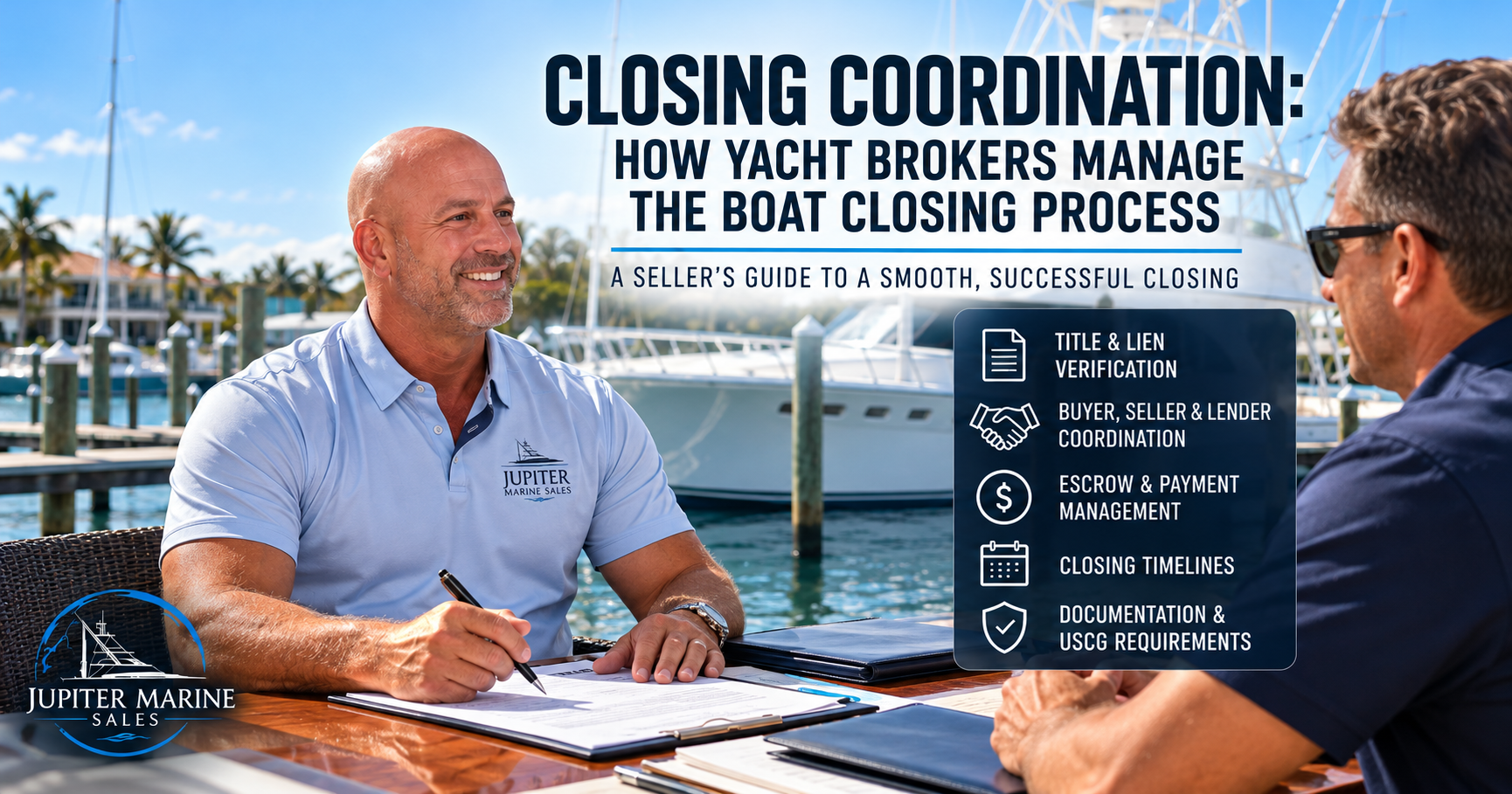
Jupiter Marine Sales | Professional Boat Selling Strategy — Article #13
A successful sea trial and survey are major milestones in selling a boat, but they do not mean the transaction is complete. Between a buyer's final acceptance and the actual closing, several importa

Getting a boat under contract is an important milestone in the selling process, but it is not the finish line.
After the seller accepts an offer and the purchase agreement is executed, the transaction typically moves into the buyer’s inspection and due-diligence period. For most brokerage t

A marine survey is one of the most important stages of buying or selling a boat—but what happens after the survey can be just as important as the inspection itself.
Survey day is often where a straightforward boat transaction suddenly becomes complicated.
A surveyor m

Receiving an offer is an important milestone in the sale of a boat or yacht—but it is not the end of the process.
It is the beginning of the negotiation.
The buyer may begin below the asking price. The seller may want to counter. The parties may disagree about the deposit, survey peri