Loading...
Loading...
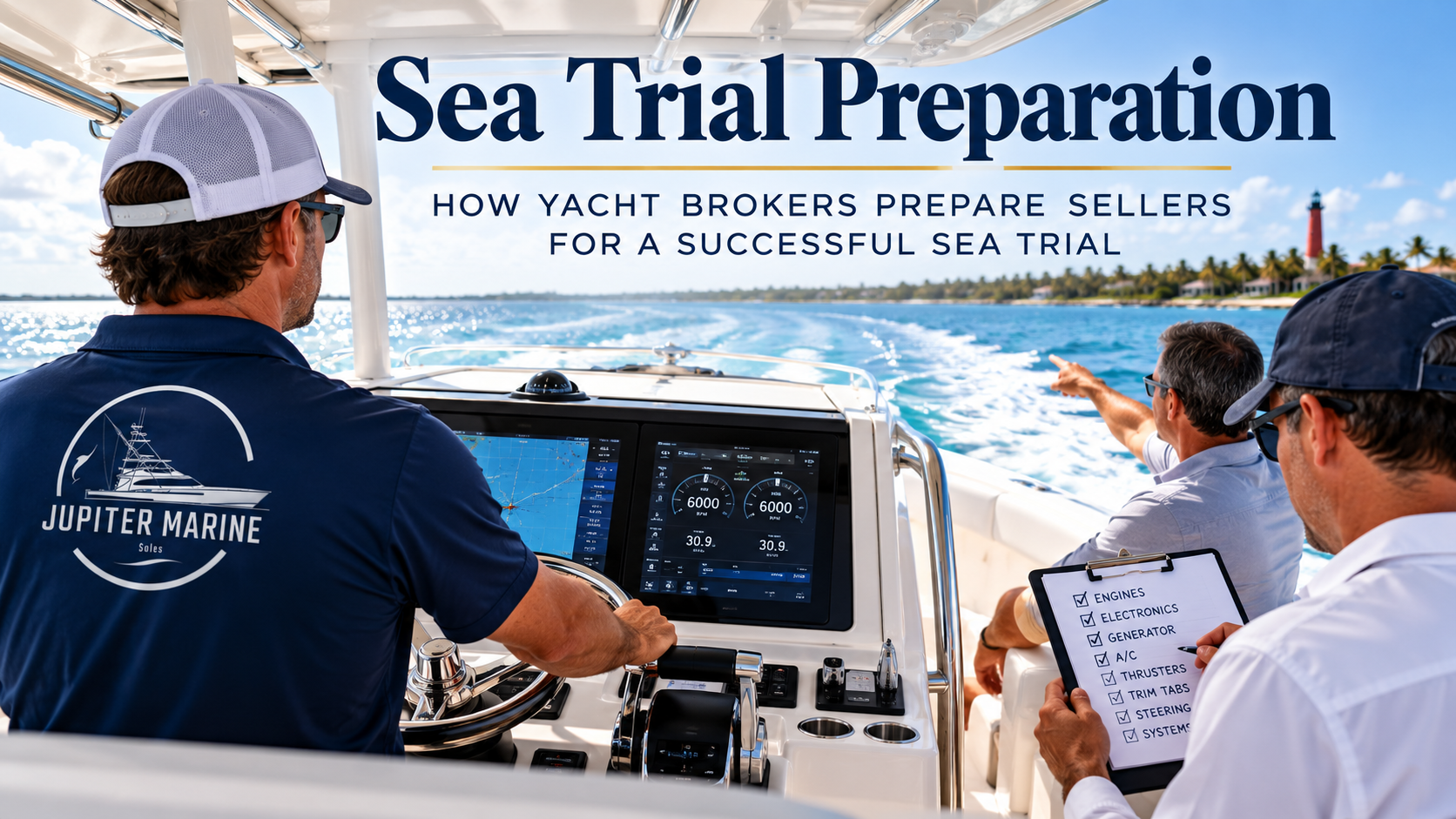
Getting a boat under contract is an important milestone in the selling process, but it is not the finish line.
After the seller accepts an offer and the purchase agreement is executed, the transaction typically moves into the buyer’s inspection and due-diligence period. For most brokerage transactions, one of the most important parts of that process is the marine survey and sea trial.
This is where the buyer has an opportunity to inspect the vessel, operate it on the water, test major systems, evaluate performance, and determine whether the boat meets expectations before making a final acceptance decision.
For sellers, this stage deserves serious preparation.
A poorly prepared boat can turn relatively minor issues into buyer concerns, additional survey findings, renegotiations, delays, or even a rejected vessel. A professionally prepared boat, on the other hand, gives the transaction the best opportunity to move smoothly toward closing.
At Jupiter Marine Sales, preparing for a successful sea trial starts well before the buyer arrives at the dock.
This guide explains how professional yacht brokers help sellers prepare their boats for a sea trial, what buyers and surveyors may evaluate, and why proper preparation can have a significant impact on the transaction.
A sea trial is an on-the-water evaluation of the vessel and its operating systems.
It generally occurs during the buyer’s contractual inspection or due-diligence period and is commonly performed in conjunction with a marine survey.
A marine survey focuses heavily on the vessel’s physical condition, construction, equipment, systems, and safety-related items.
The sea trial gives the buyer and the professionals they have retained an opportunity to see how the vessel actually performs while underway.
Depending on the boat and transaction, a sea trial may include evaluation of:
The exact procedure will vary depending on the vessel’s size, age, propulsion system, equipment, and the professionals performing the inspection.
The objective isn’t simply to determine whether the boat runs.
The buyer is trying to determine whether the vessel operates as represented and performs in a manner consistent with expectations before making a final acceptance decision.
Sellers sometimes make the mistake of thinking:
“The boat runs fine. We’ll just take them for a ride.”
A professional sea trial can be much more involved than that.
By this point in the transaction, the buyer has already gone through the offer and negotiation process. If you haven’t read those parts of our Professional Boat Selling Strategy series, see How Yacht Brokers Handle Offers on Boats and How Yacht Brokers Negotiate Boat and Yacht Deals.
Once the boat is under contract, the buyer may spend considerable money on a marine surveyor, engine technician, haul-out, fluid analysis, and other inspections.
That means they’re paying close attention.
Small problems that an owner has become accustomed to can suddenly become much more noticeable.
A gauge that intermittently stops working.
A weak battery.
A bilge pump that doesn’t activate.
A trim tab that responds slowly.
A generator that hasn’t been exercised recently.
An air-conditioning unit that isn’t cooling properly.
An engine that doesn’t reach its expected operating RPM.
A hatch that doesn’t latch correctly.
Individually, these may be manageable items.
Collectively, they can create the impression that a boat hasn’t been properly maintained.
Preparation helps prevent avoidable issues from becoming transaction issues.
The propulsion system is one of the most important—and expensive—components of virtually any powerboat.
Before a scheduled sea trial, sellers should make sure the engines are ready to operate normally.
Depending on the boat, this may include checking:
If there is a known mechanical problem, the time to address it is before the sea trial, not while the buyer, broker, surveyor, and engine technician are standing aboard the boat.
Whenever practical, one of the best things a seller can do is operate the boat before the scheduled sea trial.
Boats generally don’t benefit from sitting unused.
If a vessel hasn’t been operated recently, running it beforehand can reveal problems while there is still time to investigate or correct them.
This is particularly important for equipment such as:
Discovering an issue several days before the sea trial is inconvenient.
Discovering it during the buyer’s sea trial can affect the transaction.
It sounds obvious, but it happens.
A sea trial requires enough fuel to safely complete the inspection and performance testing.
The seller should make sure the vessel has adequate fuel before the appointment.
Fuel and water levels can also affect vessel performance. A boat carrying significant fuel and water may perform differently than the same vessel operating lightly loaded.
For larger vessels, it can be useful for the broker, surveyor, captain, and seller to understand approximately what fuel and water loads are aboard during performance testing.
Today’s boats can contain tens of thousands of dollars—or considerably more—in marine electronics.
Before the buyer arrives, major electronics should be powered up and checked.
Depending on the vessel, that may include:
If equipment was represented in the listing as operational, the buyer will reasonably expect it to work.
Finding an electronics problem before the scheduled inspection gives the seller and broker an opportunity to determine the appropriate response rather than discovering it in front of the buyer.
On larger boats and yachts, buyers will often expect the generator and climate-control systems to be demonstrated.
The generator should start and operate normally.
Air-conditioning systems should cool properly.
The same applies to other significant onboard systems that are represented as operational.
A generator that hasn’t been exercised for months isn’t something you want to discover on survey day.
The principle is simple:
Test it before the buyer does.
Weak batteries create unnecessary problems during surveys and sea trials.
A battery issue can affect much more than engine starting.
Modern vessels may have separate:
Low voltage can create alarms, electronics problems, slow pumps, starting issues, and other symptoms that can make an otherwise good boat appear problematic.
A basic battery and charging-system check before the inspection can eliminate an easily avoidable distraction.
Mechanical preparation matters, but presentation matters too.
The boat should be clean and organized for the sea trial and survey.
That means:
A surveyor needs access to the vessel.
If every hatch, machinery compartment, and storage area is buried underneath personal belongings, the inspection becomes more difficult and takes longer.
A clean, organized boat also communicates something important to the buyer:
This vessel has been cared for.
Good documentation can be extremely valuable during the due-diligence process.
If available, sellers should organize:
A buyer may still independently inspect the vessel, but documented maintenance can help answer questions and provide valuable context when something appears during an inspection.
Good records can also help distinguish between an unresolved problem and an item that has already been professionally repaired or serviced.
Trying to hide a known problem is rarely a good strategy.
Surveyors are specifically hired to identify deficiencies and potential problems.
If there is a known issue that materially affects the vessel or transaction, sellers should discuss it with their yacht broker before the survey and sea trial.
That gives the broker an opportunity to determine the appropriate way to address or communicate the issue.
Finding out about a known condition from the seller is one thing.
Having the buyer unexpectedly discover it during a survey can create a very different reaction.
Transparency becomes especially important if an issue could later become part of a negotiation.
During the sea trial, the surveyor or engine technician may want to operate the vessel through different RPM ranges.
That may include a wide-open-throttle test when vessel, engine, weather, and operating conditions permit.
Depending on the engines and instrumentation available, they may record:
They may be looking for abnormalities and comparing actual performance with manufacturer specifications or expected performance for the vessel.
That is another reason the boat should be mechanically prepared beforehand.
A marine survey frequently involves more than the sea trial itself.
The buyer may arrange for the vessel to be hauled so the surveyor can inspect its underwater components.
Depending on the boat, the surveyor may inspect:
The yacht broker can help coordinate timing among the buyer, seller, surveyor, marina, boatyard, captain, and other involved parties.
On larger transactions, this coordination becomes increasingly important.
Every transaction is different, but a sea trial may involve several parties.
These can include:
One of the broker’s responsibilities is to keep everyone coordinated so the process remains organized and productive.
A professionally managed sea trial should have a purpose and a plan. It shouldn’t feel like a casual boat ride with a crowd aboard.
A sea trial can be stressful for a seller.
Someone is inspecting a boat you’ve owned, maintained, enjoyed, and possibly invested significant money into.
Surveyors are paid to identify deficiencies. Their job isn’t to compliment the boat.
That can sometimes make sellers defensive.
This is one reason having an experienced yacht broker involved can be valuable.
The broker can communicate with the buyer’s side, provide context when appropriate, help distinguish significant concerns from routine observations, and keep the process focused on the transaction.
Sometimes the best thing a seller can do during the inspection is simply allow the professionals to do their jobs.
Most used boats will have survey findings.
That is normal.
A survey report might contain numerous observations ranging from minor maintenance recommendations to items that deserve immediate attention.
The existence of survey findings does not automatically mean the boat has failed its survey.
What matters is:
This is where an experienced yacht broker becomes particularly important.
In the previous article in our Professional Boat Selling Strategy series, we explain this process in detail:
Survey Response Negotiations: How Yacht Brokers Handle Survey Findings After the Inspection
The goal isn't to assume that every item on a survey report deserves a price reduction or repair.
The goal is to evaluate the findings, understand the contractual position of the parties, keep emotions out of the discussion, and work toward a reasonable resolution when possible.
A professional yacht broker isn’t there simply to unlock the boat and meet everyone at the dock.
The listing broker helps manage the process surrounding the inspection.
At Jupiter Marine Sales, that can include:
The objective isn’t to interfere with an independent marine survey.
It is to help make sure the transaction is organized, transparent, and professionally managed.
That process starts much earlier than survey day.
It begins with properly handling the buyer’s initial offer, which we cover in How Yacht Brokers Handle Offers on Boats, and continues through the negotiation process explained in How Yacht Brokers Negotiate Boat and Yacht Deals.
Each step builds on the one before it.
The best sea trials are often relatively uneventful.
The engines start.
The electronics work.
The generator operates.
The boat performs properly.
The surveyor can access what needs to be inspected.
The buyer gets their questions answered.
And the transaction continues moving forward.
That doesn’t happen by accident.
It comes from preparation.
For sellers, properly preparing a boat before survey and sea trial can reduce unnecessary surprises, strengthen buyer confidence, and put the seller in a much better position to move the transaction toward closing.
Once the inspection, survey, sea trial, and any resulting negotiations have been resolved, the transaction moves into another critical stage:
closing coordination.
Deposits, acceptance documents, financing requirements, lender conditions, vessel documentation, payoff information, title work, closing statements, insurance requirements, and delivery all need to come together correctly and on time.
That will be the next article in our Professional Boat Selling Strategy series:
#13 — Closing Coordination: How Yacht Brokers Manage a Boat Sale From Acceptance to Closing
At Jupiter Marine Sales, our job doesn’t end when we find a buyer.
From professionally marketing the vessel and qualifying prospective buyers to conducting showings, handling offers, negotiating the deal, coordinating surveys and sea trials, working through survey response negotiations, and coordinating the transaction through closing, our team helps manage the professional brokerage process from beginning to end.
If you’re considering selling your boat or yacht in Florida, contact Jupiter Marine Sales to discuss your vessel and our professional yacht brokerage services.

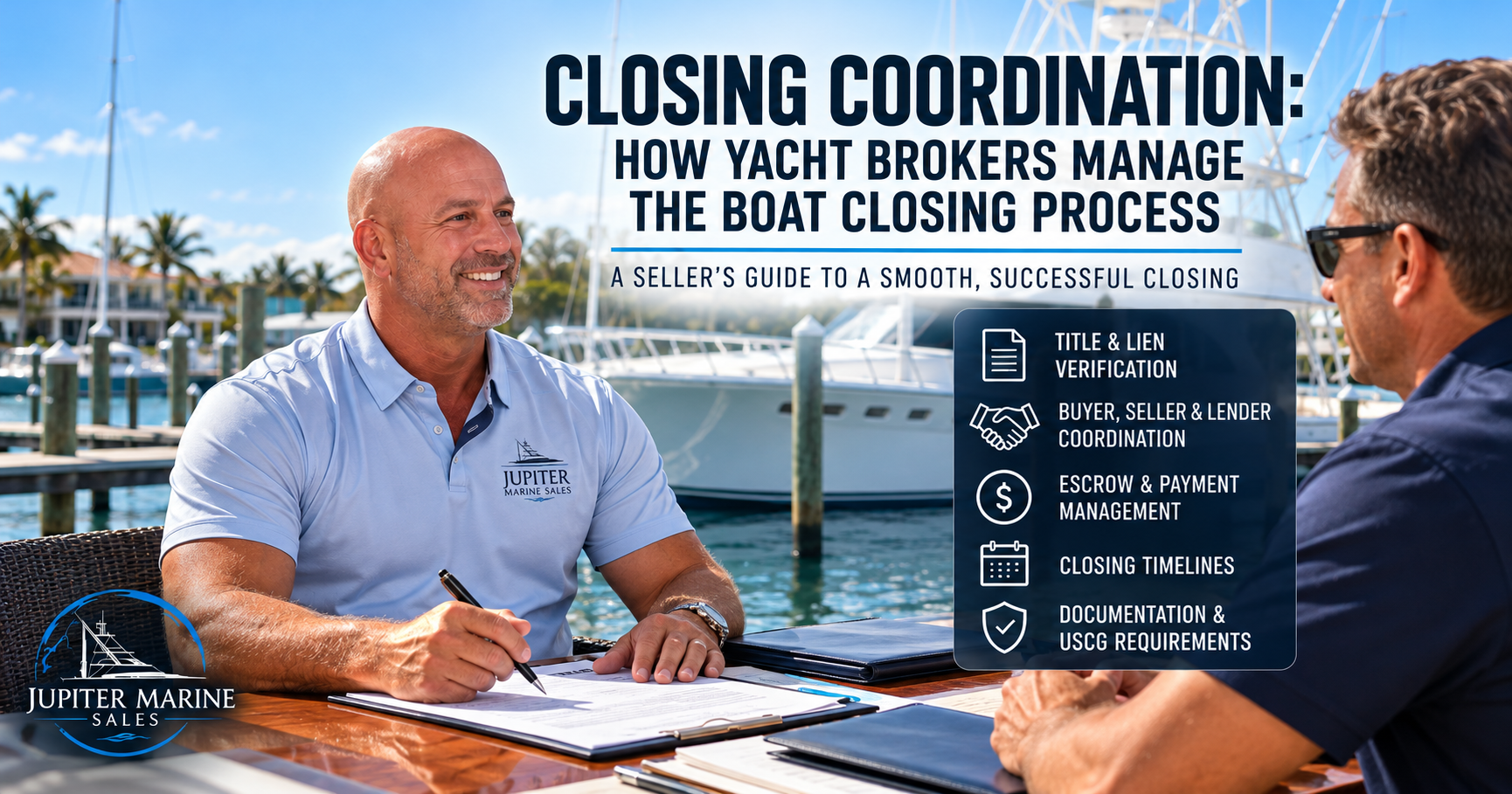
Jupiter Marine Sales | Professional Boat Selling Strategy — Article #13
A successful sea trial and survey are major milestones in selling a boat, but they do not mean the transaction is complete. Between a buyer's final acceptance and the actual closing, several importa
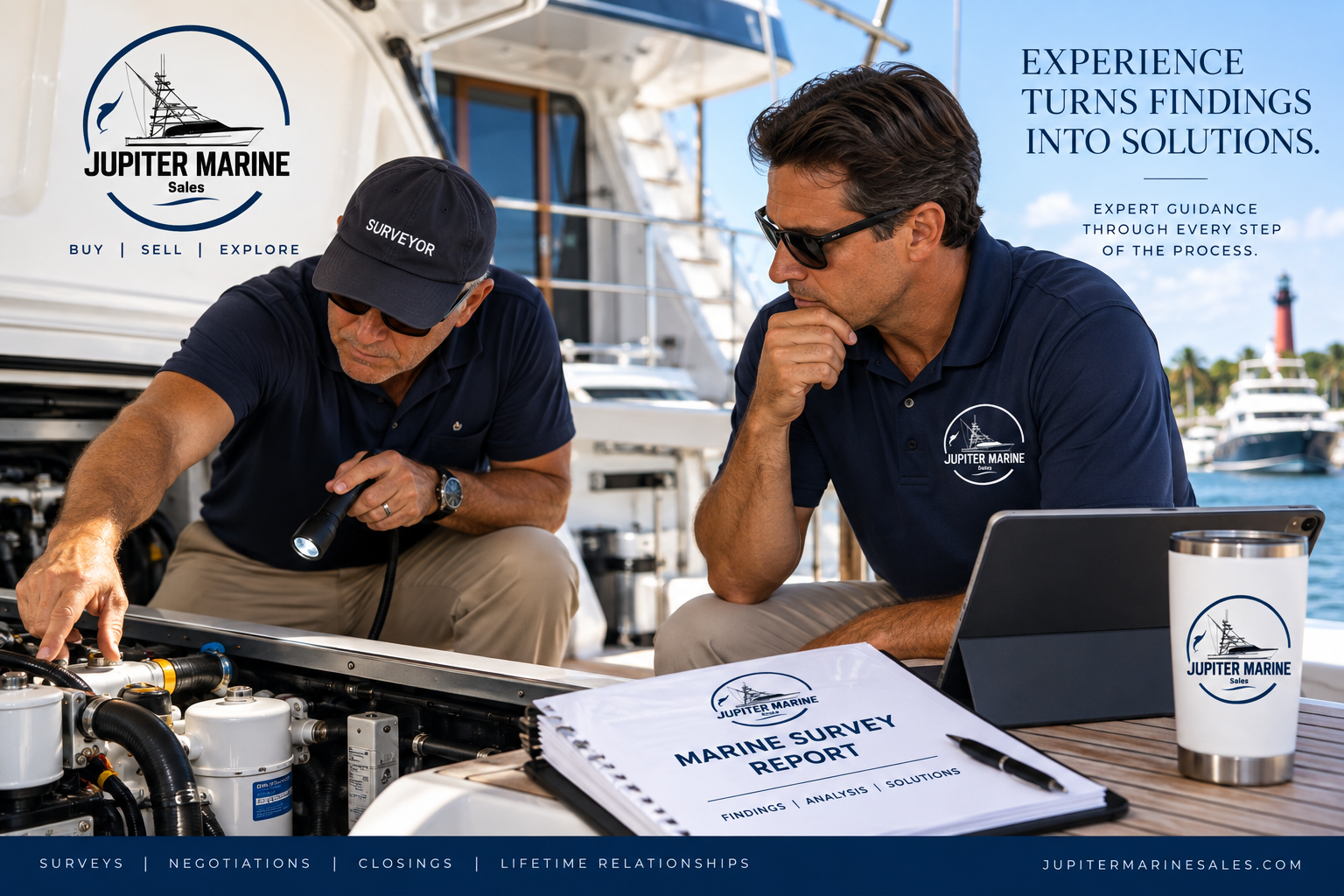
A marine survey is one of the most important stages of buying or selling a boat—but what happens after the survey can be just as important as the inspection itself.
Survey day is often where a straightforward boat transaction suddenly becomes complicated.
A surveyor m
Receiving an offer is an important milestone in the sale of a boat or yacht—but it is not the end of the process.
It is the beginning of the negotiation.
The buyer may begin below the asking price. The seller may want to counter. The parties may disagree about the deposit, survey peri
Reaching an agreement on price is an important milestone in the sale of a boat or yacht.
But agreeing on a number does not mean the transaction is complete—or even that the vessel is officially under contract.
The negotiated terms must be placed into a written Purchase and Sale Agreem