Loading...
Loading...
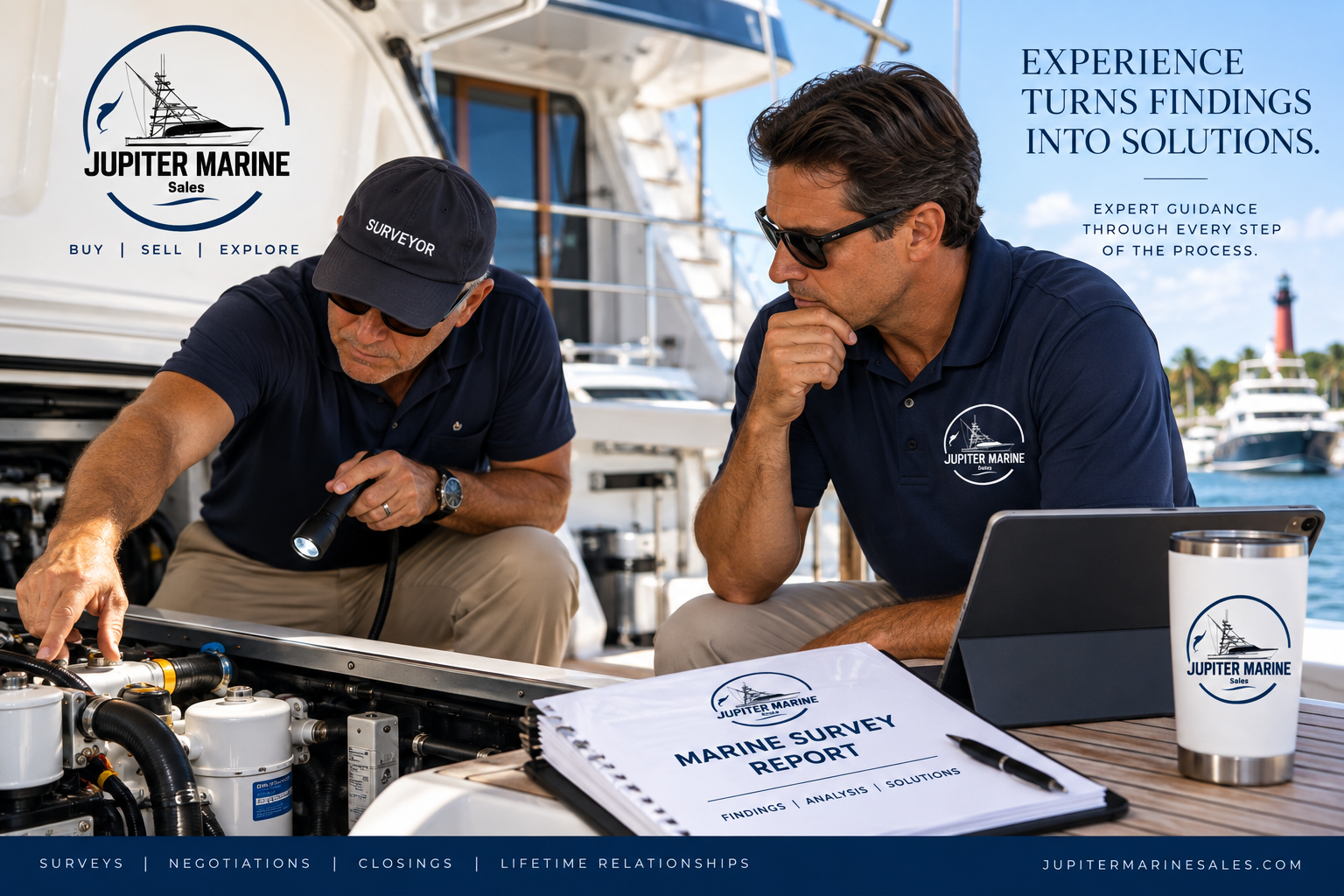
A marine survey is one of the most important stages of buying or selling a boat—but what happens after the survey can be just as important as the inspection itself.
Survey day is often where a straightforward boat transaction suddenly becomes complicated.
A surveyor may uncover deficiencies the seller didn't know existed. The seller's captain, crew, mechanics, or even previous surveyors may never have identified them. Engine technicians may discover additional concerns. Buyers may become nervous when they see a long list of findings, while sellers may feel as though every minor imperfection is suddenly being used to renegotiate a deal they thought was already agreed upon.
This is where an experienced yacht broker becomes extremely important.
At Jupiter Marine Sales, we have handled hundreds of boat transactions, and one lesson experience teaches very quickly is this:
No two deals are ever exactly the same.
Survey day is usually when that becomes most apparent.
Successful survey response negotiations require understanding the boat, understanding the survey findings, knowing which issues actually matter, communicating those issues correctly, and finding a reasonable path forward for both buyer and seller.
But good survey negotiations actually begin before the survey ever takes place.
Not every marine surveyor is the right surveyor for every boat.
One of the biggest mistakes a buyer can make is selecting a surveyor based solely on availability or price.
Experience matters.
More importantly, experience with the particular type of vessel being purchased matters.
A surveyor's job shouldn't simply be to identify everything that isn't perfect. A good surveyor should be able to explain what was found, why it matters, how serious it is, and when additional evaluation by a specialist is appropriate.
There is an enormous difference between writing:
"Deficiency noted."
and being able to explain:
"This is what we found, this is why it matters, this is how significant it is, and this is what I recommend doing next."
That distinction becomes extremely important once negotiations begin.
After you've participated in hundreds of surveys, you also begin to understand which surveyors have experience with particular vessels and which professionals communicate their findings in a way that helps buyers make informed decisions.
That is why we believe surveyors should be thoroughly vetted before being hired.
Imagine purchasing a 112-foot Westport.
Hiring someone with three years of surveying experience, little mechanical background, limited professional captain experience, and little familiarity with Westport yachts would probably not be the ideal choice for a vessel of that complexity.
Now consider the alternative.
You hire a surveyor who has inspected dozens of Westports and understands the construction, systems, common issues, equipment, and characteristics of those vessels.
Then you hire an experienced engine technician who knows the engines installed aboard that particular yacht.
Before the survey even begins, you have already put yourself in a much stronger position.
The same principle applies throughout the boating industry.
Someone who is extremely knowledgeable about small center consoles may not necessarily be the person you want surveying a large motor yacht.
Likewise, someone who specializes in large yachts may be unnecessary for a relatively straightforward outboard-powered center console.
The surveyor should fit the boat.
The word "survey" can describe dramatically different inspections depending upon the vessel.
On many boats under approximately 40 feet, particularly outboard-powered boats, the survey and sea trial can often be completed within several hours.
A typical inspection may include:
Gasoline outboards can generally be evaluated relatively quickly by a qualified technician.
Large diesel-powered yachts are an entirely different situation.
Large yacht surveys can take multiple days and, depending upon the vessel, scope of inspection, specialists involved, and findings, the overall survey process can extend much longer.
The more systems a yacht has, the more complex the inspection becomes.
Large yachts may have multiple generators, sophisticated electrical systems, hydraulic systems, stabilization equipment, watermakers, HVAC systems, navigation electronics, fire suppression equipment, tender systems, pumps, refrigeration, sewage systems, communication equipment, and numerous other systems that need to be evaluated.
Large diesel engines also require a much more involved evaluation.
A qualified diesel technician may need to evaluate operating temperatures, exhaust temperatures, cooling-water flow, engine load, acceleration and deceleration performance, boost, pressures, diagnostic history, fluid condition, and numerous other parameters.
That takes time.
Trying to rush a complex yacht survey simply to save a few hours can become an extremely expensive mistake later.
This is one of the most important things for buyers and sellers to understand.
The survey report provides information. It does not automatically determine what happens next.
A surveyor identifies and documents findings.
The buyer and seller, typically with guidance from their brokers and appropriate specialists, then have to determine how those findings affect the transaction.
A survey report might contain dozens—or even hundreds—of observations.
That does not necessarily mean the boat has dozens or hundreds of serious problems.
Some findings may involve:
Those findings shouldn't necessarily be treated equally.
This is where experience becomes extremely valuable.
Sellers are sometimes genuinely surprised by survey findings.
We've seen surveys identify issues that weren't known to the owner, captain, crew, mechanics, or even professionals who previously inspected or serviced the vessel.
That doesn't automatically mean someone neglected the boat.
Boats are complicated machines operating in an extremely harsh environment.
Components fail.
Corrosion develops.
Connections loosen.
Hoses deteriorate.
Electronics develop intermittent problems.
Pumps stop working.
Seals begin leaking.
And sometimes an issue simply isn't apparent until someone specifically looks for it.
This is why the conversation following a survey needs to be handled carefully.
Immediately assuming the seller intentionally concealed every deficiency is rarely productive.
Likewise, dismissing a legitimate survey finding simply because the seller "never had a problem with it" isn't productive either.
The objective should be determining what the issue actually is and what it means to the transaction.
One of the fastest ways to derail a transaction is treating every survey observation as though it represents a major defect.
A used boat is not a new boat.
A five-, ten-, or twenty-year-old vessel will almost always have items that aren't perfect.
The question is not:
"Did the surveyor find anything wrong?"
The better question is:
"Which findings materially affect the safety, operation, value, insurability, or intended use of the vessel?"
Those are very different questions.
For example, a failed bilge pump, significant moisture intrusion, steering problem, serious engine issue, fuel-system deficiency, or structural concern deserves careful attention.
A scratched cabinet door or weathered cushion is something entirely different.
Experienced brokers help keep these categories separate.
Marine surveyors are generalists by necessity.
Even extremely experienced surveyors cannot be specialists in every engine, generator, stabilization system, electronic component, transmission, and piece of equipment installed aboard a yacht.
When a surveyor identifies something outside his or her expertise, the appropriate response may be to bring in a specialist.
That could include:
Sometimes a finding that initially sounds serious becomes relatively minor after specialist evaluation.
Other times, something that initially appears minor turns out to deserve considerably more attention.
Get the facts before negotiating.
The buyer and seller already negotiated the purchase price before the survey.
Survey response negotiations shouldn't automatically become an opportunity to renegotiate the entire transaction.
The purpose is to address legitimate findings that were not reasonably understood when the original offer was made.
This distinction is important.
If a boat was priced appropriately for its age and condition, normal wear and obvious cosmetic imperfections were presumably already reflected in the agreed purchase price.
Survey negotiations should focus primarily on newly discovered, material information.
Otherwise, negotiations can quickly become adversarial.
A buyer who submits an excessive request covering every minor survey observation may cause a seller to stop negotiating altogether.
Likewise, a seller who refuses to acknowledge legitimate mechanical, structural, safety, or insurability concerns can cause a qualified buyer to walk away.
The goal is to find reasonable common ground.
Most survey negotiations ultimately involve some combination of three solutions.
The seller agrees to correct certain deficiencies before closing.
This can work particularly well for clearly defined repairs when both parties agree on the scope of work.
Documentation of completed repairs should be provided whenever appropriate.
Instead of delaying closing while repairs are completed, the parties may negotiate an adjustment to the purchase price.
This allows the buyer to address the issue after closing using contractors or technicians of their choosing.
Depending upon the transaction structure and applicable closing requirements, the parties may agree upon another financial accommodation to address specific deficiencies.
The exact structure should be documented by the professionals handling the transaction.
Not every finding needs the same solution.
One item might be repaired while another results in a negotiated price adjustment.
Negotiating based upon guesses rarely works well.
If a meaningful deficiency is discovered, obtaining a professional repair estimate can change the entire conversation.
Instead of saying:
"We think this could cost $20,000."
the parties can discuss an actual estimate from a qualified marine contractor or technician.
That turns an emotional negotiation into a factual one.
It also helps prevent both sides from exaggerating the potential cost.
Some survey findings aren't simply negotiating points.
They can affect whether the buyer can insure the vessel.
An insurance company may require certain deficiencies to be corrected before coverage is bound or may require repairs within a specified period following closing.
That can make an otherwise minor-looking survey recommendation much more important.
This is particularly relevant when financing is involved because lenders typically require acceptable insurance coverage before funding.
The broker, buyer, insurance professional, lender, surveyor, and seller may therefore all become involved in resolving a single survey issue.
This is another reason we say:
No two boat transactions are the same.
Survey response negotiations can become emotional very quickly.
The buyer has invested time and money into the survey, haul-out, travel, engine inspections, and possibly financing.
The seller may have maintained the boat for years and can take criticism of the vessel personally.
Neither reaction helps close the transaction.
A good broker acts as a buffer between those emotions.
Instead of:
"The buyer thinks your boat has $40,000 worth of problems."
the conversation should be based on specific findings, professional evaluations, actual estimates, contractual obligations, and reasonable solutions.
Facts generally produce better negotiations than emotion.
An experienced yacht broker shouldn't simply forward a survey report from one party to another.
The broker should help organize the information.
What was discovered?
What requires additional investigation?
What is a legitimate safety or mechanical concern?
What is routine maintenance?
What is normal wear?
What could affect insurance?
What could affect financing?
What should be repaired?
What might justify a price adjustment?
And what shouldn't materially affect the transaction at all?
The objective isn't to make every boat perfect.
The objective is to help the buyer and seller reach a fair resolution based upon the actual condition of the vessel.
There are procedures we follow on every transaction, but experience teaches you quickly that there is no universal formula for survey negotiations.
We've seen relatively simple surveys uncover unexpected major issues.
We've seen intimidating survey reports ultimately result in relatively minor repairs.
We've seen sellers immediately agree to correct deficiencies.
We've seen buyers accept boats with known issues because they understood exactly what they were purchasing.
We've seen specialists resolve concerns that initially appeared capable of ending a transaction.
And we've seen transactions where the right decision was simply for the parties not to proceed.
That experience is difficult to replace.
Every survey adds another layer of knowledge about boats, surveyors, technicians, manufacturers, engines, systems, repair facilities, insurance requirements, and the negotiation process itself.
One of the biggest misconceptions about survey response negotiations is that they begin when the survey report arrives.
They don't.
They begin when the buyer assembles the survey team.
Choosing a surveyor who understands the vessel, hiring qualified engine technicians, arranging the correct haul-out facility, allowing enough time for the inspection, and making sure the appropriate specialists are available can dramatically affect what happens afterward.
The right survey team doesn't guarantee a perfect boat.
It provides something much more valuable:
Reliable information.
And reliable information gives buyers and sellers the best opportunity to make reasonable decisions.
At Jupiter Marine Sales, our job is not simply to get a boat under contract.
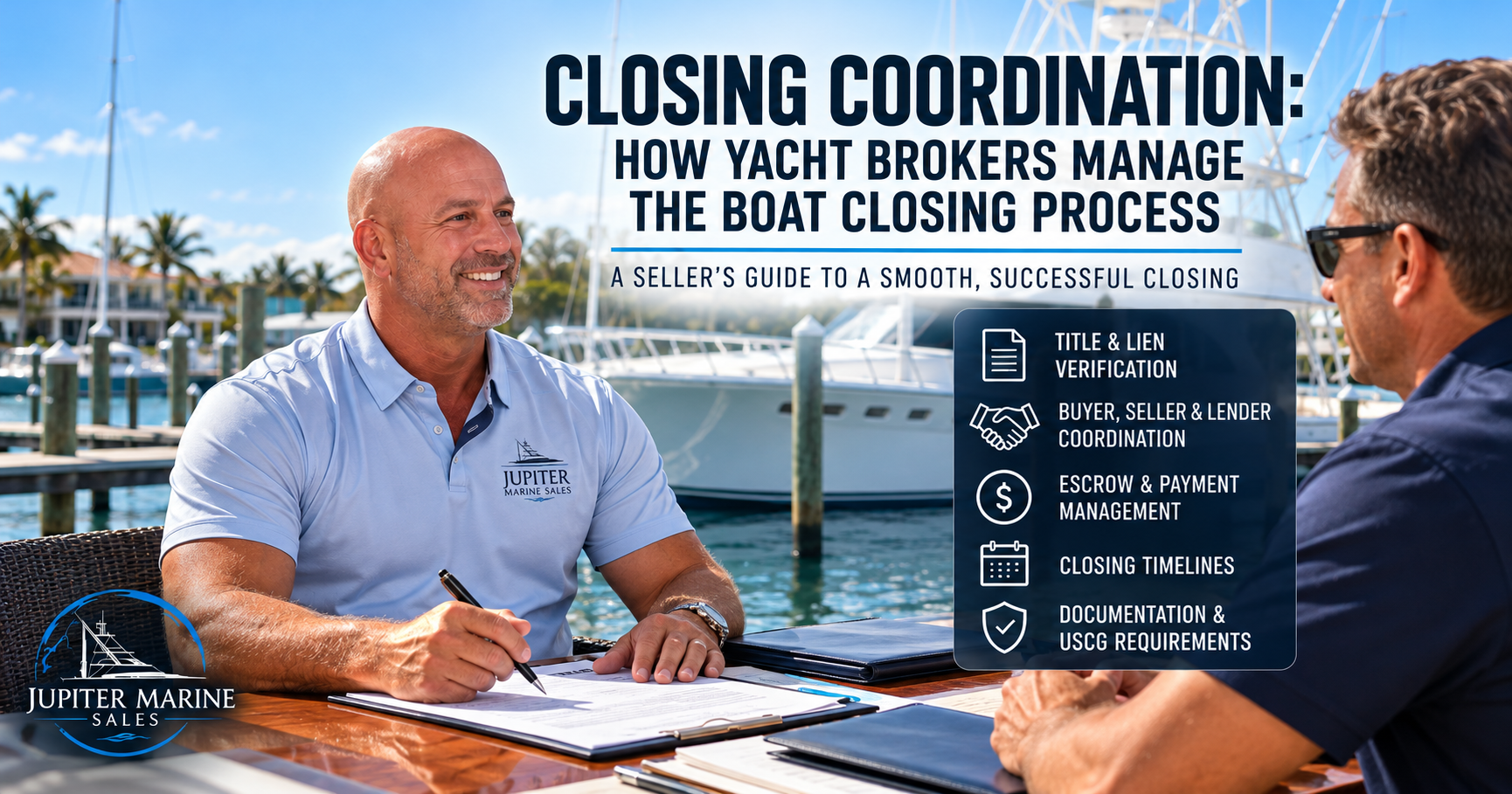
Our brokers help guide buyers and sellers through the entire transaction—from the initial offer and purchase agreement through survey, sea trial, survey response negotiations, financing, insurance, documentation, and closing.
Having experienced professionals involved becomes particularly important when a survey uncovers something unexpected.
Because when that happens, the question isn't simply whether the boat has a problem.
The questions become:
How serious is it?
Who is qualified to evaluate it?
What will it actually cost to correct?
Does it affect safety, value, financing, or insurance?
And what is a reasonable solution for the buyer and seller?
Those are the questions that turn a survey report into a successful survey negotiation.
If you're buying or selling a boat in Florida and want experienced representation throughout the transaction, contact Jupiter Marine Sales.
Jupiter Marine Sales
Professional Yacht Brokerage & Buyer Representation
Jupiter Marine Sales | Professional Boat Selling Strategy — Article #13
A successful sea trial and survey are major milestones in selling a boat, but they do not mean the transaction is complete. Between a buyer's final acceptance and the actual closing, several importa
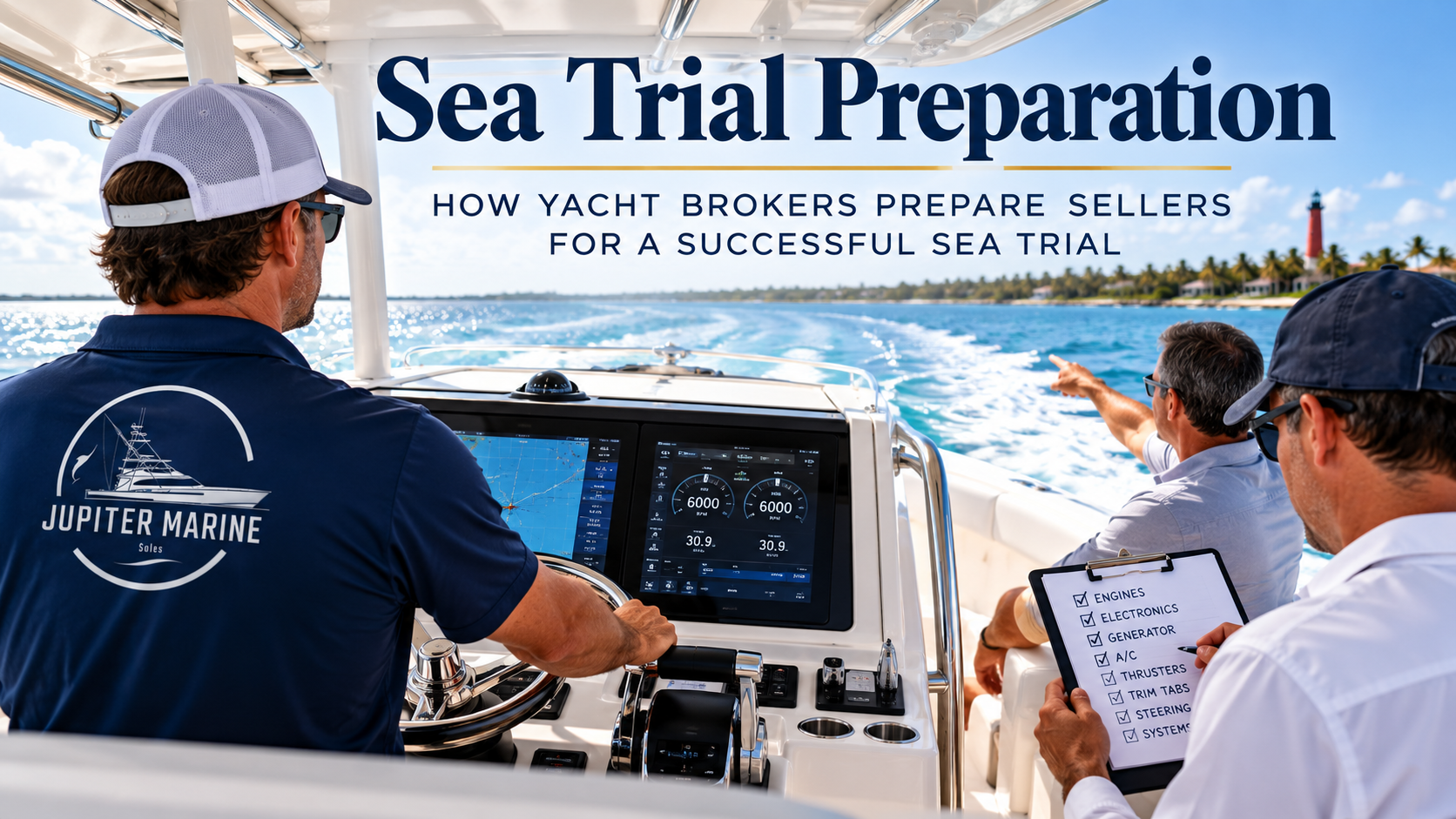
Getting a boat under contract is an important milestone in the selling process, but it is not the finish line.
After the seller accepts an offer and the purchase agreement is executed, the transaction typically moves into the buyer’s inspection and due-diligence period. For most brokerage t
Receiving an offer is an important milestone in the sale of a boat or yacht—but it is not the end of the process.
It is the beginning of the negotiation.
The buyer may begin below the asking price. The seller may want to counter. The parties may disagree about the deposit, survey peri
Reaching an agreement on price is an important milestone in the sale of a boat or yacht.
But agreeing on a number does not mean the transaction is complete—or even that the vessel is officially under contract.
The negotiated terms must be placed into a written Purchase and Sale Agreem