Loading...
Loading...
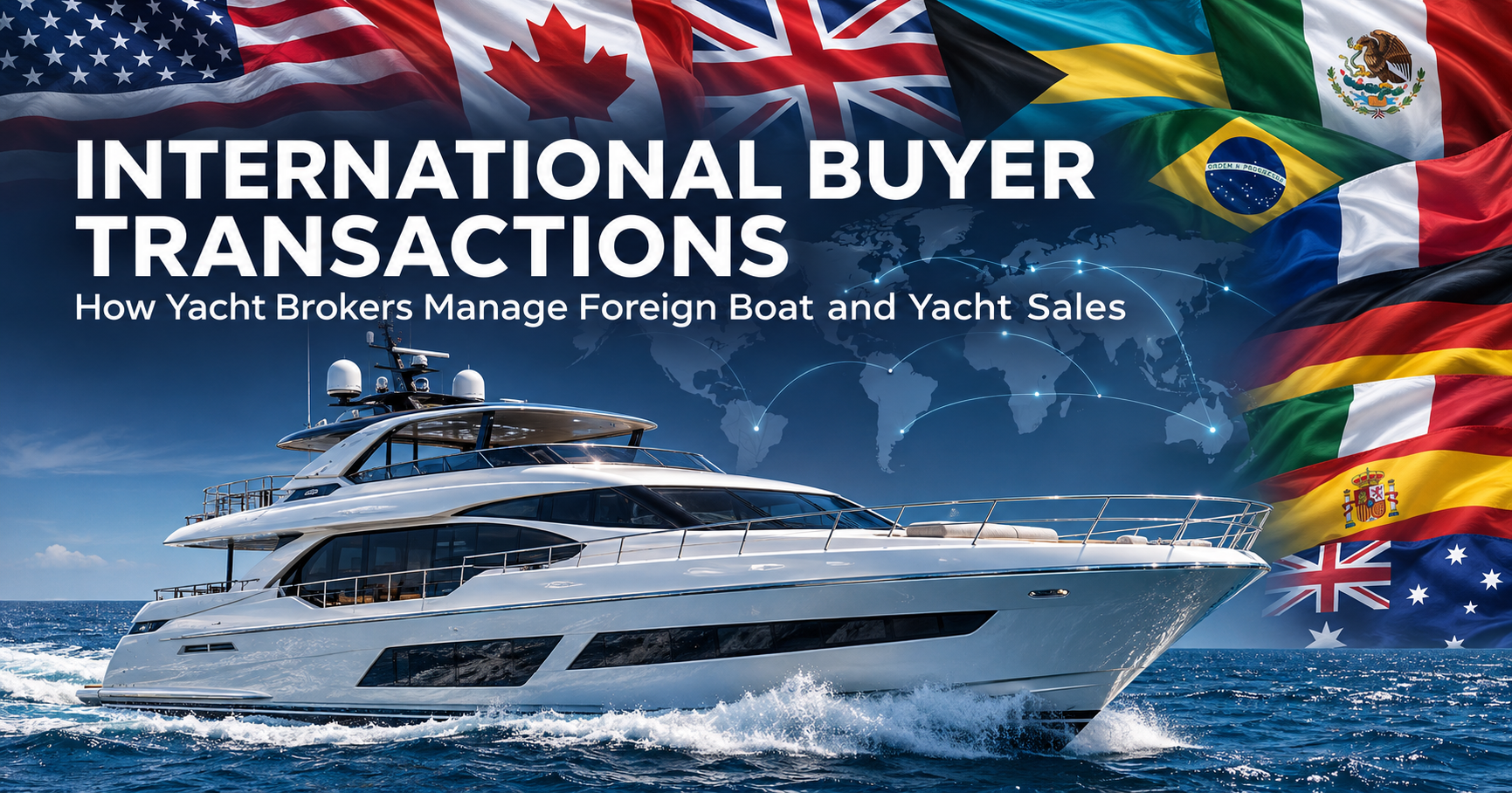
International yacht transactions require careful coordination of buyer verification, funds, documentation, taxes, insurance, export plans, and delivery
Professional Boat-Selling Strategy — Article 15
Previous Article: Documentation and Lien Handling: A Boat Seller’s Guide
Selling a boat or yacht to an international buyer can create an excellent opportunity for the seller.
Florida attracts buyers from Canada, Europe, the Caribbean, Latin America, Australia, and many other international markets. Many of these buyers are experienced boat owners who recognize the selection and value available in the United States.
However, an international transaction introduces additional questions that must be answered before the boat is released:
These issues do not automatically make the transaction risky. They simply make professional coordination more important.
At Jupiter Marine Sales, our job is to help the seller understand the transaction, qualify the buyer, establish clear deadlines, coordinate the appropriate professionals, and prevent the vessel from being released before every closing condition has been satisfied.
A transaction may be considered international when one or more of the following applies:
Some international transactions involve all of these elements. Others may involve only one.
The broker should identify the international aspects of the transaction before the purchase agreement is finalized—not a few days before closing.
Every buyer should be qualified before a seller invests significant time and money in a transaction.
International buyers may require additional verification because the parties, funds, bank accounts, and ownership entities can be located in different countries.
Depending on the transaction, the buyer or buyer’s representative may be asked to provide:
A serious international buyer should understand why this information is necessary.
Large international transactions require the closing agent, financial institutions, documentation professionals, insurers, and other participants to know who is purchasing the vessel and where the money is coming from.
The United States Treasury maintains an official OFAC Sanctions List Search for reviewing sanctioned individuals and entities. Qualified closing professionals may perform additional identity, entity, sanctions, or transaction screening based on the circumstances.
The purchase agreement is the transaction’s roadmap.
A standard agreement may still be used, but the international components should be addressed clearly. The agreement or its addenda may need to identify:
The purchase price should generally be stated in a single agreed currency. For most Florida yacht transactions, that will be United States dollars.
If the buyer must convert another currency into U.S. dollars, exchange-rate fluctuations and conversion expenses should remain the buyer’s responsibility unless the written agreement states otherwise.
The seller should not be expected to absorb a currency loss because the buyer delayed exchanging or transferring funds.
At Jupiter Marine Sales, a typical offer requires a 10% deposit.
An international buyer may need additional time to initiate the wire, but the deposit deadline should still be clearly established. The vessel should not be treated as securely under contract merely because the buyer has promised to send the deposit.
The closing or escrow professional should confirm that the deposit was actually received.
A wire confirmation, bank screenshot, email receipt, or message from the buyer does not prove that usable funds have arrived in the escrow account.
International wires can be delayed by:
These possible delays should be considered when setting the deposit and closing deadlines.
Boat and yacht transactions are attractive targets for wire fraud because they involve large transfers, multiple professionals, emailed documents, and buyers who may never meet the closing agent in person.
Wire instructions should always be independently verified using a trusted telephone number.
A buyer or seller should never rely solely on an email claiming that:
The FBI’s Business Email Compromise guidance recommends confirming changes in account information through a secondary communication channel.
If wire instructions appear to change, stop the transaction and verify them directly with the closing professional.
The seller should never release the vessel because the buyer produced a wire receipt. Delivery should occur only after the authorized closing professional confirms that the required funds have been received and the transaction is cleared to close.
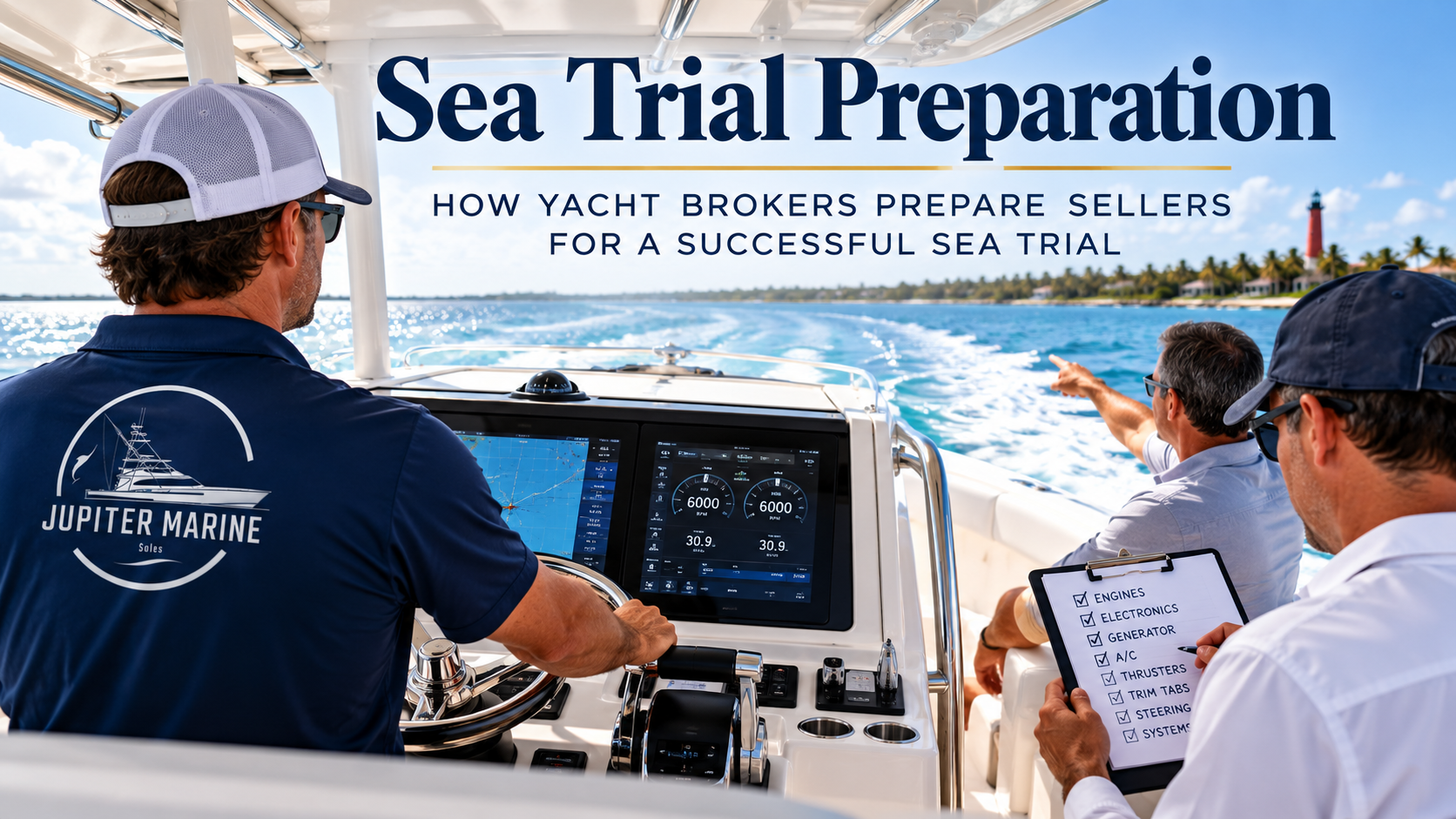
International buyers do not always attend the survey and sea trial personally.
They may appoint:
The purchase agreement should still establish the survey, sea-trial, acceptance, and rejection deadlines.
The buyer should arrange and pay the surveyors, technicians, captains, haul-out facilities, and other due-diligence professionals directly unless another arrangement is documented.
The seller should understand who is authorized to attend, operate, inspect, or make decisions concerning the vessel.
The person attending the sea trial should not automatically be assumed to have authority to accept the vessel, reject the vessel, modify the agreement, or negotiate repairs. That authority should be confirmed in writing.
For a detailed explanation of this stage, read Sea-Trial Preparation: How Yacht Brokers Prepare Sellers for a Successful Sea Trial.
The buyer’s intended ownership structure affects the closing documents.
The vessel might be purchased by:
The yacht broker should not select the buyer’s ownership structure or provide international tax or legal advice.
The buyer should obtain guidance from qualified attorneys, accountants, documentation professionals, and tax advisers familiar with the buyer’s country and the intended place of registration.
The ownership decision should be made before the bill of sale and closing documents are prepared.
Changing the purchaser’s name from an individual to a foreign company at the last minute can delay:
The exact legal purchaser should be established as early as possible.
A foreign buyer’s citizenship and ownership structure can affect whether a vessel is eligible to remain documented with the United States Coast Guard.
If the boat is currently federally documented and will be transferred to a foreign owner or placed under a foreign flag, the transaction may require deletion from U.S. documentation.
Depending on the transaction, the closing professional may coordinate:
The National Vessel Documentation Center maintains the official vessel-documentation forms and instructions.
The seller should not promise that the buyer can retain U.S. documentation without first confirming eligibility with an experienced documentation professional.
Our previous article, Documentation and Lien Handling: A Boat Seller’s Guide, explains how vessel titles, preferred ship mortgages, lender payoffs, lien releases, and USCG filings can affect a closing.
Every country has its own requirements for registering or documenting a vessel.
A foreign registry may request:
The seller should be told early which documents the buyer needs.
The seller may reasonably cooperate with the buyer’s registration process, but the seller should not assume unlimited responsibility for satisfying an unfamiliar foreign registry after closing.
The purchase agreement should establish which documents the seller must provide and which foreign-registration obligations belong to the buyer.
A foreign passport does not automatically eliminate Florida sales tax.
Tax treatment depends on the vessel, the transaction, the buyer’s residency, the delivery location, how the vessel will be used, and whether the buyer qualifies for a statutory exemption.
Florida provides specific procedures for certain nonresident boat purchasers who plan to remove a qualifying vessel from the state. Those procedures include requirements concerning affidavits, decals, removal deadlines, records, and proof that the vessel left Florida.
The Florida Department of Revenue publishes official Purchaser Removal Requirements and additional guidance concerning sales and use tax on boats.
Failure to satisfy the requirements can create tax, interest, or penalty exposure.
An international buyer should consult a qualified Florida tax professional or marine closing company before assuming that the transaction qualifies for an exemption.
The broker should not make informal promises such as:
Those statements can be dangerously incomplete.
The parties should determine who is responsible for exporting the vessel and when that responsibility begins.
Potential arrangements include:
The purchase agreement should identify:
Unless the seller has specifically agreed to provide international delivery, the buyer should generally be responsible for transportation after the transaction closes and possession transfers.
A foreign buyer may discover that insurance is more complicated than expected.
The insurer may consider:
The buyer should begin obtaining insurance during the inspection period—not on the morning of closing.
The seller’s insurance should not be treated as protection for the buyer after ownership and possession have transferred.
Financing may be available, but international buyers can face additional requirements.
A lender may request:
The lender’s requirements should be confirmed before the parties agree to an unrealistic closing date.
A financing contingency should identify the buyer’s deadline and obligations. It should not give the buyer an unlimited opportunity to delay the transaction.
Many international transactions can be completed without the buyer physically attending closing.
Documents may be exchanged through:
However, not every document can necessarily be signed electronically.
The receiving registry, lender, title agency, or government office may require:
Those requirements should be identified early enough to allow the documents to be completed and returned before closing.
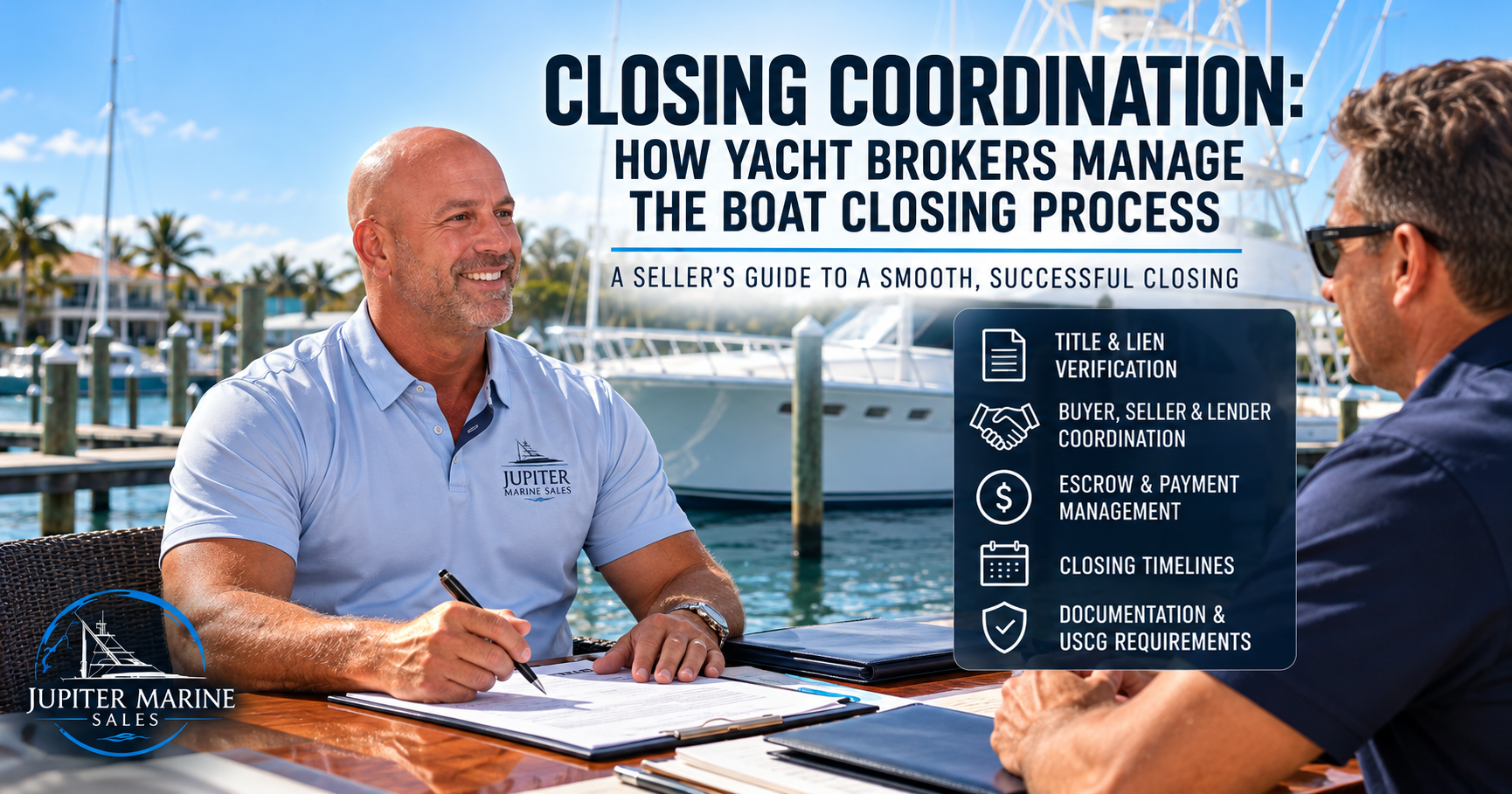
For more information about the overall closing process, read Closing Coordination: How Yacht Brokers Manage Boat Closings.
The vessel should not be released merely because:
Before releasing the vessel, the seller and broker should receive confirmation from the authorized closing professional that:
The pressure created by a captain, shipping schedule, weather window, marina deadline, or international flight should never replace proper closing authorization.
Funds may arrive from a company, relative, business partner, attorney, or other third party that is not named in the purchase agreement.
This should be reviewed by the escrow or closing professional before funds are accepted or credited to the transaction.
A buyer may decide immediately before closing to substitute a corporation or foreign entity. This can require new agreements, identity verification, entity documents, insurance, lender approval, and closing paperwork.
Citizenship and entity requirements may prevent the buyer from continuing the existing documentation arrangement.
International ownership does not automatically create a Florida tax exemption.
The buyer may accept the vessel but have no captain, insurance, dockage, transport reservation, customs plan, or foreign registration.
The foreign registry may require notarization, certified copies, translations, or apostilles that were not discussed before closing.
Banks may delay transfers for compliance review or intermediary processing.
This is a major fraud warning. Changes should be verified through a trusted secondary channel.
The lender’s payoff, mortgage release, and USCG deletion requirements can affect the closing timeline.
Early possession exposes the seller to unnecessary liability and should not be allowed without a carefully prepared written arrangement approved by the appropriate professionals.
Before closing with an international buyer, confirm that the transaction team has addressed:
The seller does not need to personally solve every issue.
The seller does need a transaction team that recognizes the issues and assigns responsibility for resolving them.
A yacht broker is not a substitute for an attorney, accountant, tax adviser, customs broker, government official, documentation specialist, insurance agent, lender, or marine title company.
The broker’s job is to coordinate the transaction and make sure critical questions are not ignored.
At Jupiter Marine Sales, that may include:
The objective is to create an organized transaction in which everyone understands what must occur before ownership and possession change hands.
Generally, yes.
However, citizenship, ownership structure, documentation, registration, taxation, insurance, sanctions, financing, and export requirements may affect how the purchase is completed.
No.
International status alone does not automatically eliminate Florida sales or use tax. The buyer should obtain transaction-specific advice from a qualified Florida tax or marine closing professional.
Possibly, but registration, tax, insurance, customs, and usage requirements may apply.
A nonresident-removal exemption should not be confused with permission to keep the vessel in Florida indefinitely.
Many international transactions can close remotely, but some documents may require original signatures, notarization, certification, witnesses, translations, or apostilles.
That depends on the buyer’s citizenship, ownership entity, vessel use, and the documentation endorsement being requested.
The buyer should consult a qualified vessel-documentation professional before closing.
The purchase agreement should answer that question.
Unless the seller specifically agrees to provide delivery or export services, transportation and export obligations will generally be assigned to the buyer after closing.
Do not assume that a third-party payment is acceptable.
The closing or escrow professional should review the source of funds, account ownership, transaction documents, and any additional verification requirements.
No.
The vessel should not be released until the authorized closing professional confirms receipt of the required funds and authorizes closing and delivery.
It depends on the buyer’s bank, financing, entity structure, inspections, documentation, tax planning, foreign registration, insurance, and export arrangements.
The transaction may close quickly when everything is prepared early. It can take substantially longer when these issues are discovered at the end.
International buyers are an important part of the Florida yacht market.
They expand the audience for the seller’s boat and can create opportunities that may not exist locally. But a foreign buyer, international bank, remote closing, foreign registry, or export plan adds responsibilities that must be addressed professionally.
A successful transaction begins by identifying the buyer, the purchasing entity, the source of funds, the intended flag, the delivery location, and the tax and export plan.
From there, the broker coordinates the purchase agreement, deposit, inspections, documentation, closing professionals, funds, and delivery.
The goal is straightforward:
Sell the vessel, protect the seller, satisfy the purchase agreement, and transfer ownership only after every closing condition has been completed.
Jupiter Marine Sales helps boat and yacht owners manage the complete brokerage process—from pricing, preparation, photography, and advertising through buyer qualification, offers, surveys, sea trials, negotiations, documentation, closing, and delivery.
Our extensive online marketing exposes listings to buyers throughout the United States and around the world.
If you are preparing to sell your boat or yacht, contact Jupiter Marine Sales before placing it on the market.
We will help you prepare the vessel, position it correctly, qualify prospective buyers, and coordinate the professionals needed to move the transaction toward a successful closing.
You can also view our featured boats and yachts for sale.
Experience. Technology. Trust.
This article provides general educational information and does not constitute legal, tax, customs, sanctions, insurance, lending, documentation, registration, or export advice. Requirements vary according to the vessel, parties, ownership structure, jurisdiction, lender, purchase agreement, and intended use. Buyers and sellers should consult qualified professionals regarding their specific transaction.

By Darren Diaz, Founder of Jupiter Marine Sales
Selling a boat involves more than finding a buyer, negotiating an acceptable price, completing the survey, and collecting the purchase funds.<
Jupiter Marine Sales | Professional Boat Selling Strategy — Article #13
A successful sea trial and survey are major milestones in selling a boat, but they do not mean the transaction is complete. Between a buyer's final acceptance and the actual closing, several importa
Getting a boat under contract is an important milestone in the selling process, but it is not the finish line.
After the seller accepts an offer and the purchase agreement is executed, the transaction typically moves into the buyer’s inspection and due-diligence period. For most brokerage t
A marine survey is one of the most important stages of buying or selling a boat—but what happens after the survey can be just as important as the inspection itself.
Survey day is often where a straightforward boat transaction suddenly becomes complicated.
A surveyor m