Loading...
Loading...
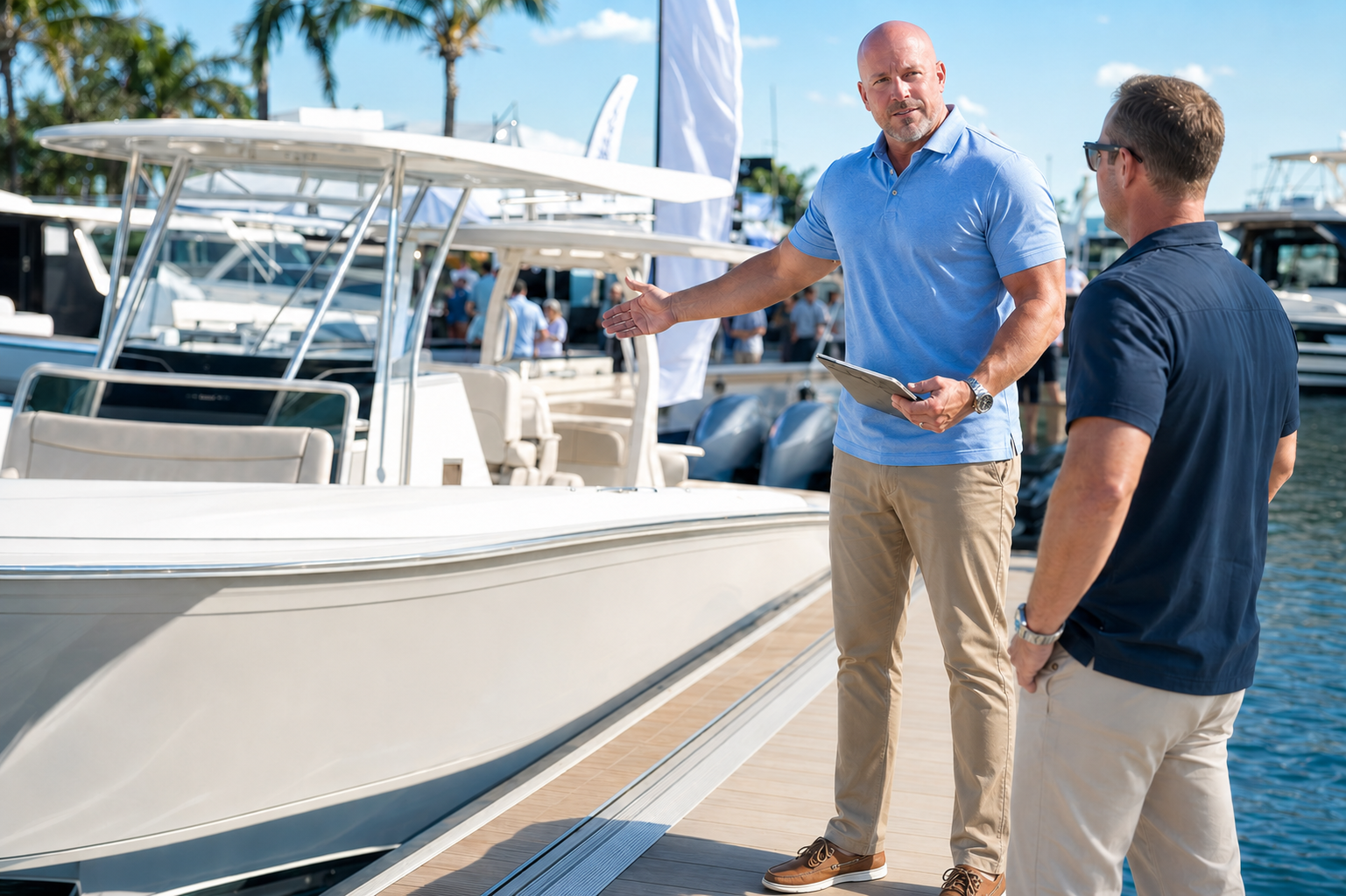
An experienced Florida yacht broker should help buyers evaluate vessels, understand market value, arrange inspections, negotiate terms, and navigate the purchase through closing
Buying a boat or yacht in Florida can involve much more than finding an attractive listing. A Florida yacht broker can help you narrow the search, arrange showings, coordinate survey and sea-trial steps, negotiate an offer, and keep the purchase moving toward a properly documented closing. The best fit understands your boating plans as well as the local waters where you expect to use the boat.
What Does a Florida Yacht Broker Do for a Buyer?
A good broker begins with the buyer, not with a particular boat. The conversation should cover the way you plan to use the vessel, the people and gear you expect to carry, preferred boating areas, your budget, and the level of ownership responsibility you are comfortable taking on. Those answers can quickly rule out boats that may look appealing online but do not fit the mission.
From there, a broker can help organize a search across featured inventory and co-broker opportunities, identify the questions to ask about a prospective boat, and coordinate showings with listing brokers or sellers. That matters when timing, location, or access can make a viewing difficult.
Professional observation: brokers who subscribe to commercial market-data services may be able to review sold-boat information and other data that are not available through every public listing. Access and coverage vary by service, so treat those reports as one input to a buying decision—not a substitute for inspecting the actual boat and its documentation.
A broker should also explain the sequence after you find a candidate: offer terms, deposit handling, survey, sea trial, negotiations, insurance or financing coordination when applicable, and closing. You should know who is responsible for each step before you commit.
Why Florida Experience Matters When Buying a Yacht
Florida is not one uniform boating environment. A boat that works beautifully for short, protected-water trips may not be the right choice for offshore fishing, frequent inlet crossings, long coastal runs, or Bahamas travel. Your broker should ask where you plan to go and how you expect to get there.
Local experience can be especially useful when discussing practical considerations such as:
- The boat's draft, bridge clearance, fuel range, and storage needs for your intended use.
- Marina access, dockage arrangements, and the amenities that matter to your crew.
- Survey and sea-trial logistics near the vessel's current location.
- Planning for inlet conditions, weather windows, fuel stops, docking, and routing on longer trips.
No broker replaces prudent seamanship, current charts, weather information, or the judgment of the person operating the boat. But a broker with meaningful Florida water time can help a buyer frame better questions about the vessel and the trips it is meant to support.
What to Ask Before You Work With a Yacht Broker
Choosing a broker is a business decision and a relationship decision. Ask direct questions before you begin:
What experience do you have with boats like mine?
Ask about the boat types, sizes, propulsion systems, and price ranges the broker works with regularly. A broker should be candid about where they have deep experience and when a specialist should be brought into the process.
How will we communicate and search?
Clarify how often you will receive options, how showings are arranged, and how the broker will compare candidate boats with your stated priorities. A disciplined search is usually more helpful than a long, unfiltered stream of listings.
What is your real boating background?
Credentials matter, but practical experience matters too. Ask about the broker's time on the water, the waters they know, and whether they have worked professionally as a captain or in another hands-on marine role. The goal is not a résumé exercise—it is to understand whether the broker can recognize the operational questions that should be raised before a purchase.
How do you handle the offer-to-closing process?
Ask who coordinates the survey and sea trial, how negotiations are handled, which closing professionals may be involved, and what documentation review is expected. You should receive a clear explanation of the process without a promise that the broker can provide legal or tax advice beyond their role.
The Typical Yacht-Buying Process in Florida
Every transaction is different, but the following sequence gives buyers a practical framework.
1. Discovery and search
Define the intended use, budget, preferred features, and timing. Your broker can then identify realistic candidates and discuss trade-offs among age, condition, equipment, location, and ownership costs.
2. Viewing and offer
Inspect the boat in person when possible. If you want to proceed, the offer should set out the price and terms, including the path for deposit, survey, sea trial, acceptance, and closing.
3. Survey and sea trial
A purchase survey and sea trial help the buyer understand condition and performance before final acceptance. Review the findings carefully and use qualified professionals for questions beyond a broker's expertise. A survey is an evaluation at a point in time, not a guarantee of future condition.
4. Negotiation and closing
Survey findings, documentation, and the agreed contract terms can affect the final negotiation. Ownership documentation deserves careful attention. Florida's official guidance states that a purchaser of a Florida-titled vessel must receive a valid title that is properly completed for transfer, and the transfer application must be filed with a county tax collector or license plate agent. Florida deadlines and fees can apply, so confirm the current requirements for your transaction before closing. [FLHSMV vessel title-transfer guidance](https://www.flhsmv.gov/motor-vehicles-tags-titles/vessels/vessel-titling-registrations/renewals-title-transfers-duplicate-certificates/)
If a title shows a lienholder, it should be addressed before or as part of closing. FLHSMV explains that liens are recorded on a paper or electronic title until satisfied, and that ownership changes require the appropriate title process. [FLHSMV liens and titles guidance](https://www.flhsmv.gov/motor-vehicles-tags-titles/liens-and-titles/)
The documentation and lien-review steps can vary with the boat's registration, title, documented-vessel status, ownership entity, and transaction terms. When a situation is complex, involve the appropriate title, documentation, legal, tax, or financing professional.
Explore Boats Available Through Jupiter Marine Sales
Start with [Jupiter Marine Sales featured boats](https://jupitermarinesales.com/featured-boats) for selected inventory, then broaden your search through the [Florida Yacht Trader MLS](https://jupitermarinesales.com/florida-yacht-trader-mls). A broker can help you compare the options against how you actually plan to use the boat.
Frequently Asked Questions
Is a yacht broker only for large yachts?
No. The value of a broker depends more on the transaction and the buyer's needs than on a label. A broker can be helpful for many types of boats when you want help finding candidates, evaluating the process, coordinating due diligence, and managing the purchase steps.
Can a broker help with boats outside their own listings?
Often, yes. Ask the broker how they work with co-broker listings and private-sale opportunities, and how they will represent your interests during the search and transaction.
What happens after an offer is accepted?
The next steps commonly include deposit arrangements, survey and sea-trial coordination, review of findings and documentation, any negotiated adjustments, and closing preparation. The exact process should be established in the purchase agreement and explained before you proceed.
Ready to Find the Right Florida Yacht?
Tell Jupiter Marine Sales how and where you plan to boat. We can help you focus the search, compare suitable options, and navigate the buying process with a practical Florida perspective. [Browse featured boats](https://jupitermarinesales.com/featured-boats) or [contact Jupiter Marine Sales](https://jupitermarinesales.com/contact) to begin the conversation.
Editorial references
- Florida Department of Highway Safety and Motor Vehicles, [Renewals, Title Transfers and Duplicate Certificates](https://www.flhsmv.gov/motor-vehicles-tags-titles/vessels/vessel-titling-registrations/renewals-title-transfers-duplicate-certificates/), accessed 2026-07-16.
- Florida Department of Highway Safety and Motor Vehicles, [Liens and Titles](https://www.flhsmv.gov/motor-vehicles-tags-titles/liens-and-titles/), accessed 2026-07-16.
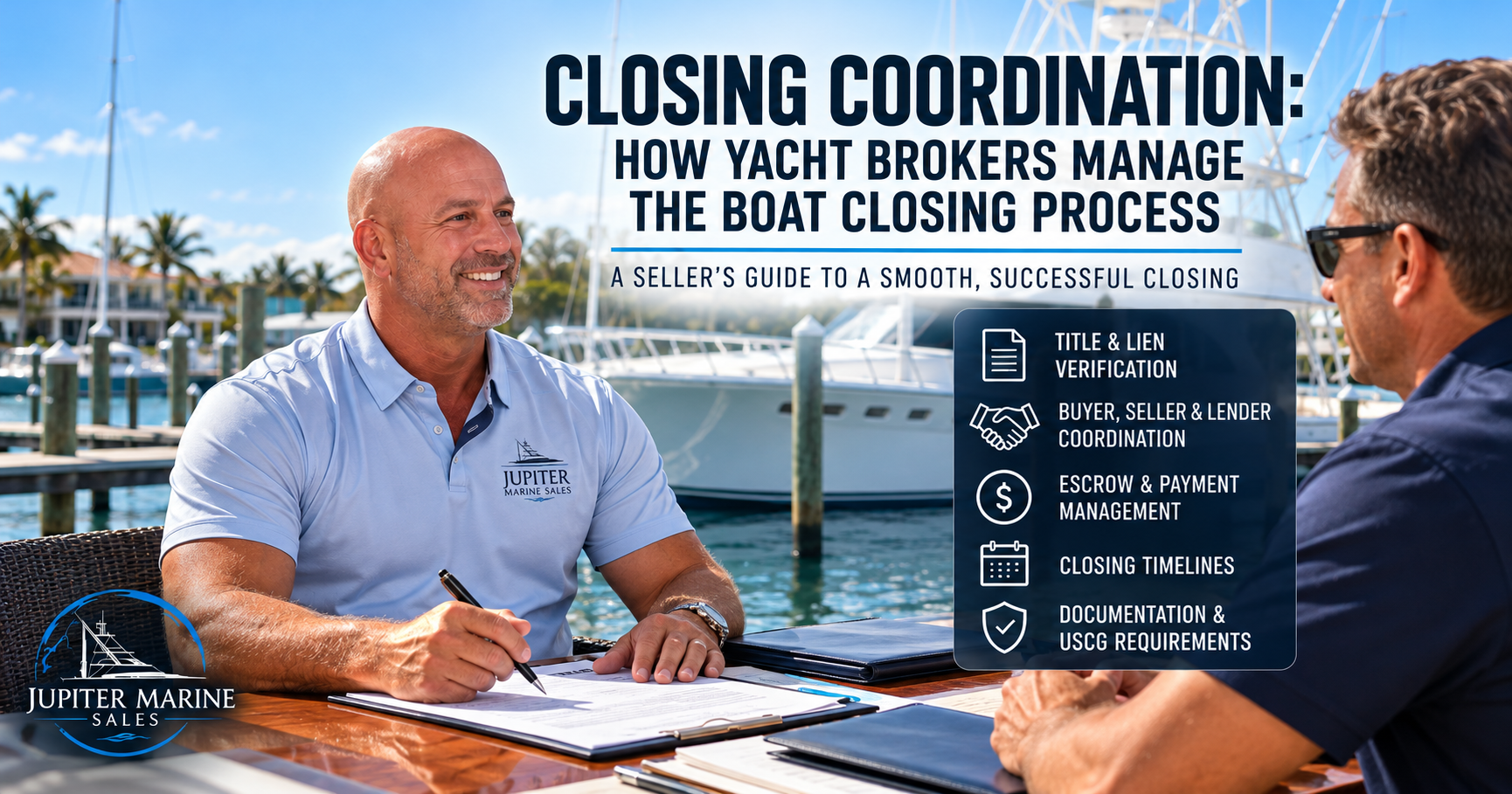
Jupiter Marine Sales | Professional Boat Selling Strategy — Article #13
A successful sea trial and survey are major milestones in selling a boat, but they do not mean the transaction is complete. Between a buyer's final acceptance and the actual closing, several importa
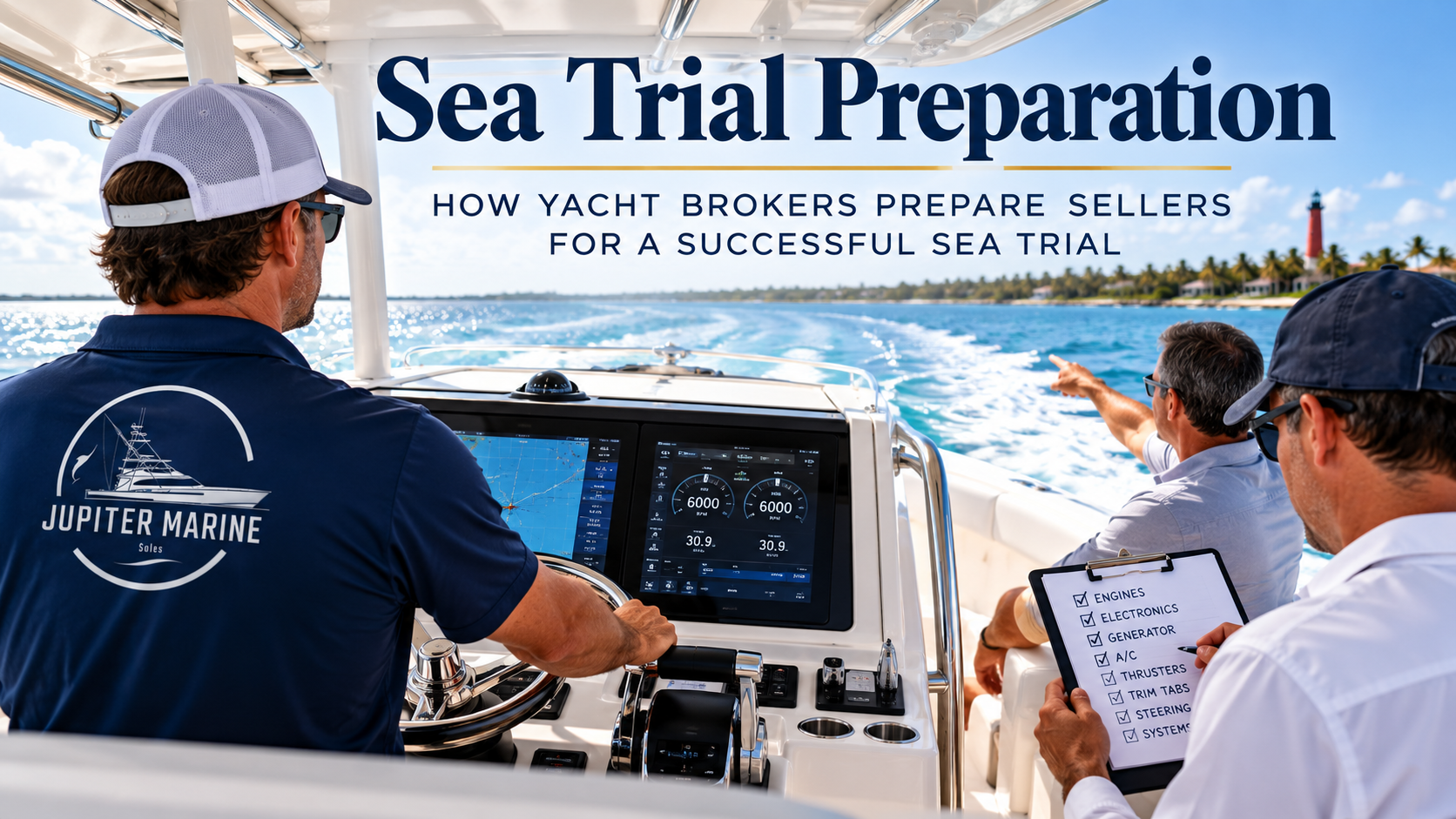
Getting a boat under contract is an important milestone in the selling process, but it is not the finish line.
After the seller accepts an offer and the purchase agreement is executed, the transaction typically moves into the buyer’s inspection and due-diligence period. For most brokerage t
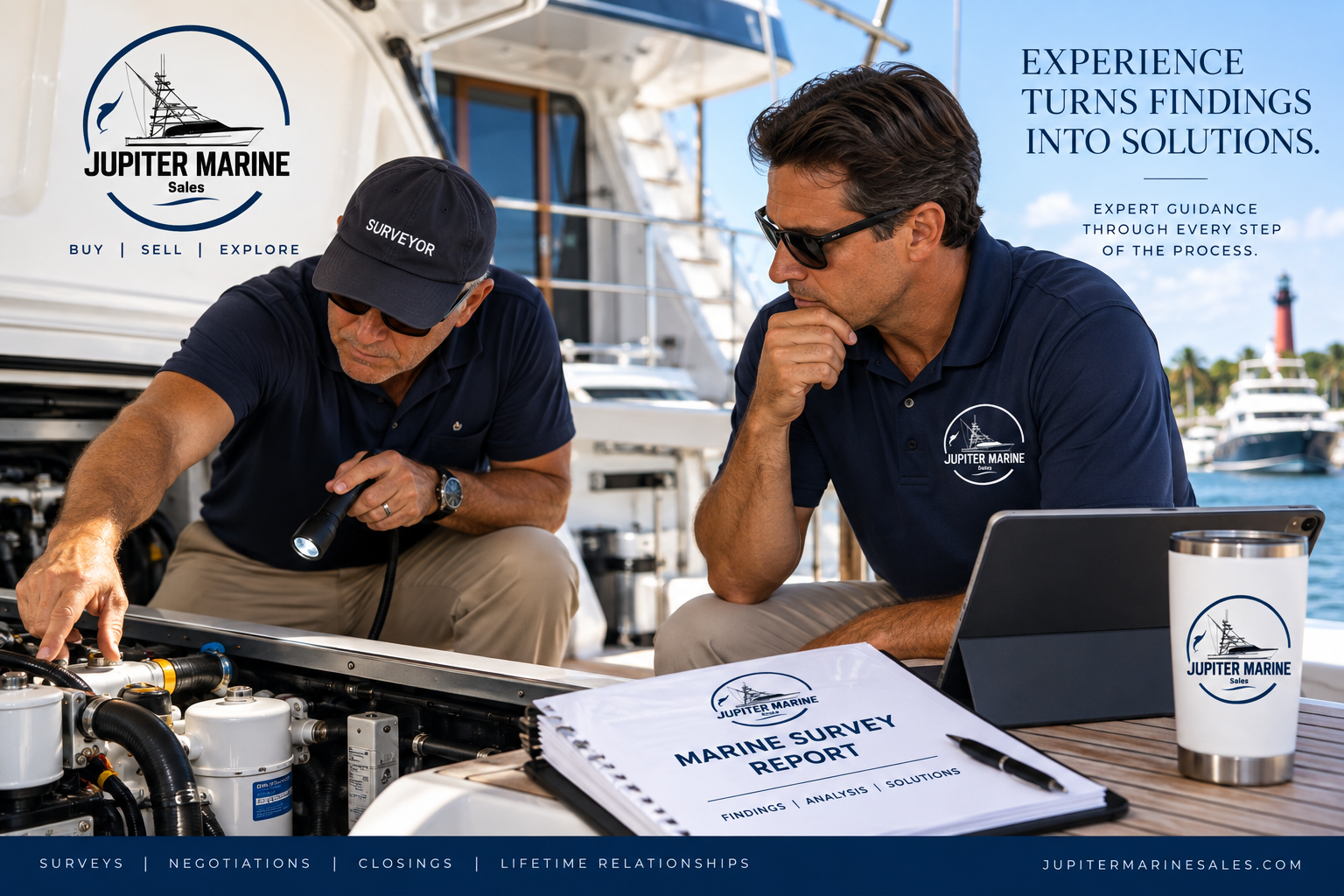
A marine survey is one of the most important stages of buying or selling a boat—but what happens after the survey can be just as important as the inspection itself.
Survey day is often where a straightforward boat transaction suddenly becomes complicated.
A surveyor m
Receiving an offer is an important milestone in the sale of a boat or yacht—but it is not the end of the process.
It is the beginning of the negotiation.
The buyer may begin below the asking price. The seller may want to counter. The parties may disagree about the deposit, survey peri