Loading...
Loading...

Professional documentation and lien coordination helps ensure boat titles, loan payoffs, USCG records, closing funds and ownership transfers are handled correctly
By Darren Diaz, Founder of Jupiter Marine Sales
Selling a boat involves more than finding a buyer, negotiating an acceptable price, completing the survey, and collecting the purchase funds.
The seller must also prove legal ownership, satisfy any outstanding loans or liens, execute the correct transfer documents, and deliver the vessel with marketable title.
On a simple transaction involving a Florida-titled boat with no loan, this process may be relatively straightforward.
A federally documented yacht with an outstanding preferred ship mortgage, corporate ownership, multiple owners, an estate, missing documents, or an older unreleased lien can be considerably more complicated.
These issues are often invisible during the listing and showing process. They may not become apparent until the transaction is already approaching closing.
That is why documentation and lien handling should begin long before closing day.
At Jupiter Marine Sales, we help sellers identify potential ownership, title, payoff, and documentation issues early. We also coordinate with qualified marine title companies, documentation specialists, lenders, closing agents, and attorneys when their expertise is required.
The objective is simple:
Make sure the seller can legally transfer the vessel, the buyer receives proper ownership, outstanding obligations are satisfied, and the transaction closes without avoidable delays.
A boat may be mechanically sound, professionally maintained, correctly priced, and under contract with a qualified buyer.
But the transaction can still fail if the ownership documents are not correct.
Common problems include:
These are not problems that should be discovered on the scheduled closing date.
The earlier they are identified, the more time the seller, broker, title company, lender, or documentation professional has to resolve them.
The first step is determining exactly how ownership is recorded.
A vessel may be:
The listing agreement should identify the same legal owner that appears in the applicable ownership record.
If the vessel is owned by an LLC or corporation, the individual signing the listing and closing documents must have authority to act for that entity.
If the vessel is jointly owned, the closing agent must determine which signatures are required.
If the titled owner is deceased, the transaction may require probate, estate documents, court orders, or other evidence establishing who has authority to sell the vessel.
A seller’s possession of the boat does not necessarily prove that the seller has the legal authority to transfer ownership.
That authority needs to be confirmed.
Ownership records must identify the correct vessel.
That means verifying more than the year, manufacturer, and model.
Important identifying information may include:
The hull identification number is particularly important because it identifies the specific vessel being sold.
Two boats may share the same year, manufacturer, model, color, and general specifications. The hull identification number distinguishes one from the other.
A transposed digit, incorrect character, undocumented hull modification, or discrepancy between the physical hull and ownership paperwork can delay the transfer.
The broker, seller, and closing professional should compare the available records with the vessel before closing.
Many recreational boats in Florida are titled through the Florida Department of Highway Safety and Motor Vehicles.
When ownership of a Florida-titled vessel is transferred, the title and supporting documents must be properly completed.
Depending on the transaction, the closing package may include:
Under Florida law, a transferor generally must sign and deliver the applicable title or ownership record to the transferee. A new owner must then complete the required title-transfer process.
The exact requirements can depend on whether the title is paper or electronic, whether a lien exists, how the vessel is owned, and whether the transaction involves another state.
Sellers should not assume that signing a basic bill of sale automatically resolves every title requirement.
The title and state ownership records still need to be transferred correctly.
Official information about Florida vessel titles and registrations is available through the Florida Department of Highway Safety and Motor Vehicles.
A missing title does not necessarily prevent a sale, but it can delay one.
If a paper title has been lost, destroyed, or misplaced, the titled owner may need to obtain a duplicate before the transfer can be completed.
If the vessel has an electronic title, the parties may need to follow the procedures required by the state, county tax collector, or closing professional.
Problems become more complicated when:
These situations should be addressed before the boat is placed under contract whenever possible.
Larger vessels are frequently documented through the United States Coast Guard’s National Vessel Documentation Center.
A Certificate of Documentation is not the same as a Florida vessel title.
When a documented vessel changes ownership, the parties may need to prepare and file documents such as:
The appropriate filings depend on what the buyer intends to do with the vessel and how the transaction is structured.
The buyer may want to:
Those decisions should be made before closing because they affect the required paperwork.
The USCG National Vessel Documentation Center provides official forms and instructions for bills of sale, documentation exchanges, mortgage filings, mortgage satisfactions, deletions, and ownership-record requests.
For a federally documented vessel, a closing or documentation professional may order an Abstract of Title from the National Vessel Documentation Center.
An Abstract of Title can provide important information about the vessel’s federal ownership record, including recorded:
This can help the closing professional review the documented chain of ownership and identify recorded encumbrances requiring attention.
However, buyers and sellers should understand an important limitation:
A federal Abstract of Title is valuable, but it should not automatically be treated as proof that no possible maritime claim exists.
Certain maritime liens or claims may arise through operation of law and may not always appear in the same manner as a recorded preferred ship mortgage.
When circumstances warrant additional investigation, the parties should consult an experienced marine title professional or maritime attorney.
A seller can usually sell a boat that still has an outstanding loan.
The loan simply needs to be handled correctly during closing.
The seller should provide accurate lender information early in the transaction so the closing professional can request a written payoff statement.
The payoff statement may identify:
Obtaining a payoff statement commonly takes approximately 48–72 hours, although some lenders may require longer.
The seller should never estimate the payoff from an online account balance.
The amount required to fully satisfy a marine loan may include accrued interest, per-diem interest, fees, late charges, or other amounts that do not appear in the principal balance shown online.
The closing professional needs an official payoff amount and verified payment instructions.
A Florida-titled vessel may have a lien recorded through the state title system.
When the debt is paid, the lienholder must provide the appropriate satisfaction or release so the lien can be removed from the ownership record.
A seller who paid off a boat years ago should not automatically assume that the lien was properly released.
We have seen situations in which:
An old lien can create a major closing problem even when the underlying debt was paid in full.
Resolving it may require contacting the original lender, its successor, or the appropriate state agency and obtaining acceptable proof of satisfaction.
That process can take time.
When a federally documented vessel is financed, the lender may record a preferred ship mortgage with the National Vessel Documentation Center.
A preferred ship mortgage does not disappear merely because the seller says the loan has been paid.
The appropriate satisfaction or release must be properly executed and filed.
USCG requirements generally call for the release to identify the vessel, official number, mortgagor, mortgagee, amount, and recorded instrument being released. The release must also be signed by or on behalf of the appropriate mortgagee and properly acknowledged.
If the original lender was acquired, merged, or renamed, additional information may be required to establish the authority of the institution signing the release.
This is one reason documented-vessel closings should be handled by professionals familiar with National Vessel Documentation Center requirements.
A small mistake in the release instrument can cause the filing to be rejected or leave the mortgage appearing in the vessel’s federal record.
When a seller has an outstanding vessel loan, the closing statement generally accounts for the payoff.
A simplified transaction may work as follows:
The precise order depends on the purchase agreement, lender requirements, closing instructions, title status, and documentation structure.
The boat should not be released simply because the buyer says the funds were sent.
The seller, broker, and closing agent should confirm that funds have been received and that the conditions required for delivery have been satisfied.
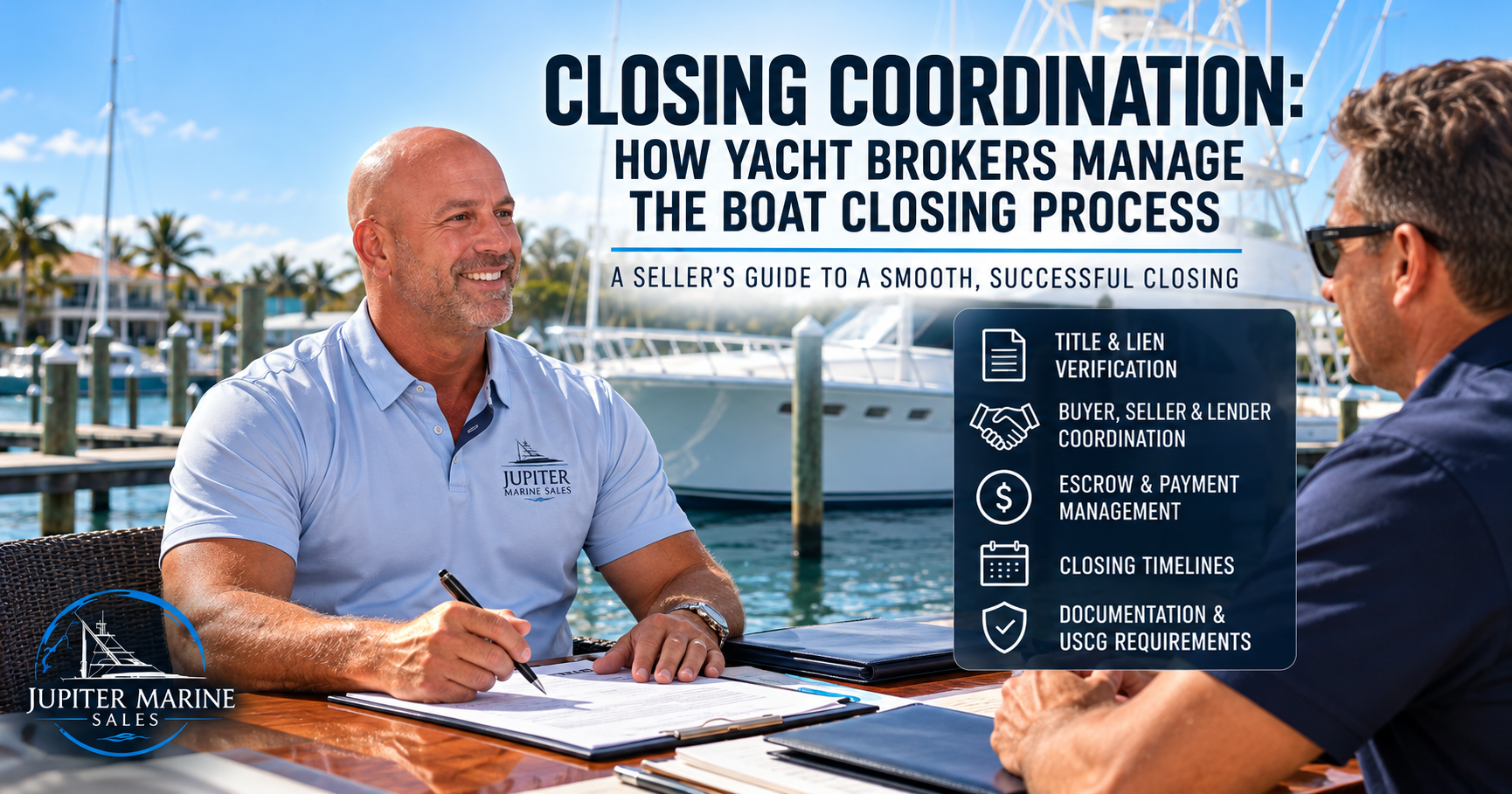
Our previous article, Closing Coordination: How Yacht Brokers Manage the Boat Closing Process, explains how the broker coordinates these final transaction requirements.
Wire fraud is a serious risk in boat and yacht transactions.
Buyers and sellers should independently verify wire instructions using a known and trusted telephone number before sending money.
Do not rely solely on:
Fraudsters frequently target high-value transactions by impersonating brokers, title companies, lenders, buyers, sellers, or closing agents.
A telephone verification takes only a few minutes.
Sending money to a fraudulent account can create a problem that no closing document can easily repair.
Every transaction is different, but a boat-closing package may include:
The appropriate documents depend on the vessel and transaction.
A small center console with a Florida title does not require the same closing package as a financed, federally documented yacht owned by a corporation.
Additional documentation may be required when a vessel is not owned by an individual.
For an LLC or corporation, the closing professional may request:
For a trust, the parties may need appropriate trust documentation and evidence establishing the trustee’s authority.
For an estate, the closing may require:
These transactions should not be treated like routine individual sales.
The person physically possessing or operating the vessel may not necessarily have authority to transfer it.
Jupiter Marine Sales strongly encourages buyers and sellers to use qualified marine title, documentation, and closing professionals.
However, a buyer may sometimes choose to handle the state-title transfer, USCG transfer, or deletion independently.
When that happens, the closing paperwork should clearly document the buyer’s decision and responsibility.
A suitable acknowledgment should explain that:
This acknowledgment does not eliminate every possible issue, but it creates a written record of the buyer’s decision.
The broker should not represent that the transfer has been completed when the buyer has elected to complete it after closing.
Many closing delays are preventable.
The most common problems include:
A duplicate may need to be obtained before closing.
The person selling the boat may use a nickname, middle name, former married name, trust, LLC, or corporate name that does not match the ownership record.
A previous private sale may never have been properly transferred.
The seller must obtain an acceptable lien satisfaction from the lender or successor institution.
Interest continues to accrue, making the previous payoff statement insufficient.
The seller may need legal or corporate documentation establishing who can transfer the entity’s property.
Multiple owners may be required to execute documents.
The title, registration, physical hull, listing, survey, and closing documents must identify the correct vessel.
Deletion or other federal records may be required before a state title can be issued.
Financing may require updated surveys, insurance binders, ownership searches, mortgage filings, entity documents, or other conditions.
A document may be rejected if it is signed by the wrong party, lacks the signer’s legal capacity, or does not contain the required acknowledgment.
The best time to discover a title problem is before the boat goes under contract.
Early review gives the seller time to:
A buyer may have deadlines involving financing, insurance, delivery, dockage, transportation, or the sale of another boat.
Discovering a documentation problem immediately before closing can disrupt all of those arrangements.
Preparation protects the seller’s transaction and gives the buyer confidence that the ownership transfer is being handled professionally.
A yacht broker is not a substitute for a maritime attorney, title company, lender, tax professional, or National Vessel Documentation Center specialist.
The broker’s role is to recognize the transaction’s requirements and coordinate the appropriate parties.
At Jupiter Marine Sales, that may include:
The objective is not for the broker to practice law or make title determinations outside the broker’s expertise.
The objective is to prevent important issues from being ignored.
Marine transactions can involve state title laws, federal vessel documentation, preferred ship mortgages, maritime claims, lender requirements, tax questions, entity ownership, and interstate transfers.
A professional who regularly handles marine closings understands how these systems interact.
Qualified marine title and documentation professionals can assist with:
Using a professional does not guarantee that every transaction will be complication-free.
It does significantly reduce the likelihood that an important ownership, lien, payoff, or filing requirement will be overlooked.
Before listing or accepting an offer, sellers should begin gathering:
The earlier this information is assembled, the easier it becomes to identify missing items.
Yes. Boats are commonly sold while a loan remains outstanding.
The closing professional typically obtains an official payoff statement and uses the seller’s closing proceeds to satisfy the loan. The lender then provides the appropriate lien or mortgage release.
Many lenders can provide a written payoff within approximately 48–72 hours, but timing varies.
Sellers should request the payoff early and confirm how long the lender will take to issue the title, lien release, or preferred ship mortgage satisfaction after receiving payment.
No.
Federal vessel documentation and state titling are separate systems. A documented vessel may still have state registration requirements, depending on where and how it is operated.
The parties should use qualified professionals to determine the requirements for the specific vessel and transaction.
A preferred ship mortgage is a mortgage recorded against a federally documented vessel.
If the vessel is sold while the mortgage remains active, the debt generally must be paid and the appropriate satisfaction or release filed with the National Vessel Documentation Center.
A bill of sale may be an important ownership document, but it does not automatically satisfy every state-title or federal-documentation requirement.
The transaction still needs to comply with the applicable ownership-transfer procedures.
The seller will generally need to obtain an acceptable lien satisfaction from the lender or its successor.
This can take time, particularly when the loan was paid many years ago or the original financial institution no longer operates under the same name.
Generally, possession should not be transferred until the required funds have been received and the closing agent has authorized delivery according to the purchase agreement and closing instructions.
Sending a wire and receiving a wire are not the same thing.
An Abstract of Title can identify recorded federal ownership instruments, preferred ship mortgages, satisfactions, and notices of claim of lien.
It should not automatically be treated as a guarantee that no other possible maritime claim exists. Qualified marine title professionals or maritime attorneys should be consulted when additional investigation is appropriate.
The buyer may elect to handle certain filings independently.
That decision should be documented in writing, and the buyer should acknowledge responsibility for properly completing the state title, registration, USCG documentation, deletion, tax, or other applicable requirements.
Marketing brings buyers to the boat.
Professional showings create interest.
Negotiations establish the price and terms.
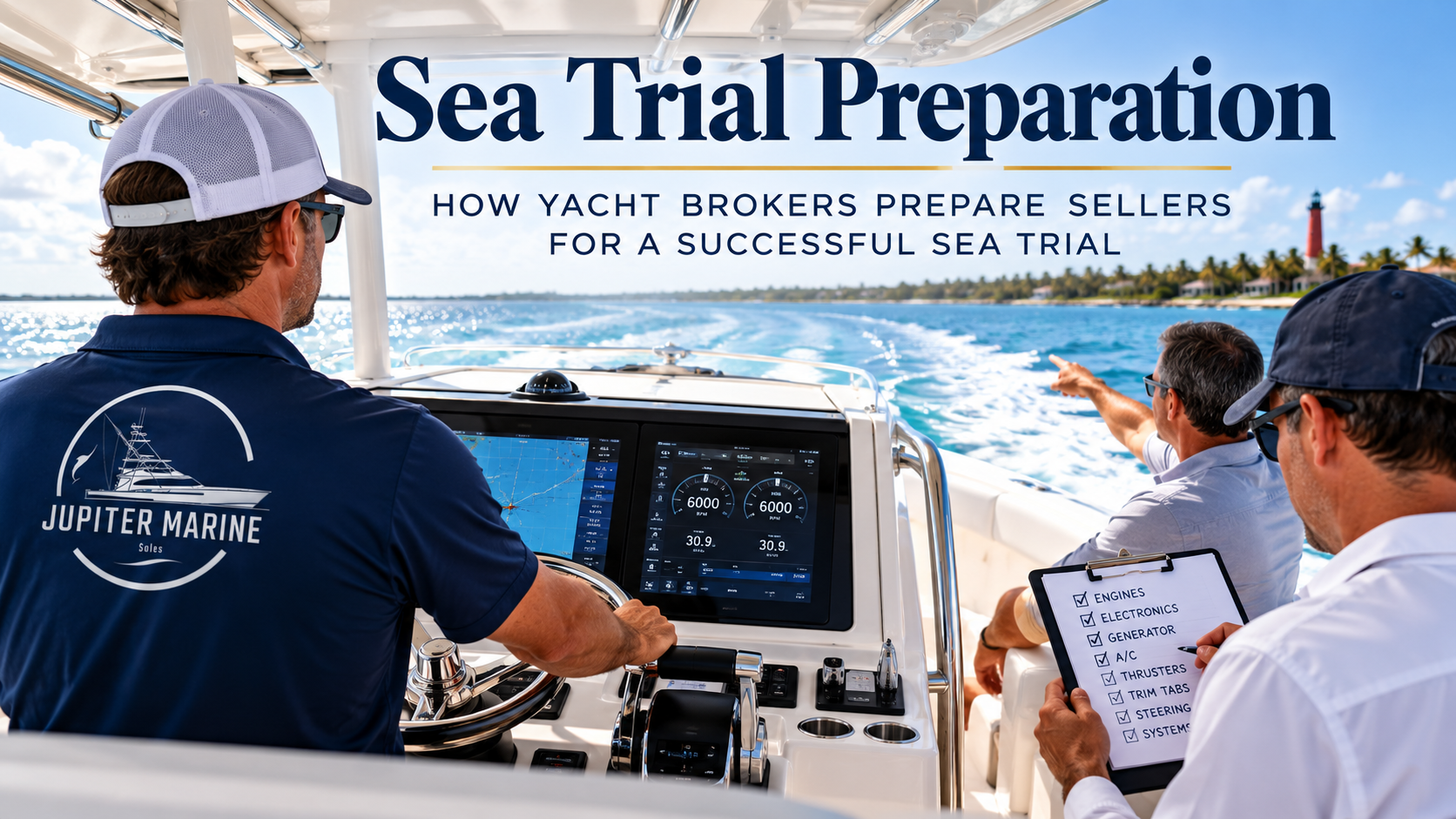
The survey and sea trial help the buyer evaluate the vessel.
Closing coordination brings the people, documents, funds, and deadlines together.
But documentation is what completes the ownership transfer.
A missing signature, unresolved lien, incorrect owner, outdated payoff, or unrecorded mortgage satisfaction can delay an otherwise successful transaction.
At Jupiter Marine Sales, we believe these issues should be addressed proactively.
That means reviewing ownership early, identifying liens, obtaining accurate payoff information, coordinating qualified professionals, and making sure the seller understands what must happen before the boat is released.
A professional boat sale is not complete when the buyer says yes.
It is complete when the funds, ownership documents, lien releases, closing records, and delivery have all been properly coordinated.
Jupiter Marine Sales helps owners manage the complete professional brokerage process—from pricing, photography, advertising, buyer qualification, and showings through offers, surveys, sea trials, negotiations, documentation, lien payoffs, closing, and delivery.
Our team has handled hundreds of boat transactions and understands how quickly a title, lien, lender, or documentation issue can affect a sale.
If you are considering selling your boat or yacht, contact Jupiter Marine Sales before placing it on the market.
We will help you prepare the vessel, organize the transaction, and identify the professionals needed to move the sale toward a successful closing.
You can also view our featured boats and yachts for sale.
Experience. Technology. Trust.
This article provides general educational information and does not constitute legal, tax, lending, documentation, or title advice. Requirements vary depending on the vessel, ownership structure, purchase agreement, jurisdiction, lender, and transaction. Buyers and sellers should consult qualified marine title, documentation, tax, and legal professionals regarding their specific circumstances.
Jupiter Marine Sales | Professional Boat Selling Strategy — Article #13
A successful sea trial and survey are major milestones in selling a boat, but they do not mean the transaction is complete. Between a buyer's final acceptance and the actual closing, several importa
Getting a boat under contract is an important milestone in the selling process, but it is not the finish line.
After the seller accepts an offer and the purchase agreement is executed, the transaction typically moves into the buyer’s inspection and due-diligence period. For most brokerage t
A marine survey is one of the most important stages of buying or selling a boat—but what happens after the survey can be just as important as the inspection itself.
Survey day is often where a straightforward boat transaction suddenly becomes complicated.
A surveyor m
Receiving an offer is an important milestone in the sale of a boat or yacht—but it is not the end of the process.
It is the beginning of the negotiation.
The buyer may begin below the asking price. The seller may want to counter. The parties may disagree about the deposit, survey peri