Loading...
Loading...
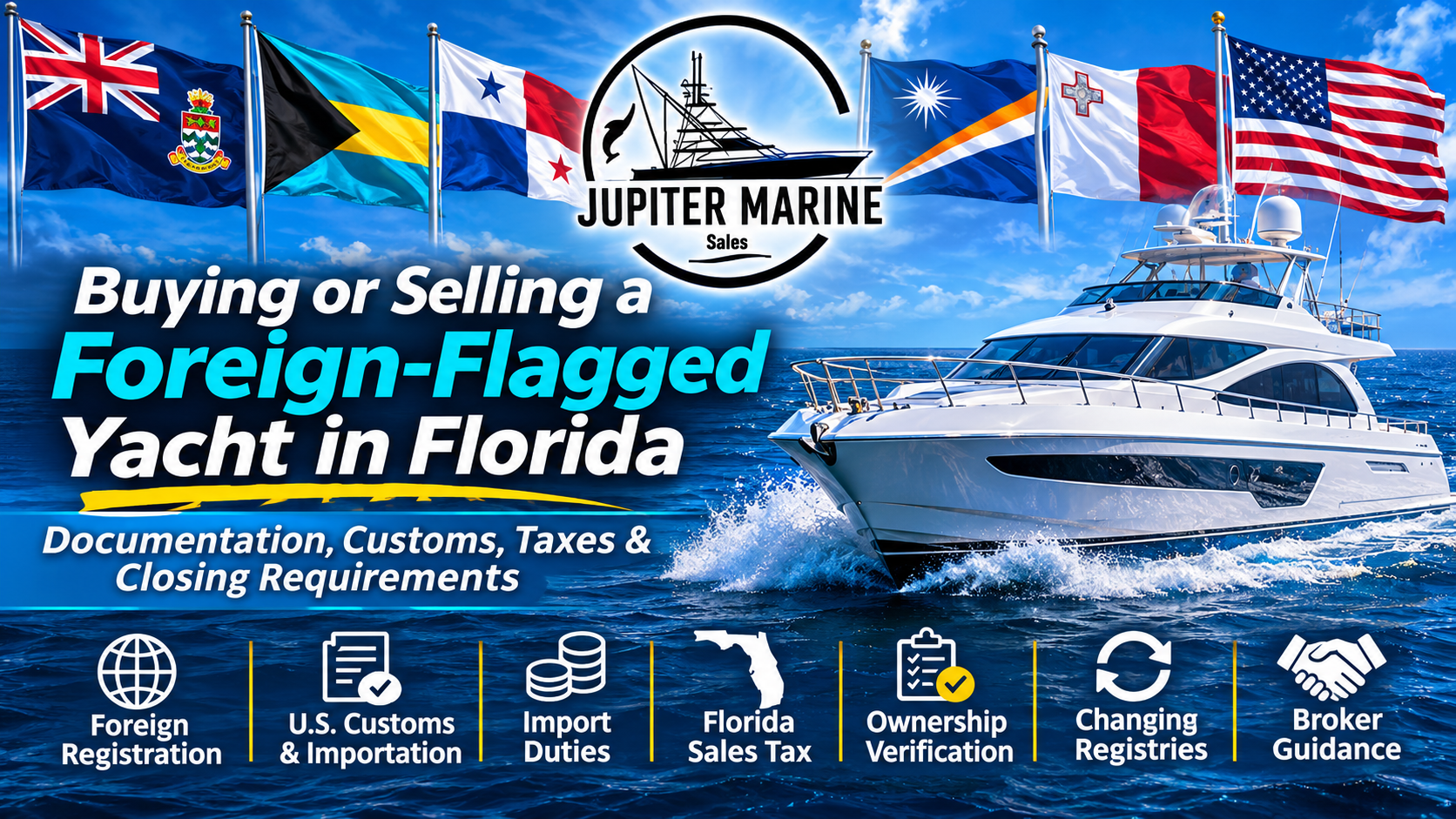
Buying or selling a foreign-flagged yacht in Florida requires careful attention to U.S. Customs regulations, import duties, vessel documentation, and tax requirements. Jupiter Marine Sales helps buyers and sellers navigate complex yacht transactions
Florida is one of the world's most active yacht markets, attracting buyers and sellers from the United States, the Bahamas, Caribbean, Europe, Central America, and beyond.
Walk through a major marina in Fort Lauderdale, Miami, Palm Beach, or Jupiter, and you'll likely see yachts registered in several different countries.
Some fly the United States flag. Others are registered in the Marshall Islands, Cayman Islands, Bahamas, British Virgin Islands, or other international jurisdictions.
While foreign registration is perfectly legitimate, buying or selling a foreign-flagged yacht in Florida can involve substantially more paperwork, regulatory considerations, and financial exposure than a typical domestic boat transaction.
A yacht may be physically located in Florida but legally registered in another country. It may have entered the United States under temporary cruising privileges, may not have been formally imported, and may be subject to customs restrictions that affect how and where it can be marketed or sold.
At Jupiter Marine Sales, we believe understanding these distinctions before signing a purchase agreement is essential to protecting both buyers and sellers.
This guide explains foreign yacht registration, U.S. Customs requirements, import duties, Florida sales tax, ownership verification, and the steps involved in successfully closing a foreign-flagged yacht transaction.
A foreign-flagged yacht is a vessel registered under the laws of a country other than the United States.
The country of registration is commonly referred to as the vessel's flag state.
That flag state establishes the yacht's nationality and has authority over various aspects of its registration, documentation, and maritime compliance.
Some of the more recognizable international yacht registries include:
Different registries have their own ownership qualifications, documentation requirements, fees, and compliance obligations.
A yacht's flag does not necessarily indicate where its owner lives, where it was built, or where it normally operates.
For example, a yacht owned by a U.S. citizen may be registered in the Cayman Islands and operate primarily in South Florida and the Bahamas.
That vessel remains foreign-flagged despite its American ownership.
There are several legitimate reasons an owner might choose foreign registration.
Owners who regularly travel between countries may select a registry that is widely recognized internationally and accommodates their cruising plans.
Larger yachts are sometimes owned through corporations or limited liability companies.
Depending on the circumstances, a foreign registry may accommodate a particular ownership structure.
Some foreign registries provide frameworks for commercial yacht registration and charter operations.
However, foreign registration does not automatically authorize a yacht to conduct charter operations in U.S. waters.
Owners and lenders may prefer particular registries based on their documentation procedures, mortgage recording systems, or other legal considerations.
Registration can also be one component of broader ownership and estate-planning arrangements.
However, registering a yacht offshore does not automatically eliminate U.S. taxes, customs duties, or other legal obligations.
JMS Broker Insight: Foreign registration is not inherently a problem. The important question is whether the yacht's registration, ownership, customs status, and intended use are properly documented and compliant.
Yes. Foreign-flagged yachts can be purchased by American and international buyers.
However, the vessel's physical location does not determine whether the transaction is straightforward.
Before proceeding, buyers should establish several important facts:
These questions should be addressed early, preferably before the buyer incurs substantial expenses for surveys, inspections, or travel.
One of the most misunderstood aspects of foreign-flagged yacht transactions is the distinction between registration and importation.
A yacht's flag establishes its nationality. Its customs status determines whether it has been properly entered into the United States and whether applicable import obligations have been satisfied.
These are two separate issues.
When a foreign-built or otherwise dutiable yacht is imported into the United States, the importer may be required to file a customs entry and pay applicable duties.
After the importation process has been properly completed, the owner should retain the customs entry and payment documentation.
Buyers should request evidence of importation rather than relying on a seller's verbal statement that the vessel is duty-paid.
A yacht may be lawfully present in U.S. waters under a temporary customs arrangement without having been entered for permanent importation.
This is not necessarily a violation.
However, restrictions can apply to its ownership, sale, charter, and use.
A vessel's temporary permission to cruise in the United States should never be confused with unrestricted authorization to sell it domestically.
Absolutely.
A foreign-flagged yacht can have completed the U.S. importation process and paid applicable duties while continuing to maintain its foreign registration.
Likewise, changing a yacht to U.S. documentation does not, by itself, establish that all customs obligations have been satisfied.
This is one of the most important issues for yacht brokers and sellers.
A foreign-flagged yacht that has not been properly imported may face restrictions on being offered for sale or charter to U.S. residents.
Under U.S. Customs regulations, offering certain dutiable yachts for sale can create customs consequences, even before an actual sale takes place.
That means a seller should not assume that placing a foreign-flagged yacht on a brokerage website is permissible simply because the vessel is docked at a Florida marina.
Imagine a foreign-flagged yacht arrives in Florida under temporary cruising privileges.
The owner decides to sell the vessel and contacts a yacht brokerage.
Before publicly advertising the yacht to U.S. buyers, the broker needs to establish whether the vessel's customs status permits the proposed marketing and sale.
Depending on the facts, importation or another legally compliant transaction structure may be required.
Simply labeling the vessel "not for sale to U.S. residents while in U.S. waters" does not automatically resolve every customs issue.
Failure to comply with applicable customs requirements can result in significant financial penalties and potentially seizure of the vessel.
JMS Broker Insight: Customs compliance should be investigated before advertising a foreign-flagged yacht, not after a buyer makes an offer.
For official information, consult U.S. Customs and Border Protection and the yacht regulations in 19 CFR § 4.94.
Import duties are another major consideration when buying or selling an internationally registered yacht.
The amount of duty owed depends on the vessel's classification, country of origin, applicable tariff provisions, entry date, and any exemptions or additional duties.
It is important not to assume that every yacht is subject to the same duty rate.
Historically, many recreational yachts have been associated with a general customs duty rate of 1.5%, but that figure should never be treated as a guaranteed total import cost.
Additional tariffs or other charges may apply, and tariff treatment can change.
A licensed customs broker should confirm the current rate and requirements for the specific vessel before a purchase agreement is finalized.
Consider a yacht valued at $1,000,000 for customs purposes.
If an applicable duty rate were 1.5%, the base duty calculation would be:
$1,000,000 × 1.5% = $15,000
However, that example excludes potential additional tariffs, fees, and professional expenses.
The actual amount could be different.
Responsibility for importation costs should be clearly addressed in the purchase agreement.
Depending on the circumstances, the seller may complete importation before closing, or the buyer may arrange importation as part of the transaction.
The parties should never leave this question unresolved.
Federal import duties and Florida sales or use taxes are separate obligations.
A yacht may be properly imported into the United States and still be subject to Florida sales or use tax.
Likewise, a Florida tax exemption does not automatically eliminate federal customs obligations.
Florida generally imposes a 6% state sales tax on taxable boat purchases, with a statutory maximum of $18,000 in state sales tax on an individual boat sale.
Certain local discretionary surtax rules and exemptions may also be relevant.
The actual tax treatment depends on the transaction and applicable law.
Florida provides specific exemptions for qualifying nonresident boat purchasers who meet statutory requirements.
These rules can involve:
Certain qualifying vessels and purchasers may be eligible for additional time under specific provisions.
JMS Broker Insight: Never assume that a foreign-flagged vessel is exempt from Florida sales tax. The buyer's residency, delivery arrangements, and statutory requirements must be evaluated separately from the yacht's flag.
For additional information, visit the Florida Department of Revenue.
Ownership verification is critical in any yacht transaction, but foreign-flagged vessels can require additional investigation.
Unlike a straightforward Florida-titled boat, a foreign-registered yacht may be owned through an offshore company or another legal entity.
The person communicating with the broker may not be the individual or entity named on the vessel's registration.
Depending on the registry and ownership structure, relevant documents may include:
Not every vessel will require every document.
However, a qualified closing professional should establish a clear chain of ownership and verify that the seller has authority to transfer the yacht.
A yacht owned by a corporation may be sold through an asset sale or, in some circumstances, a transfer of ownership interests in the company.
These transactions are not interchangeable.
Purchasing a company can expose a buyer to obligations and liabilities beyond the yacht itself.
Corporate yacht transactions should be reviewed by qualified legal and tax professionals before proceeding.
Some American buyers want to retain the yacht's foreign registration.
Others prefer to document the vessel with the United States Coast Guard.
The appropriate choice depends on citizenship, ownership structure, intended use, vessel eligibility, and other factors.
Not every vessel or ownership structure qualifies for U.S. documentation.
The buyer must satisfy applicable citizenship and ownership requirements, and the vessel must meet documentation eligibility rules.
Before a yacht is registered under a new flag, the parties generally need to coordinate termination of its existing registration.
The foreign registry may issue a Certificate of Deletion or equivalent documentation.
Requirements vary by flag state.
Recorded mortgages and other encumbrances must be addressed as part of the transfer.
A buyer should not assume that changing the vessel's flag eliminates an existing financial obligation.
The Bill of Sale should correctly identify the vessel, seller, buyer, and relevant ownership information.
Some foreign registries require specific forms, notarization, authentication, or other formalities.
If eligible, the buyer can apply through the USCG National Vessel Documentation Center.
The application may require evidence of ownership, tonnage information, and other supporting documents.
Importation and state tax obligations must be handled separately.
Foreign yacht transactions also occur in the opposite direction.
A U.S.-documented yacht may be sold to an international buyer who intends to register it in another country.
In that situation, the closing process may involve deleting the vessel from U.S. documentation.
Depending on the transaction, the National Vessel Documentation Center may require:
The timing of deletion and new registration should be coordinated carefully to avoid unnecessary gaps in documentation.
For additional guidance, consult the USCG National Vessel Documentation Center.
Mechanical inspections and sea trials remain essential when purchasing a foreign-flagged yacht.
However, the logistics can become more complicated when the vessel is operating under temporary customs privileges.
A qualified marine surveyor should inspect the vessel's condition, systems, structure, and safety equipment.
For larger yachts, the buyer may also require specialized inspections of:
The sea trial should be arranged with consideration for the vessel's location, insurance, crew, operational restrictions, and customs status.
The parties should confirm that the planned operation is permitted before departing.
Some internationally registered yachts may have equipment or certifications associated with their flag state or previous operating region.
Buyers should determine whether modifications or additional compliance steps will be needed for the vessel's intended U.S. use.
A successful survey does not establish customs compliance or guarantee eligibility for a particular registration.
Foreign registration can also affect financing and insurance options.
Some lenders may have restrictions involving:
Buyers should discuss these issues with their marine lender before making an offer.
Insurers may evaluate the yacht's flag, operating area, captain and crew qualifications, hurricane exposure, and intended use.
A vessel insured for private recreational use may not have coverage for commercial charter operations.
Buyers should confirm that insurance can be bound under the intended ownership and registration structure before closing.
Several avoidable mistakes can delay or jeopardize an international yacht transaction.
A yacht being located in Florida does not prove that it has been imported.
Request actual customs documentation.
Marketing an unimported foreign yacht to U.S. buyers can raise serious compliance issues.
Verify the rules before listing.
The individual negotiating the sale may not be the legal owner.
Confirm ownership and signing authority.
Recorded mortgages or other encumbrances can complicate transfer of ownership.
Obtain appropriate registry searches and releases.
Federal customs duties, Florida taxes, and foreign registration fees are different obligations.
Each must be evaluated independently.
Where the yacht is delivered, imported, and legally transferred can affect the transaction.
An offshore closing should never be assumed to eliminate U.S. tax or customs requirements.
Foreign registry deletions, mortgage releases, customs entries, and U.S. documentation applications may take additional time.
Begin the process early.
Foreign-flagged yacht transactions often require coordination among multiple parties.
These may include:
An experienced yacht broker helps keep these moving parts organized while identifying potential issues early in the transaction.
At Jupiter Marine Sales, our approach is to help buyers and sellers understand the process, coordinate inspections, negotiate transaction terms, and work with the appropriate professionals when specialized legal, customs, or documentation assistance is required.
A successful international yacht transaction isn't simply about agreeing on a price. It's about ensuring the vessel can be legally transferred, documented, insured, and delivered as intended.
Yes. U.S. citizens may own yachts registered in foreign jurisdictions, subject to the applicable registry's requirements and relevant U.S. laws.
Potentially, yes. Its permitted stay and operations depend on customs status, cruising privileges, reporting requirements, and other applicable rules. Foreign registration alone does not establish unlimited permission to remain.
Not necessarily in every circumstance. Duty obligations depend on how the yacht enters and is used in the United States, its ownership and intended sale, and the applicable tariff provisions.
Some transaction structures may be permissible, but the answer depends on the specific facts and customs regulations. A vessel's location, buyer residency, entry status, and marketing arrangements can all matter. Consult a qualified customs professional before advertising or contracting for the sale.
Potentially, if the vessel and new owner satisfy U.S. documentation requirements. The existing foreign registration generally must be terminated and the required ownership documents submitted.
No. Foreign registration alone does not create an automatic Florida sales tax exemption.
Foreign registration does not automatically authorize commercial charter operations in U.S. waters. Charter legality depends on federal coastwise laws, vessel status, operating arrangements, and other requirements.
Working with a knowledgeable yacht broker can help coordinate negotiations, inspections, documentation, and closing logistics. For complex transactions, qualified maritime legal and customs professionals may also be necessary.
Buying or selling a foreign-flagged yacht can be a rewarding opportunity.
Internationally registered vessels represent a substantial portion of the larger yacht market, and many are exceptionally well-maintained, professionally operated yachts.
However, the transaction requires more than a standard purchase agreement and a successful sea trial.
Buyers and sellers must understand the vessel's registration, ownership, customs status, potential import duties, tax obligations, and closing requirements.
The most expensive mistakes often occur when these issues are overlooked until the final stages of a transaction.
The best approach is to identify potential complications before making commitments, not after the money is on the line.
Whether you're purchasing an internationally registered yacht, selling a foreign-flagged vessel, or planning to transfer a yacht into or out of U.S. documentation, Jupiter Marine Sales can help coordinate the brokerage process.
Our team works with buyers and sellers throughout Florida and beyond, helping manage the details that make yacht transactions successful.
Jupiter Marine Sales — Experience, Integrity & Results.
Article Series: The Complete Guide to Buying and Selling Boats Through a Yacht Broker
Article #16: Buying or Selling a Foreign-Flagged Yacht in Florida
Previous Article: International Buyer Transactions
Next Article #17: Yacht Trade-Ins: How Trading Your Boat Toward Another Vessel Works
Author: Jupiter Marine Sales Editorial Team
Professional Boat-Selling Strategy — Article 15
Previous Article: Documentation and Lien Handl

By Darren Diaz, Founder of Jupiter Marine Sales
Selling a boat involves more than finding a buyer, negotiating an acceptable price, completing the survey, and collecting the purchase funds.<
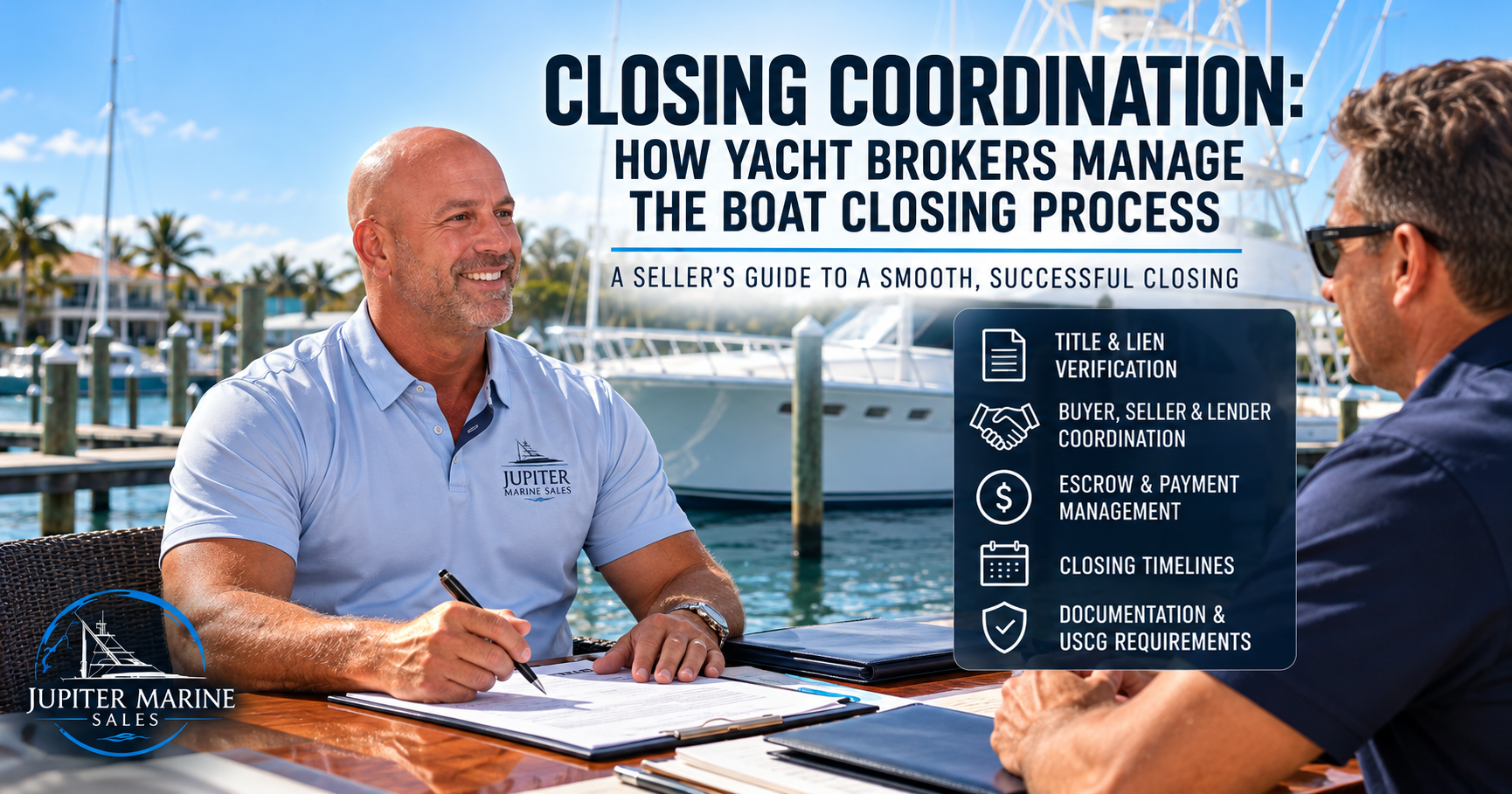
Jupiter Marine Sales | Professional Boat Selling Strategy — Article #13
A successful sea trial and survey are major milestones in selling a boat, but they do not mean the transaction is complete. Between a buyer's final acceptance and the actual closing, several importa
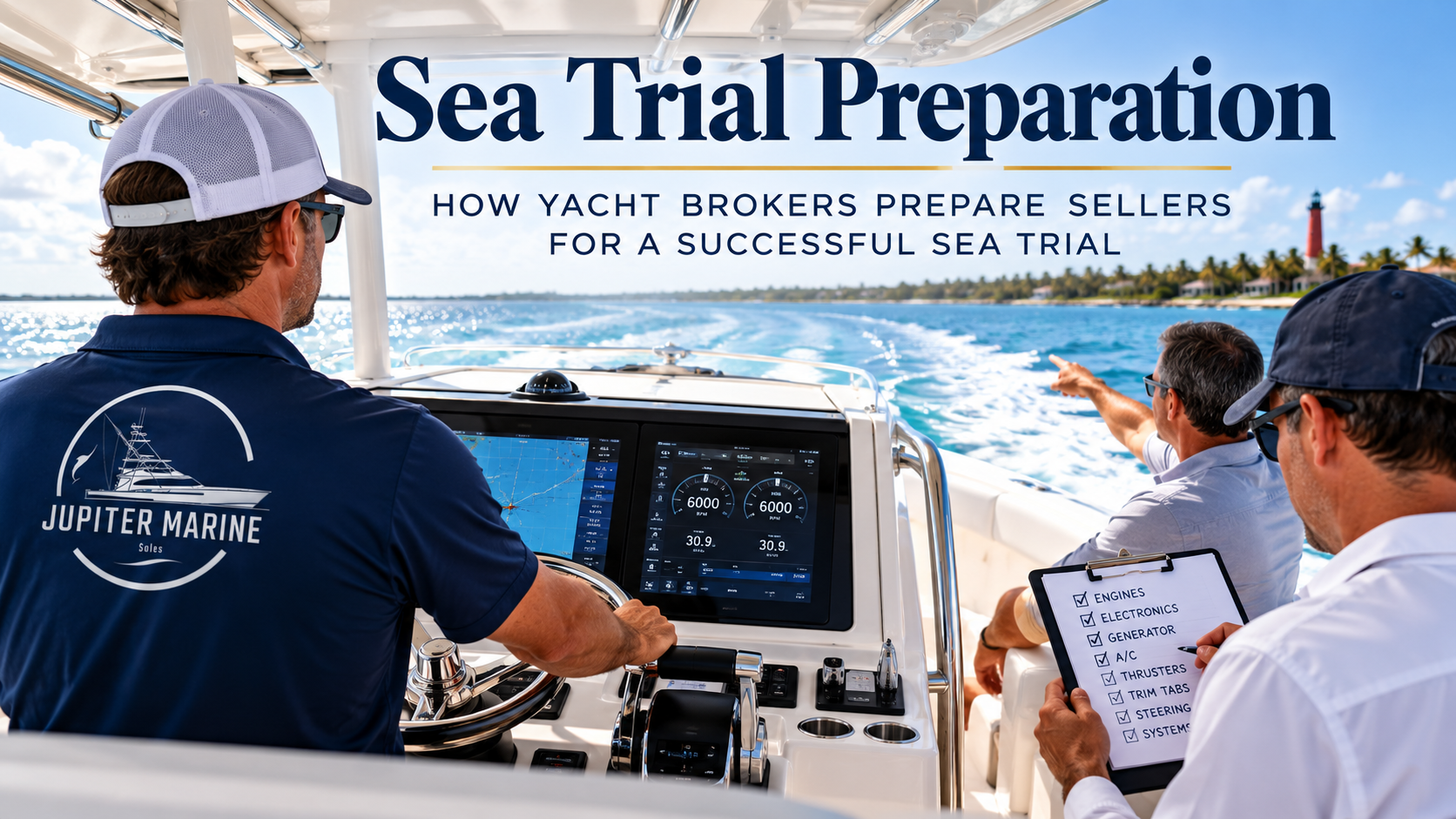
Getting a boat under contract is an important milestone in the selling process, but it is not the finish line.
After the seller accepts an offer and the purchase agreement is executed, the transaction typically moves into the buyer’s inspection and due-diligence period. For most brokerage t