Loading...
Loading...
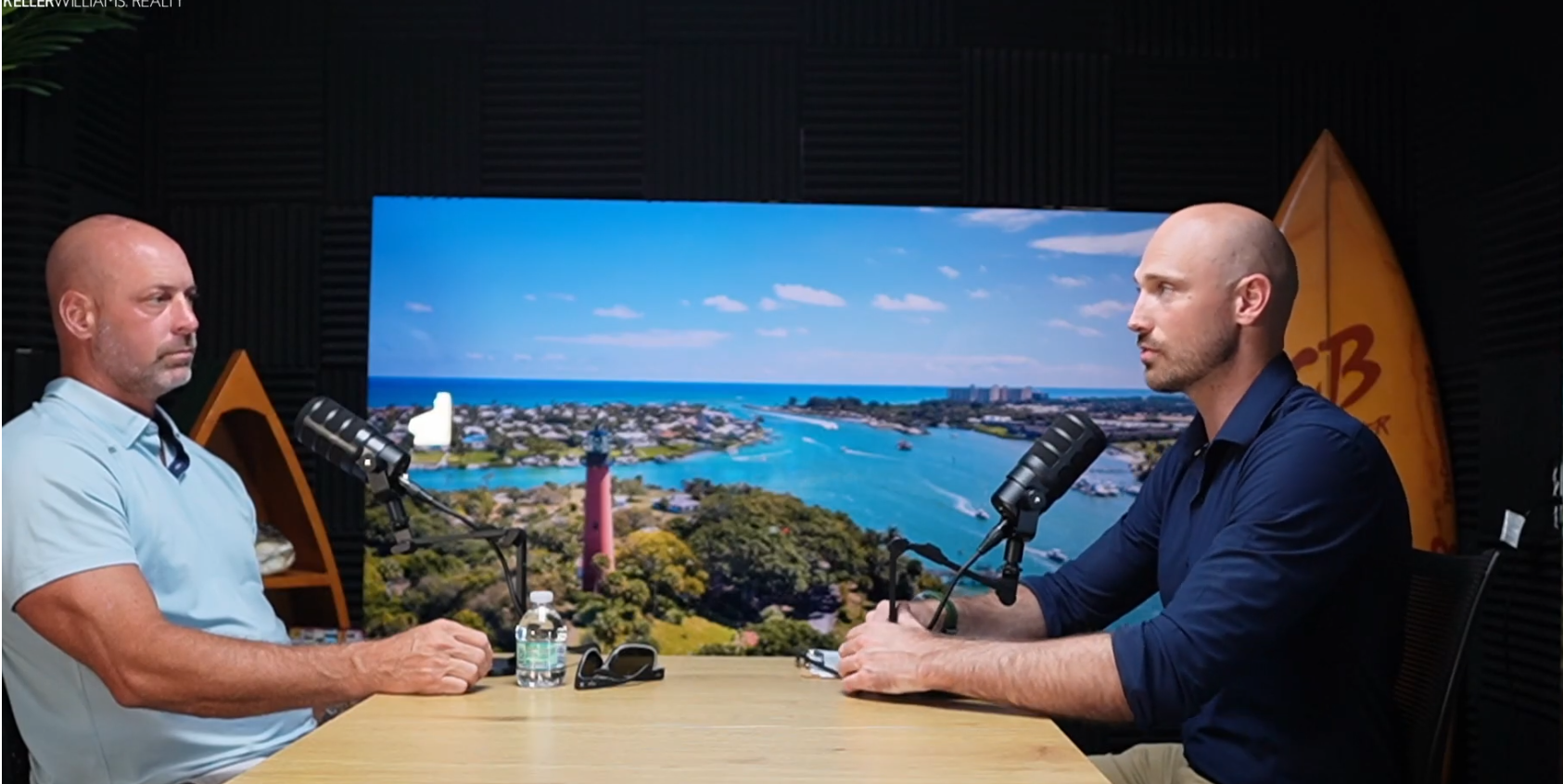
Darren Diaz joins Jamin Goecker of Palm Beach County Living to discuss moving to Jupiter, waterfront homeownership, boat ownership, hurricanes, and building a South Florida marine business
I recently sat down with Jamin Goecker from Palm Beach County Living for a wide-ranging conversation about moving to Jupiter, boating in South Florida, raising a family in Palm Beach County, and building Jupiter Marine Sales and Florida Yacht Trader.
What started as a discussion about buying a home and boat in Jupiter quickly became a much broader conversation about the realities of living here—the good, the expensive, the unpredictable, and the reasons so many of us would not want to live anywhere else.
We talked about everything from hurricanes and homeownership to restaurants, schools, yacht brokerage, boat maintenance, artificial intelligence, and why an honest yacht broker should occasionally talk someone out of buying a boat.
You can watch the full conversation on YouTube.
I came to South Florida from Chicago, so moving here meant adjusting to an entirely different pace of life.
Fort Lauderdale was my first real introduction to the Florida boating industry. I had always wanted to become a professional boat captain, and South Florida was the place where that dream could become a career.
Eventually, I became a charter captain and earned my 100-ton Master Captain’s license.
From the outside, running yachts and taking people boating in South Florida sounds like an ideal job—and in many ways, it was. I was able to spend my days on the water, operate beautiful vessels, fish, travel, and meet people from all over the world.
But professional captaining is not the permanent vacation people sometimes imagine.
The hours can be brutal. You are responsible for the vessel, the passengers, the weather, the mechanical systems, the schedule, and everyone’s safety. If something goes wrong, you cannot simply walk away from it.
There were days when I operated in rough conditions and seas approaching 10 feet. There were also countless hours spent cleaning, maintaining, preparing, and repairing boats after the guests had gone home.
That experience taught me something that still guides the way I work today: boats are meant to be enjoyed, but they must also be respected and maintained.
After living farther south, Jupiter felt different.
It had the Florida lifestyle we wanted without feeling like an endless concrete city. Jupiter still had a small-town quality, good schools, safer neighborhoods, and a strong sense of community.
You could be close to the ocean, fishing, golf, restaurants, parks, and everything Palm Beach County offers while still feeling slightly removed from the heavier congestion farther south.
For me, Jupiter offered a better balance.
It is difficult to overstate how much the area has grown since then. The restaurants, businesses, housing market, and population have all changed. However, Jupiter has managed to retain much of the character that originally attracted us.
People jokingly say, “Jupiter is closed,” because those of us who live here understand why so many people want to move here.
Affordability is relative, especially for people relocating from other major metropolitan areas.
South Florida housing has become significantly more expensive, but someone moving from Chicago, New York, New Jersey, or another high-cost market may evaluate those prices differently than a longtime Florida resident.
The important thing is to look beyond the purchase price.
Florida homeowners also need to consider:
Newer Florida homes generally benefit from stronger building codes and improved hurricane standards. Older houses can still be excellent purchases, but buyers should understand how the property was constructed and what may need to be updated.
The least expensive house is not always the least expensive house to own.
Hurricanes are part of living in Florida, but it can be difficult to appreciate their power until you experience one directly.
Hurricane Wilma changed my perspective.
The storm caused tremendous damage, and the aftermath continued long after the winds stopped. Boats had to be recovered and cleaned, properties needed repairs, debris was everywhere, and normal life did not immediately resume.
Experiencing a major storm as a resident and property owner is very different from watching hurricane coverage on television.
It teaches you to take preparation seriously.
That does not mean living in constant fear. It means understanding your elevation, drainage, construction, insurance coverage, evacuation plan, and responsibilities as a homeowner or boat owner.
People in the Midwest prepare for tornadoes and winter storms. Floridians prepare for hurricanes, flooding, heat, and power outages. Every region has risks; the key is understanding the ones that come with where you choose to live.
Despite the storms and rising costs, the Jupiter lifestyle is hard to beat.
On the right day, living here can feel a little like living in the Bahamas. The water can be beautiful, the fishing is excellent, and you can spend a large part of the year outside.
Boating is obviously a major part of that lifestyle, but Jupiter also has tremendous golf, beaches, parks, paddleboarding, diving, and nearby shopping.
The restaurant scene has improved dramatically over the years. Local places such as Dune Dog, Food Shack, and Hog Snappers have become part of the area’s identity.
Jupiter is not Miami, and most residents do not want it to become Miami. But Palm Beach Gardens, West Palm Beach, Fort Lauderdale, and Miami are accessible when you want a larger-city experience.
For families, one of the greatest advantages is the opportunity for children to stay active outdoors throughout the year. Florida kids can fish, boat, dive, golf, play sports, and spend time outside during months when families elsewhere are stuck indoors.
My years as a captain eventually led me into the brokerage side of the marine industry.
Knowing how to operate a boat is valuable, but understanding how boats are maintained and how they actually behave on the water is equally important when helping someone buy one.
A boat can look fantastic in photographs and still be completely wrong for a buyer.
The wrong boat may be too large for the owner’s experience, too expensive to maintain, unsuitable for the intended use, or incompatible with the home, dock, lift, water depth, or bridge clearance.
That is why I believe a good yacht broker needs to do more than sell.
Sometimes the best advice I can give a customer is not to buy the boat they originally called about.
That may not create the fastest commission, but it creates trust—and it can save a buyer from an expensive mistake.
Jupiter Marine Sales grew from that philosophy. Over time, we expanded beyond Jupiter and added representation in other parts of Florida, including the West Coast.
The business has changed significantly, but the underlying goal has remained the same: give people honest guidance based on real boating experience.
Many people moving to Jupiter picture buying a waterfront home and placing a boat behind it.
It is a great dream, but the home and the boat must work together.
Before purchasing a waterfront home, you need to know whether the dock can physically accommodate the type of boat you want.
Water depth, fixed bridges, canal width, dockage, lift capacity, tides, current, and the distance to the inlet can all affect which boat makes sense.
A lift advertised as having a certain capacity may not safely hold a boat once fuel, water, batteries, accessories, and equipment are added. A boat that fits at high tide might not be able to leave at low tide. A center console with a tower may not fit beneath a fixed bridge.
These are details a first-time Florida buyer may not consider while touring an otherwise beautiful home.
Ideally, the real estate agent, marine contractor, and yacht broker should help the buyer evaluate the complete picture before the home or boat is purchased.
The price of the boat is only the beginning.
Fuel, insurance, maintenance, storage, washing, engine service, repairs, safety equipment, and hurricane planning are all part of ownership.
The amount varies enormously depending on the boat. A straightforward outboard-powered center console is very different from a yacht with diesel engines, a generator, air conditioning, plumbing, refrigeration, and multiple onboard systems.
Buyers also need to be honest about how frequently they will use the boat.
Boats do not necessarily benefit from sitting untouched. Engines, pumps, batteries, fuel systems, seals, and electronics should be operated and monitored regularly.
If you are only going to use a boat a few times a year, you may need someone to maintain it, inspect it, and exercise its systems between trips.
The question is not simply whether you can afford to buy the boat. It is whether the boat fits your lifestyle well enough that you will use and maintain it.
Saltwater boating requires discipline.
Salt, heat, humidity, and the Florida sun attack nearly everything on a boat. Engines need to be flushed when appropriate, decks and hardware need to be rinsed, upholstery must be cleaned, and small maintenance concerns need to be handled before they become major repairs.
A neglected boat can deteriorate quickly in South Florida.
This is one reason service history matters so much when purchasing a used boat. Low engine hours do not automatically mean a boat has been properly maintained. Sometimes a boat that has been used regularly and professionally serviced is a much better purchase than one that has been sitting.
Maintenance records tell a story that an hour meter cannot tell by itself.
During the interview, we discussed several types of boats that can work well for new owners.
There is no universal answer because a fishing family has different needs than someone who primarily wants to cruise to restaurants or spend afternoons at the sandbar.
Sea Hunt center consoles can offer an approachable combination of performance, fishing features, and value. Family-oriented dual consoles from manufacturers such as Grady-White and Boston Whaler can provide additional seating, protection, storage, and versatility.
Yamaha outboards remain extremely popular in Florida because buyers are familiar with them and service and parts are widely available.
But the name on the hull or engine cowling should never be the only reason to buy a boat.
The best first boat is one the owner can confidently operate, afford to maintain, store properly, and use frequently.
The marine sales industry is also changing.
Large online marketplaces have controlled much of the boat-advertising market for years. Those platforms can provide exposure, but the cost of advertising has become a major concern for brokers and dealers.
Private sellers frequently turn to general social media marketplaces, where they may encounter spam, scams, unqualified inquiries, unnecessary comments, and people with no real intention of buying.
We created Florida Yacht Trader to offer boat owners another option: a dedicated marine marketplace where private sellers can advertise directly to boat buyers without relying entirely on general social media.
We are also incorporating artificial intelligence and mobile technology to make it easier for people to create listings, search for boats, and navigate the sales process.
The Florida Yacht Trader and Jupiter Marine Sales apps extend that experience to mobile devices, allowing customers to browse inventory and connect from virtually anywhere.
Technology cannot replace knowledge, integrity, or personal service. But used correctly, it can make the process faster, safer, and more efficient.
Selling a boat today means reaching buyers in several different places.
Social media may be part of the strategy, but it should not be the entire strategy. Email marketing, search engines, mobile apps, professional photography, video, marine marketplaces, broker relationships, and optimized website content all contribute to exposure.
At Jupiter Marine Sales, our marketing reaches a large database of boat buyers while our educational content helps people find us through search long before they are ready to purchase.
That matters because many buyers spend weeks or months researching a model before they ever call a broker.
The companies that provide useful information throughout that research process are often the ones buyers remember when they are finally ready to act.
Our conversation covered boats, houses, hurricanes, schools, restaurants, technology, and business, but all of those subjects connect to a larger idea.
Moving to Jupiter is usually about pursuing a particular way of life.
People come here because they want to be near the water. They want their children outside. They want access to boating, fishing, golf, beaches, restaurants, and a community that still feels smaller than the cities many of them left behind.
That lifestyle can be incredible, but it works best when people understand the reality along with the dream.
A waterfront home needs to match the boat. A boat needs to match the owner. Both need to fit the family’s budget, schedule, and expectations.
The right professionals should help you understand those decisions—not simply tell you what you want to hear.
This article touches on only part of our discussion. We also talked about growing up in Chicago, becoming a charter captain, surviving Hurricane Wilma, local schools, Jupiter restaurants, HOA issues, technology, the changing marine marketplace, and how South Florida has evolved.
If you are thinking about purchasing or selling a boat, visit Jupiter Marine Sales.
If you prefer to advertise your own boat directly, visit Florida Yacht Trader.
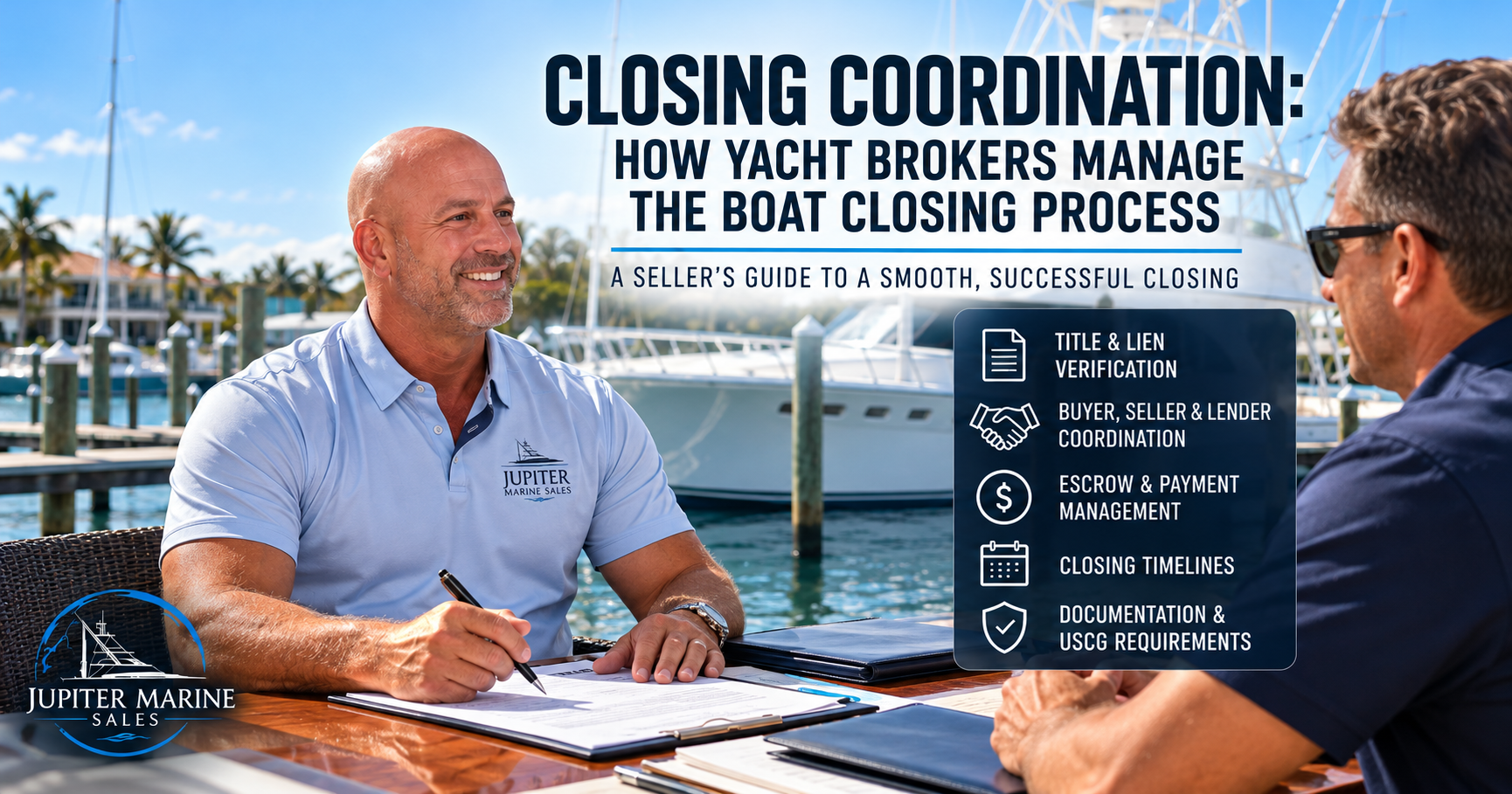
Jupiter Marine Sales | Professional Boat Selling Strategy — Article #13
A successful sea trial and survey are major milestones in selling a boat, but they do not mean the transaction is complete. Between a buyer's final acceptance and the actual closing, several importa
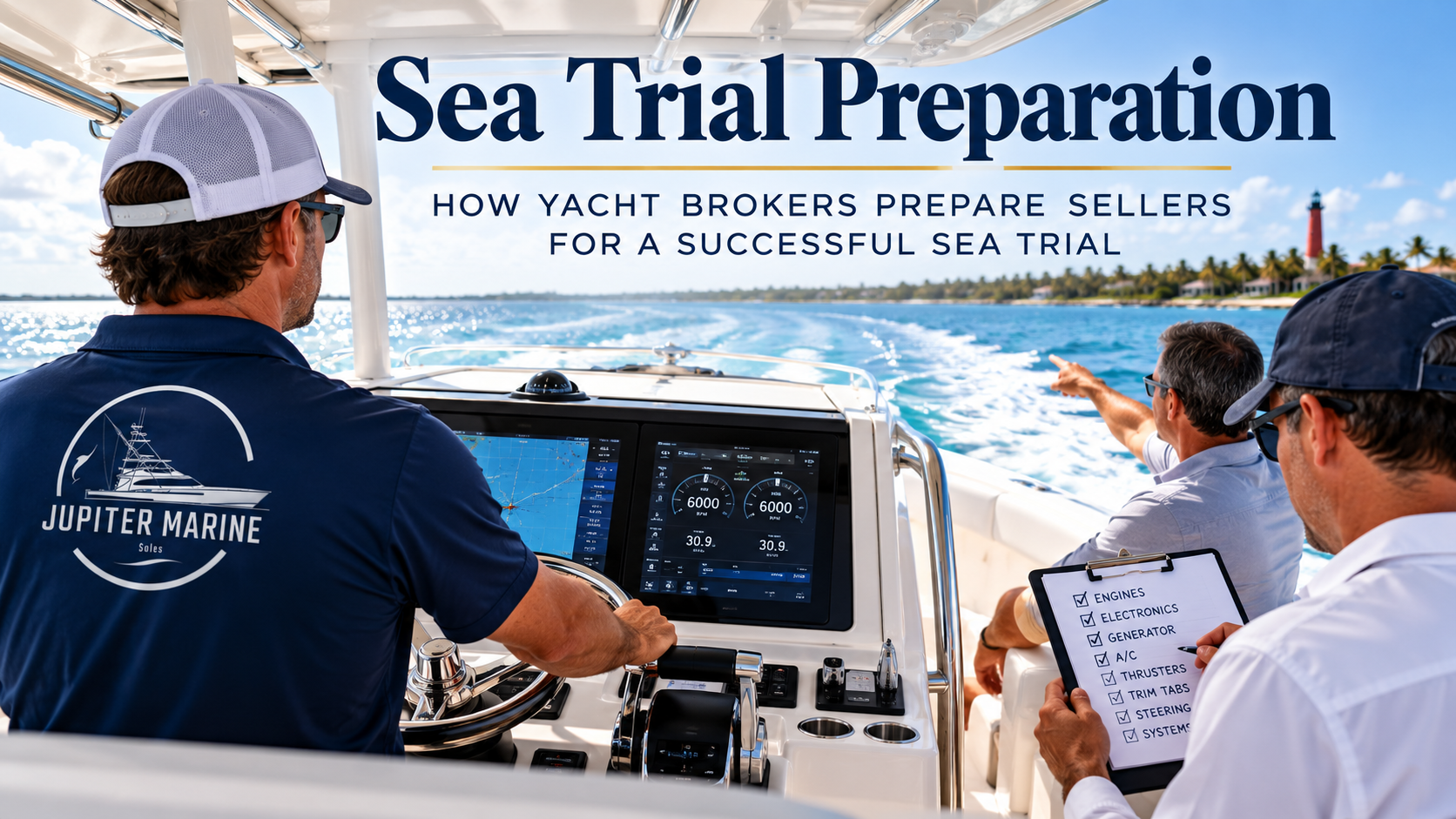
Getting a boat under contract is an important milestone in the selling process, but it is not the finish line.
After the seller accepts an offer and the purchase agreement is executed, the transaction typically moves into the buyer’s inspection and due-diligence period. For most brokerage t
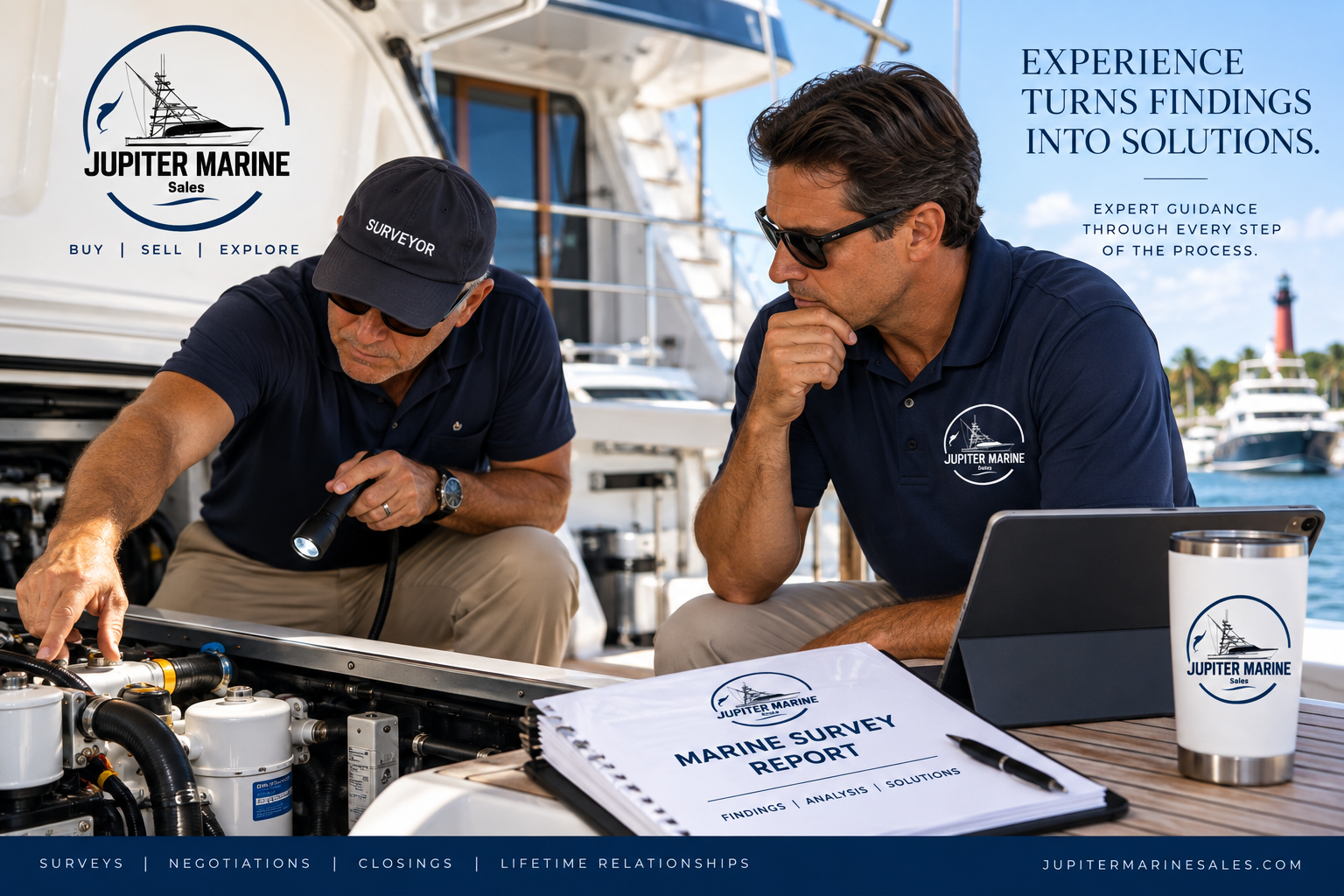
A marine survey is one of the most important stages of buying or selling a boat—but what happens after the survey can be just as important as the inspection itself.
Survey day is often where a straightforward boat transaction suddenly becomes complicated.
A surveyor m
Receiving an offer is an important milestone in the sale of a boat or yacht—but it is not the end of the process.
It is the beginning of the negotiation.
The buyer may begin below the asking price. The seller may want to counter. The parties may disagree about the deposit, survey peri