Loading...
Loading...
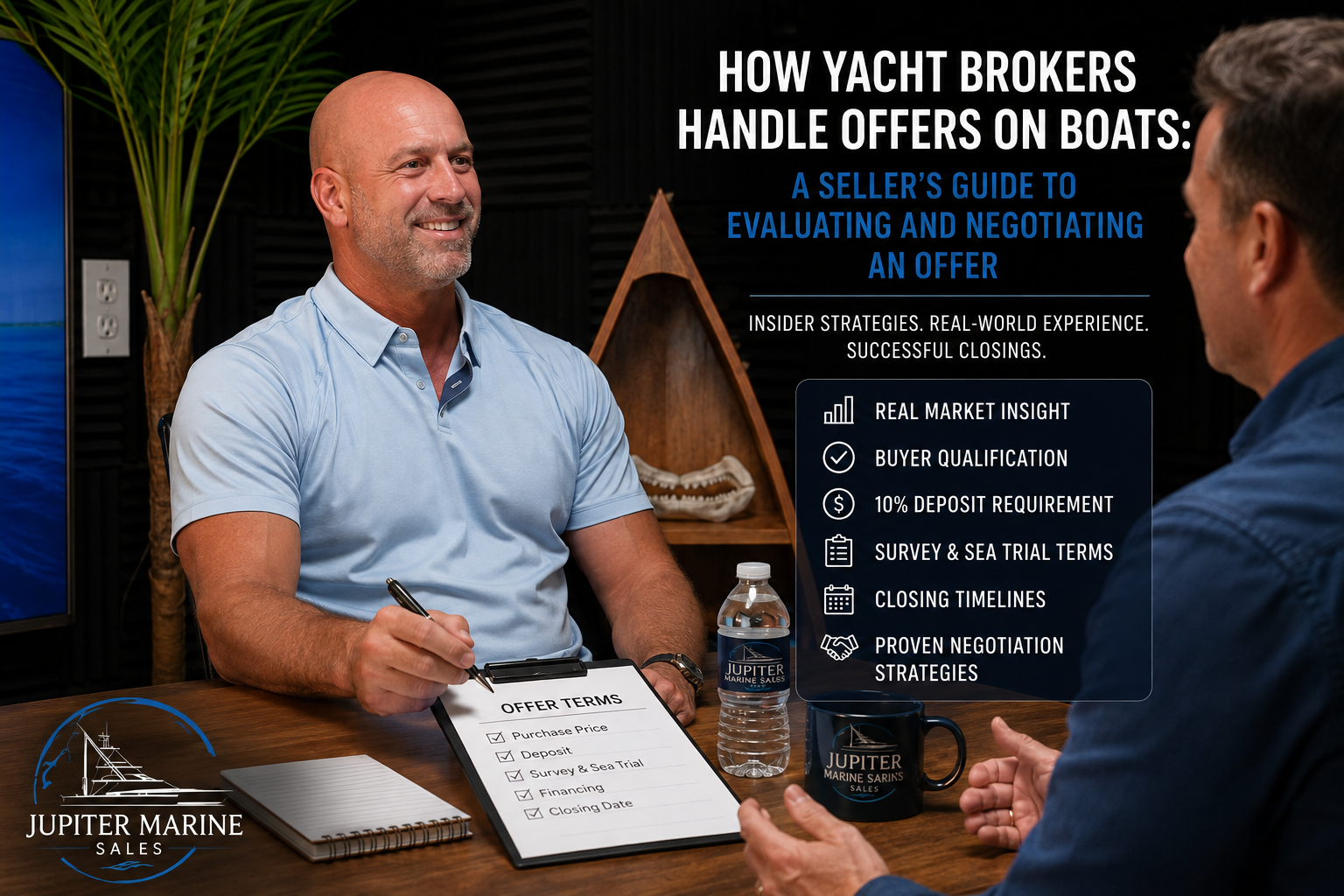
Jupiter Marine Sales uses real-world market experience, buyer qualification and structured negotiations to help sellers evaluate offers and move qualified transactions toward closing
Getting an offer on your boat is exciting.
After preparing the vessel, determining the asking price, creating professional photography and video, advertising the boat, responding to inquiries, qualifying buyers, and conducting showings, someone is finally ready to make an offer.
But receiving an offer doesn't mean the boat is sold.
In many ways, this is where some of the most important work begins.
At Jupiter Marine Sales, we don't simply take a number from a buyer and pass it along to our seller. By the time a serious written offer is presented, we've usually already begun negotiating, qualifying the buyer, discussing the market, and setting expectations for what happens next.
After closing more than 600 boat transactions over the past five to six years, we've learned that a successful negotiation isn't about one side beating the other.
It's about creating a fast, smooth, and fair transaction where both parties feel like they got a good deal—and then getting that deal all the way to closing.
Here's how the process works.
Purchase price gets everyone's attention.
But an experienced yacht broker should be evaluating much more than the number written at the top of the offer.
Consider two buyers interested in a boat listed for $500,000.
Buyer A offers $475,000.
Buyer B offers $465,000.
At first glance, Buyer A appears to have made the better offer.
But what if Buyer A needs financing, hasn't been qualified, can't schedule a survey for three weeks, and wants an extended closing period?
Meanwhile, Buyer B is paying cash, is prepared to make the required deposit, has a surveyor available in several days, and could potentially close within a week.
Now the decision isn't so simple.
That's why we look at the entire transaction, including:
The highest offer isn't always the strongest offer.
At Jupiter Marine Sales, the negotiation usually begins before an offer ever reaches the seller.
When a prospective buyer tells us they're ready to make an offer, we have typically already started an informal first round of negotiations.
Why?
Because our job isn't simply to act as a messenger between a buyer and seller.
Our job is to use our experience to help create a fast, smooth, and fair transaction where both parties feel like they win.
After closing more than 600 transactions over the past five to six years, we've had plenty of opportunities to see what works—and what can kill a perfectly good deal before it ever gets started.
We've got this part of the process dialed in.
It's common for the first number from a buyer to come in low.
Sometimes it's a reasonable attempt to begin negotiations.
Other times, it's a legitimate lowball.
That's usually when we have what we jokingly call a "come-to-Jesus meeting" with the buyer.
Before taking an unrealistic number to our seller and potentially starting the negotiation on the wrong foot, we'll have a straightforward conversation with the prospective buyer.
We explain the market.
We discuss comparable boats.
We talk about the vessel's condition, engine hours, equipment, upgrades, service history, and other factors affecting its value.
And when appropriate, we'll prepare the buyer for what a realistic counteroffer is probably going to look like.
We're not negotiating against our seller.
We're doing the opposite.
We're trying to turn an unrealistic opening number into a legitimate negotiation.
There's little value in carrying an offer to a seller that has almost no chance of being accepted if a conversation with the buyer can first bring everyone closer to reality.
Once we understand where the buyer stands, it's time for another candid conversation—this time with our seller.
We sometimes refer to this as ripping the Band-Aid off for the second time.
The first time should have happened when we initially listed the boat.
That's when we discussed:
A seller may want $500,000 for a boat.
That doesn't necessarily mean the market will pay $500,000.
We would much rather have that conversation at the beginning of the listing than surprise the seller when a real buyer is standing in front of us.
So when the first serious offer arrives, we've already prepared for this moment.
Now the pain of seeing a lower number is usually much more tolerable because we've discussed the possibility from day one.
This is where experience really matters.
We don't want to counter so high that we lose a legitimate buyer.
But we certainly don't want our seller leaving unnecessary money on the table either.
Suppose a seller has a specific number they want to net.
We may have a conversation that sounds something like this:
"I know you want to net X, but let's think about the next 30 to 60 days. You've got marina bills, boat washes, insurance payments, maintenance, possibly loan payments, and continued depreciation. Sometimes taking a little less today actually leaves you in a better financial position than holding out another two months hoping someone pays more. Let's make a realistic counter that keeps this buyer engaged."
That's not telling a seller to give their boat away.
It's looking at the real economics of owning the boat for another 30, 60, or 90 days.
Sometimes the better financial decision is taking slightly less today.
Sometimes it's holding firm.
Our job is to help the seller understand the difference.
There's another side to this.
We don't want sellers dropping their price unnecessarily.
Suppose a buyer offers:
$450,000.
If the seller immediately responds:
"I'll take $460,000."
perhaps the buyer was actually prepared to pay $475,000.
The seller may have just negotiated against themselves.
A professional broker acts as a buffer between buyer and seller.
We want to understand:
Negotiation is partly about numbers.
It's also about understanding people.
Negotiating a boat sale isn't about proving which side is tougher.
If the buyer comes in low and the seller counters unrealistically high, we've accomplished nothing.
The buyer thinks the seller isn't serious.
The seller thinks the buyer isn't serious.
And a transaction that could have worked dies before either side discovers where the other was actually willing to finish.
The objective is to find the range where both sides can win.
The buyer should feel like they negotiated a fair deal.
The seller should feel like they received a fair market price.
And both parties should feel comfortable moving into due diligence and ultimately closing.
That's what a successful negotiation looks like to us.
There is one important variable that can make the negotiation more difficult.
Sometimes Jupiter Marine Sales represents the seller while another brokerage represents the buyer.
Now we may not have the ability to speak directly with both sides.
We communicate with the buyer's broker, and that broker communicates with their client.
When you're working with another experienced professional, that can work extremely well.
Both brokers understand the objective:
Represent your client, protect their interests, find common ground, and get the transaction closed.
Problems can arise when an inexperienced broker believes their job is simply to play hardball to impress their client.
Every conversation becomes a battle.
Every counter becomes a challenge.
Nobody wants to give any indication of where their client realistically stands.
That strategy may make someone feel like a tough negotiator.
It can also get a perfectly viable deal rejected before the real negotiation ever begins.
Professional negotiation isn't about one broker beating another.
There has to be a willing buyer and a willing seller at the end of the process.
Reaching an acceptable purchase price is only part of the job.
Before asking one of our sellers to lock up their boat for due diligence, we want reasonable confidence that the buyer can actually complete the transaction.
Getting someone's signature on an offer isn't enough.
If financing is involved, we want that discussed early.
We work with our financing partners to help ensure the buyer has been properly qualified before unnecessarily tying up the seller's boat.
A boat can potentially be off the active market for two or three weeks while the buyer completes survey, mechanical inspection, trial run, and financing.
We don't want to put a seller in that position for someone who was never financially capable of completing the purchase.
Putting a boat under contract isn't the goal. Getting a qualified buyer from contract to closing is the goal.
Our standard process requires a 10% deposit regardless of the other terms of the offer.
That requirement serves an important purpose.
It immediately helps separate serious buyers from casual shoppers and non-serious prospects.
Consider a $500,000 transaction.
A 10% deposit represents $50,000.
That's a meaningful commitment.
When a seller agrees to take their boat through the due-diligence process with a buyer, we want that buyer to have meaningful skin in the game.
The deposit is handled according to the terms of the applicable purchase agreement, including the circumstances governing its return or application to the transaction.
But from a qualification standpoint, our philosophy is simple:
If you're serious about buying the boat, be prepared to demonstrate that commitment.
Our typical transaction requires the buyer to complete their survey and trial run within approximately two weeks.
Depending on the vessel and agreement, our typical transaction may be subject to:
This gives the buyer a reasonable opportunity to properly evaluate the vessel without allowing the boat to remain unnecessarily tied up for an indefinite period.
Clear deadlines are important for both parties.
Jupiter Marine Sales also recommends that vessels go through survey, sea trial, and mechanical inspection before the buyer signs vessel acceptance and moves toward closing.
A cash offer isn't automatically better than a financed offer.
Many highly qualified buyers finance boats and yachts.
But financing adds another process and additional time.
Financing may involve:
That's why we want financing disclosed and addressed from the beginning.
In our experience, financing generally adds approximately 10–12 business days to the transaction.
That doesn't make financing a problem.
It simply means everyone needs to understand the timeline.
The last thing we want is to reach the end of the buyer's due-diligence period and discover that the financing process has barely started.
Insurance becomes particularly important when financing is involved.
A financed boat purchase generally cannot move to lender funding until the buyer has satisfied the lender's applicable insurance requirements.
That makes the insurance agent a pivotal part of a financed transaction.
Depending on the vessel and circumstances, the insurance agent may need information concerning:
If an insurance issue appears late in the process, funding can potentially be delayed.
And when funding gets delayed, everything behind it can get delayed too.
That's why we prefer to get financing and insurance moving early rather than waiting until everyone thinks they're ready to close.
Our typical transaction is structured around an approximately 30-day closing.
But that doesn't mean every transaction takes 30 days.
With:
a transaction can potentially close within a week.
At Jupiter Marine Sales, we've closed transactions in as little as three days.
But we don't promise every seller a three-day or seven-day closing.
There are too many moving parts.
One of the biggest variables in a transaction is sometimes neither the buyer nor the seller.
It's the surveyor.
A qualified marine surveyor might be available in several days.
During a busy period, getting the right surveyor scheduled can take two weeks or longer.
That can immediately affect the transaction.
Other potential scheduling issues include:
If the original purchase agreement contains dates that can no longer reasonably be met, the parties may need to execute an amendment extending the applicable deadlines.
This is normal transaction management.
The important thing is identifying the problem early and keeping everyone informed.
Once the agreement is executed and the deposit is in place, the buyer begins due diligence.
Depending on the vessel, that might include:
Not every boat requires exactly the same process.
A 25-foot center console and a 70-foot sportfish are completely different transactions.
But the principle is the same:
Establish what inspections are permitted, establish the deadlines, and keep the transaction moving.
For sellers who want to understand how important professional presentation is before buyers ever reach this stage, see our guide The Professional Yacht Broker's Guide to Creating a Boat Video That Attracts Serious Buyers. A detailed video can help buyers understand a vessel before scheduling a showing, survey, or making an offer.
Marine surveys frequently identify items.
That's normal.
Used boats are used boats.
A survey may identify:
That doesn't automatically mean every survey item should result in a dollar-for-dollar reduction in the purchase price.
There is a major difference between discovering a significant undisclosed mechanical problem and attempting to renegotiate normal wear that was visible when the buyer made the offer.
This is another point where an experienced broker becomes extremely valuable.
The objective is to address legitimate concerns without allowing the transaction to unnecessarily fall apart.
Sellers also need to consider whether there is an outstanding loan on the vessel.
If the seller has financing, the lender's payoff needs to be coordinated before clear ownership can ultimately be transferred.
In our experience, a payoff can commonly add approximately 48–72 hours toward the end of a transaction.
That timeline can vary depending on the lender and circumstances.
The important thing is identifying the payoff early.
We don't want to reach the scheduled closing date and only then discover that the lender needs several additional days to process the payoff.
Sellers understandably focus on sale price.
Experienced brokers also look at time and carrying costs.
Keeping a boat for another 30, 60, or 90 days may mean additional:
And there's no guarantee the next buyer will offer more.
Suppose rejecting today's offer costs another $5,000 over the next 60 days—and the next buyer ultimately offers exactly the same amount.
What did holding out accomplish?
This doesn't mean sellers should accept every offer.
It means time has a cost, and that cost should be part of the negotiation.
Multiple legitimate offers can make the decision more complicated.
Consider:
TermBuyer ABuyer B
Offer
$490,000
$480,000
Deposit
10%
10%
Financing
Yes
Cash
Survey Availability
2 Weeks
4 Days
Potential Closing
~30 Days
~1 Week
Buyer A offers $10,000 more.
Buyer B may get the seller's boat closed and funded weeks earlier.
Which offer is better?
There isn't one universal answer.
Perhaps the seller doesn't care about timing and wants to maximize price.
Perhaps their new boat arrives next week and they need the existing boat gone.
Maybe another 30 days of carrying costs significantly reduces the difference between the two offers.
This is why we don't simply circle the highest number.
We evaluate the transaction.
Another interested buyer may appear after the boat is already under contract.
Depending on the agreement and circumstances, a seller may be able to consider a backup offer if the original transaction doesn't close.
But receiving a better offer doesn't automatically allow a seller to walk away from an existing contractual obligation.
Once a purchase agreement is executed, the contract controls.
This is another reason we put so much effort into evaluating the buyer and the offer before our seller commits to the transaction.
Once buyer and seller reach an agreement, the transaction generally moves through several stages:
1. Executed purchase agreement
2. 10% deposit
3. Financing process, if applicable
4. Survey scheduling
5. Mechanical inspection
6. Trial run
7. Haul-out when applicable
8. Resolution of any agreed survey issues
9. Buyer acceptance
10. Lender funding when applicable
11. Seller payoff coordination when applicable
12. Title and documentation
13. Closing
14. Vessel delivery
This sequence is important.
The survey, mechanical inspection, trial run, and any agreed survey issues need to be addressed before the buyer moves to final vessel acceptance. Jupiter Marine Sales' published policy similarly states that survey, sea trial, and mechanical inspection precede the vessel-acceptance form used for closing.
Once the buyer has accepted the vessel, a financed transaction can move toward lender funding. Any seller payoff can then be coordinated along with the title and documentation necessary to complete closing.
Some transactions move through these stages extremely quickly.
Others encounter scheduling, financing, insurance, documentation, payoff, or weather issues that require additional time.
That's why professional transaction management matters.
A yacht transaction can involve far more people than just the buyer, seller, and brokers.
Depending on the transaction, Jupiter Marine Sales may be coordinating with:
Every one of these parties can affect the timeline.
The insurance agent is particularly important in a financed transaction because satisfying the lender's insurance requirements can be necessary before funding.
The surveyor may need to provide documentation.
The insurance agent may need information from the survey.
The lender may need proof of insurance.
The seller's lender may need to provide a payoff.
Documentation professionals may need information from multiple parties before the closing documents can be finalized.
A boat transaction is essentially a chain.
If one link gets delayed, everything behind it can get delayed too.
That's why a yacht broker's job doesn't end when an offer is accepted.
In many ways, that's when the job becomes even more important.
This is one of the biggest distinctions we want sellers to understand about the Jupiter Marine Sales process.
Anyone can celebrate putting a boat under contract.
But if that contract falls apart three weeks later, what did it accomplish?
The seller's boat was tied up.
Other buyers may have moved on.
The seller lost valuable market time.
And now the boat has to return to the market.
That's why we emphasize:
Realistic negotiations.
Buyer qualification.
A meaningful 10% deposit.
Defined due-diligence periods.
Financing qualification when applicable.
Early insurance coordination.
Active transaction management.
We don't measure success by how many boats we put under contract.
We measure success by how many transactions we successfully get across the finish line.
Every transaction is different.
We've dealt with cash transactions that closed almost immediately.
We've dealt with financed transactions.
We've dealt with lender payoffs.
We've dealt with difficult surveys.
We've dealt with scheduling problems.
We've dealt with insurance issues.
We've dealt with buyers thousands of miles away.
We've worked directly with buyers and alongside cooperating brokerages.
We've negotiated transactions where buyer and seller initially appeared miles apart and ultimately found a number that worked for both.
After more than 600 closed transactions in approximately five to six years, one lesson stands out:
The best negotiator isn't necessarily the person who pushes the hardest.
It's the person who understands the market, understands the transaction, understands the people involved, and knows how to keep everyone moving toward a closing.
At Jupiter Marine Sales, our work begins long before an offer reaches our seller.
We've already marketed the vessel, communicated with prospective buyers, worked with cooperating brokers, helped qualify prospects, and established expectations about how our transactions work.
Professional marketing also plays an important role in bringing qualified buyers into that process in the first place. Our approach includes professional presentation, video, online exposure, buyer follow-up, negotiation, survey and sea-trial coordination, and closing support.
When a buyer is ready to make an offer, we begin working toward a realistic negotiation before unnecessarily wasting anyone's time.
Then we help our seller evaluate:
The seller always makes the final decision.
Our responsibility is to give them the experience, information, market perspective, and guidance necessary to make that decision intelligently.
Because ultimately, the best negotiation isn't the one where somebody can brag that they "won."
It's the one where the buyer gets the boat, the seller gets paid, both parties feel they were treated fairly, and the transaction actually closes.
Selling a boat professionally involves much more than placing an advertisement online and waiting for someone to make an offer.
There's pricing.
Presentation.
Marketing.
Buyer qualification.
Professional showings.
Negotiations.
Deposits.
Surveys.
Mechanical inspections.
Trial runs.
Financing.
Insurance.
Documentation.
Payoffs.
Closing.
And every one of those stages can affect the final result.
At Jupiter Marine Sales, we manage the process from the day your boat enters the market until the transaction reaches the closing table.
If you're considering selling your boat or yacht, contact Jupiter Marine Sales to discuss your vessel and the strategy we would use to bring it to market.
Browse Jupiter Marine Sales Featured Boats
The current JMS site provides direct access to the brokerage's contact information and featured inventory.
Jupiter Marine Sales
Professional representation. Maximum exposure. Experienced guidance from listing to closing.
Previous Article:
How Yacht Brokers Conduct Professional Yacht Showings: A Seller’s Guide
Current Article:
How Yacht Brokers Handle Offers on Boats: A Seller’s Guide to Evaluating and Negotiating an Offer
Next Article:
Boat Purchase Agreements Explained: What Sellers Need to Know Before Signing

Jupiter Marine Sales | Professional Boat Selling Strategy — Article #13
A successful sea trial and survey are major milestones in selling a boat, but they do not mean the transaction is complete. Between a buyer's final acceptance and the actual closing, several importa

Getting a boat under contract is an important milestone in the selling process, but it is not the finish line.
After the seller accepts an offer and the purchase agreement is executed, the transaction typically moves into the buyer’s inspection and due-diligence period. For most brokerage t

A marine survey is one of the most important stages of buying or selling a boat—but what happens after the survey can be just as important as the inspection itself.
Survey day is often where a straightforward boat transaction suddenly becomes complicated.
A surveyor m
Receiving an offer is an important milestone in the sale of a boat or yacht—but it is not the end of the process.
It is the beginning of the negotiation.
The buyer may begin below the asking price. The seller may want to counter. The parties may disagree about the deposit, survey peri