Loading...
Loading...
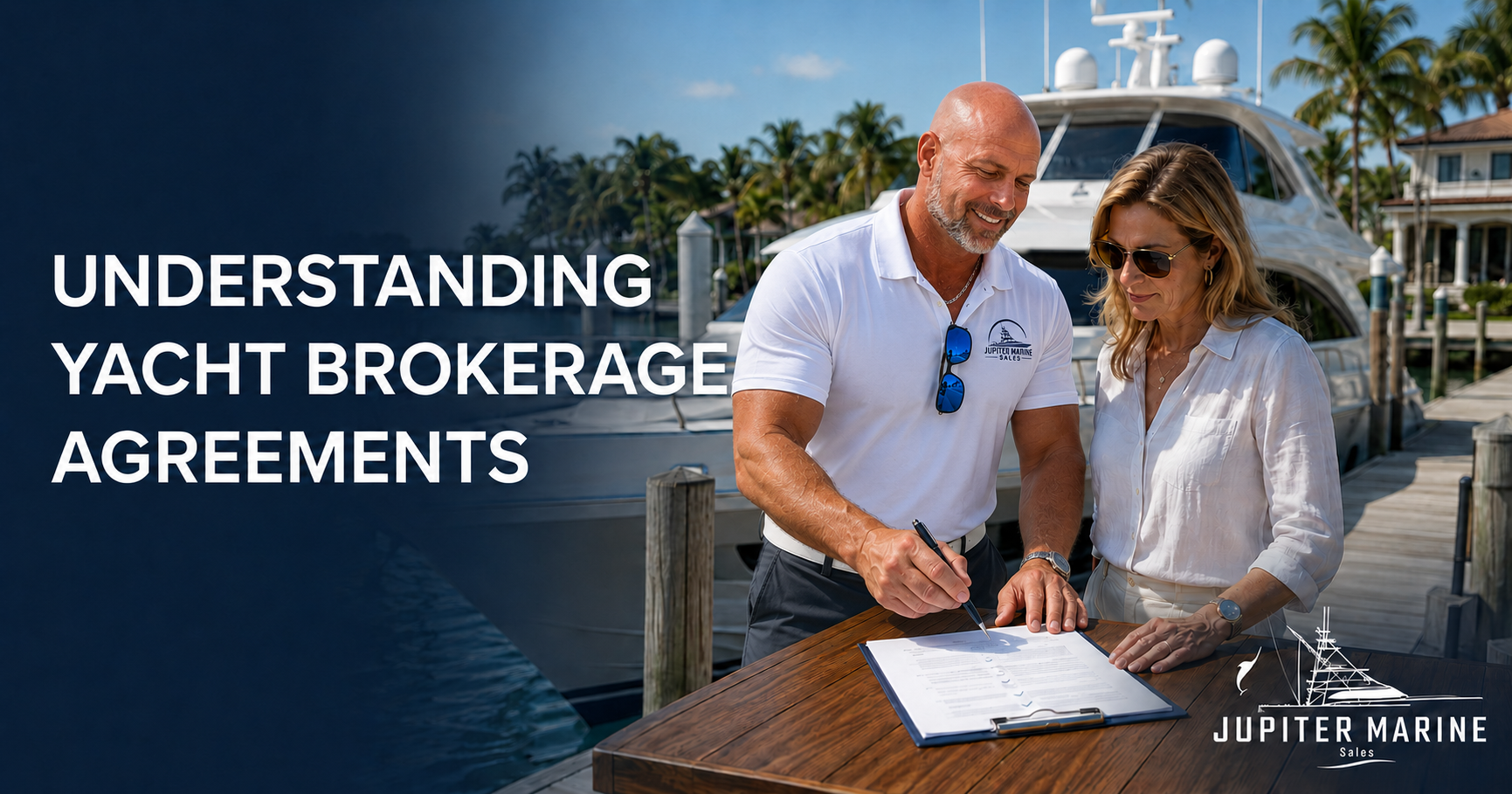
Jupiter Marine Sales broker Darren Diaz reviews a yacht brokerage agreement with a seller at a South Florida marina
Hiring a yacht broker involves more than selecting someone to photograph the vessel and publish a listing.
The brokerage agreement establishes the professional relationship between the seller and the brokerage. It identifies the vessel, defines the broker’s authority, explains how compensation works, establishes the listing period, outlines each party’s responsibilities, and describes what happens if the relationship ends before the yacht is sold.
These details matter.
Two brokerage agreements may carry similar titles while containing different provisions concerning commission, owner-procured buyers, advertising expenses, cancellation, automatic renewal, cooperating brokers, and post-termination protection periods.
A seller should therefore evaluate the actual written agreement—not rely solely on how the broker describes it during a conversation.
This guide explains the major provisions commonly found in yacht brokerage agreements, the questions sellers should ask, and the terms that deserve careful review before signing.
Before signing a yacht brokerage agreement, confirm that you understand:
Do not leave blanks in the document. Do not rely on verbal promises that are absent from the written agreement.
If a provision is unclear, ask for an explanation before signing. If the financial or legal consequences are significant, consult a qualified attorney.
A yacht brokerage agreement appoints a brokerage to represent the owner in connection with the marketing and sale of a particular vessel.
Depending on the agreement, the broker may be authorized to:
The agreement should also establish limits on that authority.
A broker generally markets the yacht, communicates with prospects, and advises the seller. The seller retains the authority to decide whether to accept, reject, or counter an offer unless the seller has provided some different written authorization.
The listing agreement is not the same as the eventual purchase-and-sale contract. The listing agreement governs the relationship between the owner and brokerage. The purchase contract governs the proposed transaction between the seller and buyer.
The correct parties must be identified before the vessel is marketed.
The seller may be:
The person signing should have authority to act for the titled owner.
If the vessel is owned by an LLC, the broker may request documents showing who has authority to sign. If it is owned by a trust or estate, additional documentation may be required. When several people share ownership, the broker should understand who must authorize the listing, approve price changes, and execute closing documents.
The agreement should also identify the brokerage by its correct legal name.
Sellers should confirm:
Incorrect ownership information can delay offers, title research, lien payoff, documentation, and closing.
The agreement should clearly identify the yacht being listed.
Relevant information may include:
The seller and broker should also clarify which personal property will not be included.
Artwork, fishing equipment, tools, personal electronics, water toys, tender equipment, linens, dishware, and other movable items can create disagreements when they appear in listing photographs but are not intended to convey.
Exclusions should be documented clearly rather than left to assumption.
The agreement should state whether the relationship is exclusive, open, or structured in another way.
The name alone does not explain every consequence. Sellers need to understand how the agreement treats:
An exclusive listing does not necessarily mean that only one broker can bring a buyer. In many professional brokerage arrangements, the listing broker actively cooperates with other brokers while remaining responsible for the listing, marketing information, seller communication, and transaction coordination.
Our guide to exclusive versus open yacht listings explains the strategic differences between these listing structures. The brokerage agreement is where those general concepts become specific contractual obligations.
The agreement should state:
A brokerage needs enough time to prepare the yacht, create marketing materials, distribute the listing, communicate with other brokers, qualify prospects, arrange showings, and respond to the market.
That does not mean every agreement should continue indefinitely.
The appropriate listing period may depend on:
Be cautious with automatic-renewal provisions that are easy to overlook. If the agreement renews unless notice is delivered by a particular date or method, record that requirement when the agreement is signed.
The initial asking price should appear clearly in the agreement or an attached listing schedule.
The seller should understand:
The broker may recommend a price adjustment based on buyer response, comparable sales, competing inventory, days on market, or survey-related information. The seller should retain the decision-making authority unless the written agreement states otherwise.
The asking price is also different from the seller’s net proceeds.
A seller’s eventual proceeds may be affected by:
A seller should not assume that an advertised price represents the amount that will be received at closing.
“Marketing the yacht” can mean different things to different people.
The agreement itself may provide a general authorization, while a separate marketing plan describes the specific campaign. In either case, the seller should understand what the brokerage intends to provide.
The plan may include:
The broker should also explain which services are included in the normal commission and which, if any, require separate approval or reimbursement.
A strong campaign is not simply a promise to place the yacht online. It should identify the likely buyer, select appropriate channels, maintain consistent information, and provide a reliable path for inquiries.
How Yacht Brokers Choose Advertising Platforms explains how vessel type, price, location, buyer behavior, syndication, video, broker networks, and measurable results influence a professional advertising strategy.
A successful brokerage relationship also depends on the seller.
The agreement may require the owner to:
The broker cannot represent the yacht accurately if the owner withholds important information or supplies specifications that have not been verified.
If an engine fails, equipment is removed, the vessel changes location, storm damage occurs, or another condition materially affects the listing, the broker should be informed promptly.
The seller should also decide how showings will be handled when the yacht has a captain, crew, tenant, charter schedule, or restricted marina access.
Brokerage compensation should be stated clearly.
The agreement may define compensation as:
Do not assume that every brokerage uses the same rate or that every transaction triggers compensation in the same way.
Review:
A seller should understand the difference between a broker earning a commission under the agreement and the commission actually being paid at closing.
These provisions can have significant consequences. If their meaning is uncertain, obtain professional legal advice before signing.
Many qualified yacht buyers are already represented by brokers.
The listing agreement should allow the seller to understand whether the listing brokerage may cooperate with other licensed brokers and how the compensation will be handled.
Professional cooperation can expand the buyer pool without requiring the seller to negotiate separate arrangements with every broker who may have a client.
Questions to ask include:
The seller should not assume that an exclusive appointment prevents cooperation. Often, the exclusive listing broker serves as the central point of responsibility while other brokers remain free to introduce qualified buyers.
A situation may arise in which the listing brokerage also communicates with or represents the eventual buyer.
The seller should ask how the brokerage handles that possibility, what disclosures will be made, and whether written consent will be required.
For transactions governed by Florida’s Yacht and Ship Brokers’ Act, a licensee may face discipline for acting for both buyer and seller without the knowledge and written consent of both parties. Sellers can review the current provisions in Chapter 326 of the Florida Statutes.
The practical question is not simply whether one brokerage is involved on both sides. The parties should understand:
Representation rules and terminology may differ by jurisdiction and transaction structure. Ask for an explanation specific to the proposed relationship.
The agreement should establish a professional communication process.
The seller should know:
The broker may advise the seller about price, deposit, contingencies, closing schedule, included equipment, and buyer qualifications. The seller decides whether to accept, reject, or counter an offer.
A brokerage agreement should not be interpreted as permission for a broker to sell the yacht on terms the owner has not approved.
The brokerage agreement may describe how transaction funds will be handled, although the buyer’s deposit is usually established in the purchase contract.
For transactions covered by Florida’s Yacht and Ship Brokers’ Act, qualifying broker funds received in connection with a yacht transaction generally must be placed in an appropriate Florida trust account, with separate transaction records maintained. The statute also addresses the provision of an itemized closing statement to the buyer and seller when the broker or another escrow holder completes the closing.
Before accepting an offer, the seller should understand:
The listing agreement, purchase contract, escrow instructions, and closing documents should work together. They should not leave the parties guessing about where funds are held or who may authorize their release.
Survey, sea trial, financing, insurance, documentation, and other buyer contingencies are usually addressed in the purchase-and-sale agreement rather than the original brokerage listing agreement.
However, the seller should understand what role the listing broker will play once a transaction is pending.
That may include:
The seller should also understand who pays for fuel, captains, haul-outs, technicians, travel, and other transaction expenses.
A marine survey and a sea trial serve different purposes. Our Boat Survey vs. Sea Trial guide explains how buyers use each stage to evaluate a vessel before closing.
A seller should understand how the agreement may end before its scheduled expiration.
Review:
A broker may also want the right to terminate the relationship if the seller provides inaccurate information, refuses reasonable access, demands misleading advertising, acts unlawfully, or makes professional representation impractical.
Termination should be handled through the process described in the written agreement. A telephone conversation or informal text message may not satisfy a contractual notice requirement.
Many brokerage agreements contain a post-termination protection period, sometimes called a tail provision.
This provision may protect the broker if the yacht is sold after the agreement ends to a buyer who was introduced to the vessel or engaged in negotiations during the listing period.
Review:
A protection period should be specific enough for the seller to understand which later transactions may trigger compensation.
If the language could expose the seller to two commissions or creates an unclear obligation long after the listing ends, obtain legal advice before signing.
Some owners already know people who may be interested in the yacht.
If a family member, business associate, marina neighbor, charter guest, captain, or previous prospect may purchase the vessel, discuss that possibility before the agreement is signed.
The agreement should make clear whether:
Do not assume that finding the buyer independently eliminates the broker’s compensation. Under some exclusive arrangements, the commission may still be earned.
Any agreed exception should be written into the agreement. A verbal understanding about a particular buyer may be difficult to prove later.
If the yacht was previously marketed, the seller may already have:
Disclose those relationships before signing a new agreement.
The new broker should know whether another brokerage may claim compensation if a particular prospect purchases the yacht. Written exclusions or acknowledgments can help prevent confusion.
The seller should also review any prior agreement before making commitments to a new brokerage. Expiration does not necessarily eliminate every surviving obligation.
The brokerage should know about ownership and documentation complications at the beginning of the relationship.
These may include:
A lien does not necessarily prevent a yacht from being listed or sold. It does affect how the transaction must be prepared and how funds will be distributed at closing.
The seller should obtain a current payoff amount and understand how the lender will release its interest. Waiting until closing to investigate ownership problems can delay or jeopardize the sale.
Legal, tax, customs, and documentation questions should be directed to qualified professionals rather than resolved through assumptions in the listing process.
Sellers should know which expenses are included in the brokerage’s services.
Potential expenses may include:
Ask:
A seller should not be surprised by a reimbursement request that was never discussed.
Likewise, a brokerage should not be expected to provide unlimited third-party services that were never included in the agreed compensation.
Professional marketing materials have continuing value.
The agreement may address who owns or may use:
The seller should understand whether these materials may remain online after the listing ends and whether they may be transferred to another broker.
A brokerage may retain ownership of content it paid to produce while granting the seller limited use. Another agreement may assign broader rights to the owner.
There is no reason to leave this question unresolved when the campaign begins.
Brokerage agreements may contain provisions concerning:
These clauses may appear routine, but they can materially affect the parties if a disagreement occurs.
A broker can explain the business purpose of the agreement. The seller should rely on a qualified attorney for legal interpretation or advice concerning enforceability, liability, dispute resolution, or the consequences of specific wording.
A seller should be comfortable asking:
A broker should be able to answer these questions directly and identify where the answers appear in the agreement.
Potential warning signs include:
Not every unfamiliar clause is improper. It should nevertheless be understood before the seller accepts it.
Florida regulates qualifying yacht brokerage activity through the Yacht and Ship Brokers’ Act.
For purposes of that act, a yacht generally means a vessel longer than 32 feet that is propelled by sail or machinery and used primarily for pleasure, including certain pleasure-charter uses. The statute establishes licensing and financial requirements and regulates specific brokerage practices.
Among other provisions, the act addresses:
The complete current language is available in Chapter 326 of the Florida Statutes.
The statutory definition does not mean agreements involving smaller boats are unimportant or unregulated. Other contract, title, consumer, licensing, tax, documentation, and commercial laws may apply.
Transactions outside Florida may be governed by different requirements. Sellers should obtain advice appropriate to the vessel, ownership, location, and proposed transaction.
A well-prepared agreement does more than protect the parties during a dispute.
It gives the seller and broker a shared understanding of:
That clarity helps the broker work confidently and helps the seller evaluate performance fairly.
Problems often arise when expectations exist only in conversation. One person remembers a promise of extensive paid advertising. Another remembers only marketplace placement. One person believes the owner can sell independently without compensation. Another believes the listing is fully exclusive.
The written agreement should resolve those questions before the yacht enters the market.
Jupiter Marine Sales approaches a brokerage agreement as the foundation of a professional selling relationship.
Before launching a listing, JMS works to understand the vessel, ownership, market position, likely buyer, showing requirements, documentation status, and the seller’s objectives.
The agreement and marketing plan should give the seller a clear understanding of:
JMS believes that realistic pricing, accurate presentation, professional marketing, broker cooperation, and direct communication create a stronger selling process.
If you are considering professional representation, Jupiter Marine Sales can review your yacht, current competing inventory, ownership circumstances, likely buyer audience, and the brokerage approach suited to the opportunity.
Contact Jupiter Marine Sales to request a confidential yacht market evaluation and listing consultation.
A yacht brokerage agreement is a contract between a vessel owner and a brokerage. It defines the broker’s authority, the listing period, compensation, marketing responsibilities, seller obligations, termination rights, and other terms governing the professional relationship.
There is no single term appropriate for every yacht. The period should reflect the vessel, price, market conditions, preparation requirements, season, and expected buyer pool. Sellers should understand the start date, expiration date, renewal provisions, and termination process.
Cancellation rights depend on the written agreement. Some agreements allow termination with notice, while others require cause, reimbursement of expenses, or satisfaction of additional conditions. Review the termination provision before signing.
That depends on the listing structure and the agreement. Under some exclusive arrangements, compensation may still be owed even when the owner produces the buyer. Existing prospects or named exceptions should be documented in writing.
The agreement should explain when compensation is earned and when it becomes payable. The answer may depend on whether the broker produces a ready, willing, and able buyer, whether the seller accepts an offer, whether the transaction closes, and whether another contractual event occurs. Ask for legal advice if the provision is unclear.
Not necessarily. Many exclusive listing brokers cooperate with other licensed brokers. The listing broker remains responsible for the seller relationship and listing campaign while cooperating brokers may introduce represented buyers.
That possibility depends on applicable law, required disclosures, written consent, and the brokerage relationship. For Florida transactions governed by the Yacht and Ship Brokers’ Act, acting for both parties without their knowledge and written consent may subject a licensee to discipline.
The purchase contract should identify the deposit holder and the applicable escrow terms. Depending on the transaction, funds may be held by a qualifying brokerage trust account, attorney, documentation company, or another authorized escrow holder.
A protection period is a post-termination provision that may entitle the broker to compensation if the yacht is later sold to a buyer introduced or engaged during the listing period. Review its duration, covered prospects, notice requirements, and exceptions carefully.
Legal review may be appropriate when the yacht has substantial value, ownership is complicated, the seller is an entity or estate, the vessel is foreign registered, unusual expenses or exclusions apply, or the seller does not understand the agreement’s legal consequences.
Provide accurate ownership records, vessel specifications, engine information, service history, known damage, lien information, included equipment, exclusions, location, showing requirements, and any existing buyer or broker relationships that may affect the sale.
Public marketing may end, but certain obligations can survive expiration. These may include protection-period provisions, pending negotiations, reimbursement obligations, confidentiality, or rights concerning marketing materials. Review the agreement rather than assuming every obligation ends automatically.
This article provides general educational information and is not legal advice. Brokerage agreements, licensing requirements, escrow rules, documentation procedures, and seller obligations vary by jurisdiction and transaction. Consult a qualified attorney or other appropriate professional regarding your specific agreement and circumstances.

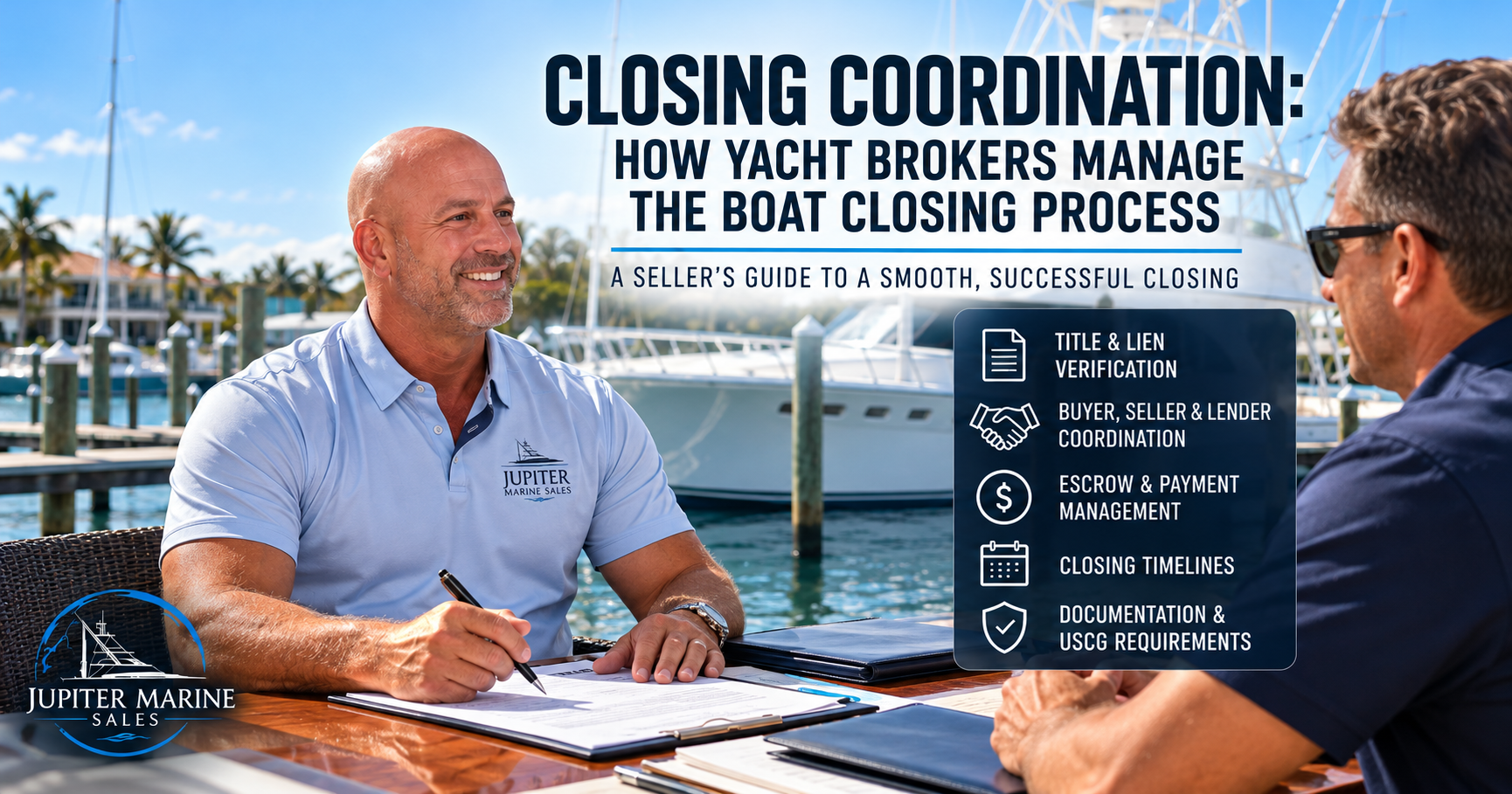
Jupiter Marine Sales | Professional Boat Selling Strategy — Article #13
A successful sea trial and survey are major milestones in selling a boat, but they do not mean the transaction is complete. Between a buyer's final acceptance and the actual closing, several importa
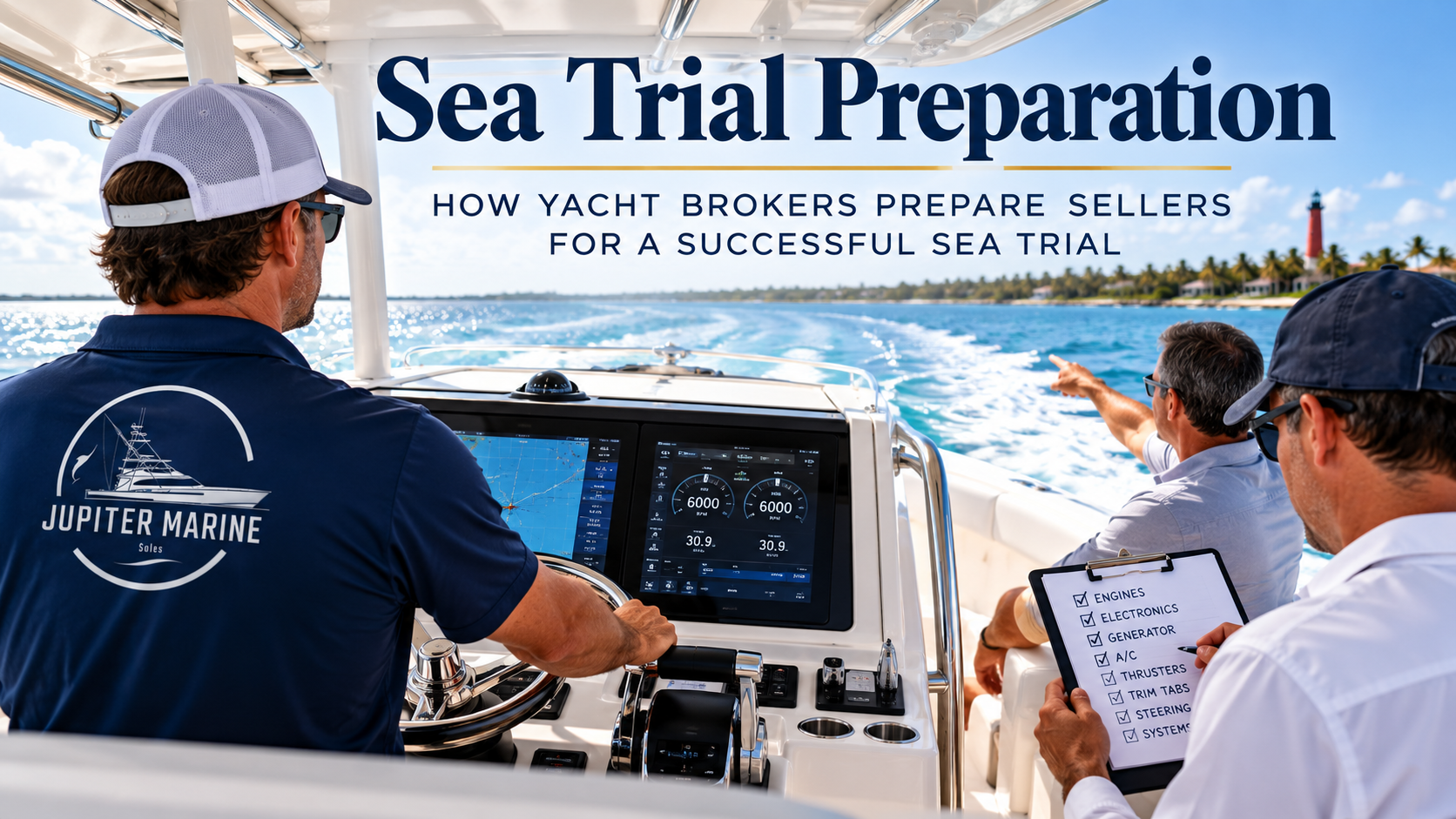
Getting a boat under contract is an important milestone in the selling process, but it is not the finish line.
After the seller accepts an offer and the purchase agreement is executed, the transaction typically moves into the buyer’s inspection and due-diligence period. For most brokerage t

A marine survey is one of the most important stages of buying or selling a boat—but what happens after the survey can be just as important as the inspection itself.
Survey day is often where a straightforward boat transaction suddenly becomes complicated.
A surveyor m

Receiving an offer is an important milestone in the sale of a boat or yacht—but it is not the end of the process.
It is the beginning of the negotiation.
The buyer may begin below the asking price. The seller may want to counter. The parties may disagree about the deposit, survey peri