Loading...
Loading...
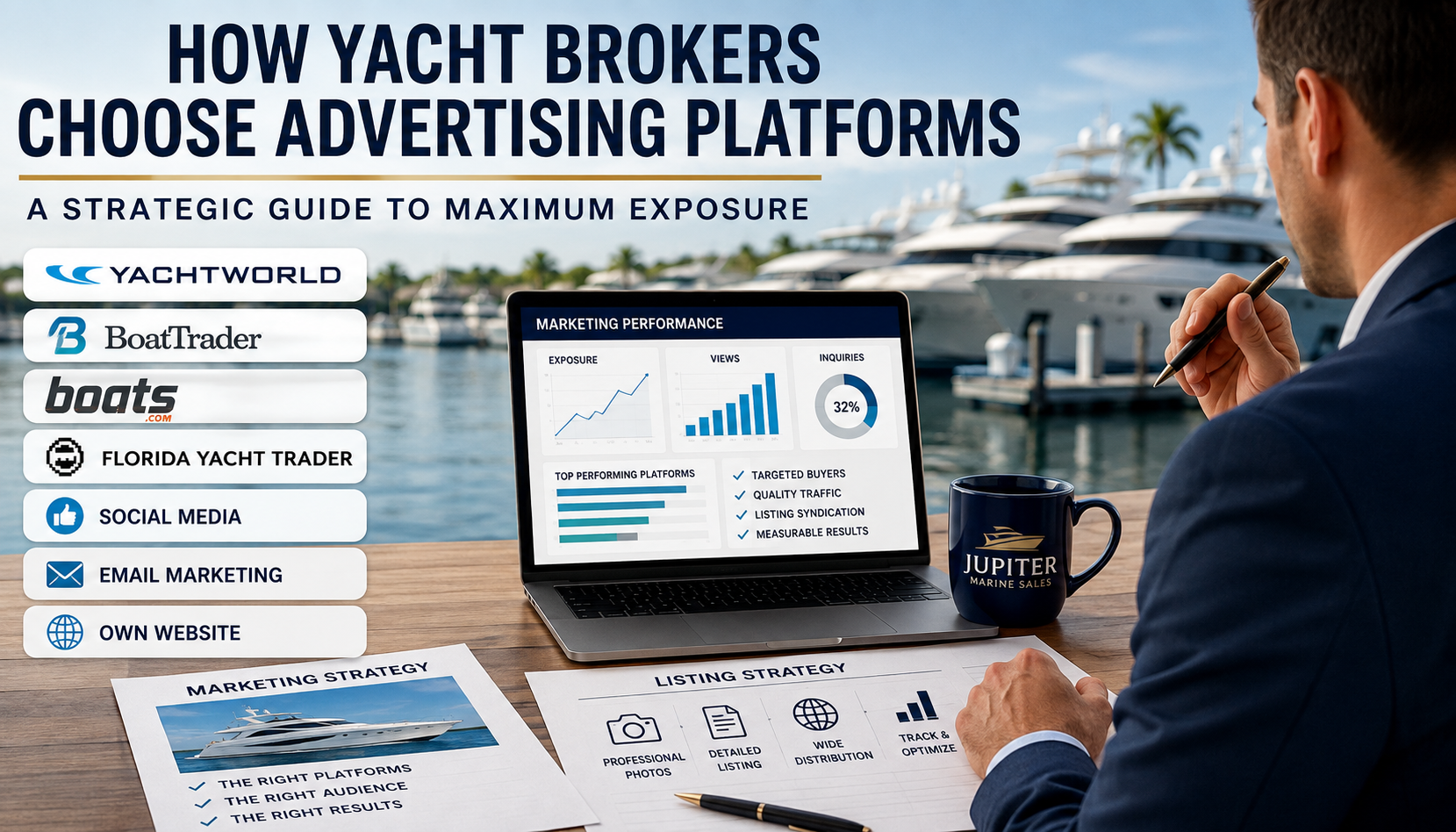
Professional yacht brokers evaluate advertising platforms, buyer reach, listing quality, syndication, and market performance to maximize exposure for boats and yachts for sale
Placing a yacht on the internet is easy. Choosing the right advertising strategy is not.
Professional yacht brokers do not select advertising platforms simply because they are popular or because competing brokers use them. They consider the vessel, likely buyer, price range, location, season, available marketing materials, current competition, and how each platform fits into a coordinated campaign.
That distinction matters.
A boat can appear on several websites and still receive weak exposure if its listing is incomplete, poorly positioned, duplicated inconsistently, or shown to the wrong audience. Conversely, a professionally prepared yacht listing distributed through the right channels can reach qualified buyers without creating unnecessary confusion.
The goal is not to put a yacht everywhere. The goal is to place it where serious prospects will discover it, understand its value, trust its presentation, and take the next step.
Before selecting an advertising platform, a professional yacht broker develops a likely buyer profile.
A 24-foot family center console, a 40-foot performance boat, a long-range cruising yacht, and a late-model sport-fishing vessel do not attract identical buyers. Their prospects may use different marketplaces, search terms, social channels, broker networks, and geographic filters.
A yacht broker may evaluate:
The more accurately the broker identifies the likely buyer, the easier it becomes to select advertising platforms intentionally.
Professional advertising also begins with an understanding of why buyers respond to certain listings and ignore others. As explained in Why Boats Don’t Sell: The Top 25 Reasons Boat Listings Fail, insufficient exposure is only one possible problem. Pricing, presentation, condition, incomplete information, and poor communication can undermine a listing even when it appears on major platforms.
Professional yacht marketing generally uses several complementary channels. Each channel has a different purpose, audience, and level of buyer intent.
Dedicated boat and yacht marketplaces attract people who are actively shopping.
Prospective buyers can filter listings by:
These platforms can provide valuable high-intent exposure, but their effectiveness depends on accurate information and a strong presentation.
A weak headline, incomplete equipment list, poor photography, or unrealistic asking price can undermine even a prominent placement. Buyers comparing similar boats may quickly dismiss a listing that appears incomplete or inconsistent.
Professional brokers also consider:
The platform can introduce the yacht, but the listing must give buyers a reason to investigate it.
For a broader seller-focused overview of available marketing channels, read Where Should You Advertise a Boat for Sale? A Professional Yacht Broker’s Guide to Maximum Exposure.
A professional brokerage website should do more than repeat inventory from a third-party marketplace.
It should provide a stable, authoritative home for the listing and allow the brokerage to present the yacht within a larger collection of useful buyer information.
A well-developed listing page can include:
The brokerage website also gives search engines, email campaigns, social-media posts, online advertisements, and direct broker outreach a reliable destination.
When properly developed, the website supports both the individual yacht and the broader trust required for a high-value transaction.
A seller evaluating a brokerage should examine more than the company’s inventory pages. The seller should consider its professional expertise, responsiveness, marketing standards, transaction experience, and ability to represent the vessel properly. These considerations are covered in How to Choose a Florida Yacht Broker: What Buyers Should Expect.
Many qualified buyers are already working with yacht brokers. Professional cooperation is therefore an essential part of yacht exposure.
A listing broker may distribute:
For specialized vessels, a targeted message to brokers with relevant clients can be more valuable than broad, untargeted advertising.
A broker who regularly works with offshore-fishing clients, for example, may already know prospective buyers for a well-equipped sport-fishing boat. Another broker may have a client seeking a specific cruising yacht, engine package, model year, or price range.
Effective broker cooperation helps connect the yacht with buyers who may never submit an inquiry through a public marketplace.
Buyers often begin with highly specific searches, including:
Search visibility therefore depends on more than purchasing an advertisement.
A strong listing or supporting article should include:
Paid search may also be useful when the audience and economics justify it. However, paid traffic should be directed to a complete, current, trackable page—not a weak listing that leaves important buyer questions unanswered.
Social platforms can introduce a yacht to buyers who are not checking marine marketplaces every day.
Useful social-media content may include:
Social media is most effective when it supports the primary listing rather than attempting to replace it.
A prospective buyer who clicks a post should reach complete and current information with an obvious contact path. The social post creates attention; the listing page must convert that attention into a serious inquiry.
A qualified brokerage database may include:
Email gives a broker the ability to segment outreach.
A sport-fishing yacht can be presented to buyers and brokers interested in that category rather than being sent indiscriminately to every contact. A family-oriented dual console can be shared with a different group than a high-performance center console or long-range cruising yacht.
Relevance generally produces better engagement than volume alone.
A complete walkthrough video can answer questions that photographs cannot.
It can show:
Video is particularly valuable for remote buyers and complex yachts. However, it must be accurate, organized, and professionally presented.
A shaky or incomplete tour may reduce buyer confidence rather than build it. That is why brokers should follow a structured production process, such as the one outlined in The Professional Yacht Broker’s Guide to Creating a Boat Video That Attracts Serious Buyers.
A professional marketing strategy weighs the strengths of each channel against the yacht’s characteristics.
For a widely recognized production model, marine-marketplace visibility and model-specific search demand may be especially important.
For a custom or unusual yacht, direct broker outreach, detailed technical content, and a long-form walkthrough video may do more to explain its value.
For a locally oriented family boat, regional promotion and a strong social-media launch may supplement national marketplace exposure.
Price range also matters.
Higher-value yachts often require:
The advertising campaign must generate interest while preserving accuracy, credibility, and control of the transaction.
No advertising platform can compensate indefinitely for a weak listing.
Before distribution begins, a broker should confirm ownership and vessel details, review comparable inventory, organize specifications, identify important upgrades, and establish a clear market position.
The campaign should include:
The listing should answer the questions a serious buyer is likely to ask:
Advertising creates opportunity. Presentation converts that opportunity into inquiries.
The written listing is a particularly important part of that presentation. How to Write a Boat Listing That Actually Sells explains how professional descriptions help buyers understand a vessel, recognize its strongest features, and decide whether to request additional information.
Listing syndication can distribute one yacht to several websites, saving time and expanding reach.
It can also create problems when data feeds update slowly or different platforms interpret information differently.
A broker should monitor syndicated listings for:
When the asking price changes or the yacht goes under contract, the update should appear consistently across the network.
The seller should not have to discover that different websites are showing different versions of the same yacht.
Some platforms offer:
These tools may increase visibility, but additional impressions are not automatically qualified interest.
A broker considers whether the platform’s audience matches the vessel and whether the listing is prepared for additional traffic.
Paid promotion may be especially useful when:
Organic exposure remains important.
Strong photography, useful video, accurate specifications, search-friendly content, broker outreach, internal links, and prompt communication can continue producing interest after temporary paid placement ends.
Professional yacht marketing should produce useful information, not just activity.
Depending on the platform, a broker may review:
These metrics require context.
A large number of views with no serious inquiries may indicate that the price, condition, presentation, or targeting is not aligned with the market.
A smaller number of highly relevant views can be more valuable than broad curiosity.
The broker’s responsibility is to interpret the response and advise the seller—not merely forward a monthly view count.
When a yacht is significantly above competing inventory, expanding the number of advertising platforms rarely solves the underlying problem.
Buyers compare boats across marketplaces and often recognize an unrealistic asking price quickly.
More advertising may generate additional views, but it can also make the pricing mismatch more visible.
A professional broker combines advertising results with:
The right platform can introduce the yacht. It cannot make buyers ignore value.
This is one of the recurring problems discussed in Why Boats Don’t Sell: The Top 25 Reasons Boat Listings Fail.
Before appointing a broker, an owner should ask:
The broker should be able to explain not only where the yacht will appear, but why each channel belongs in the campaign.
For additional guidance on evaluating professional representation, read How to Choose a Florida Yacht Broker: What Buyers Should Expect.
Generating a qualified inquiry is not the end of a broker’s responsibility.
Once a buyer expresses serious interest, the process may involve:
The listing broker must ensure that marketing information, showing expectations, and transaction details remain consistent.
Buyers who move forward will usually want to verify the vessel through professional inspections and on-water testing. Boat Survey vs. Sea Trial: The Complete Florida Buyer’s Guide explains how those two important stages serve different purposes during a purchase.
Jupiter Marine Sales approaches advertising as one part of a complete professional selling strategy.
The process begins with realistic market positioning and thorough listing preparation. JMS then selects the appropriate marine marketplaces, broker networks, website content, direct outreach, video, social media, email, and other advertising channels based on the vessel and its likely buyer.
The objective is not exposure for its own sake.
The objective is accurate, credible exposure that reaches qualified prospects and gives the seller useful feedback throughout the campaign.
If you are preparing to sell a boat or yacht, Jupiter Marine Sales can review your vessel, current competing inventory, likely buyer audience, and the marketing channels best suited to the opportunity.
Contact Jupiter Marine Sales to request a confidential yacht market evaluation and customized professional marketing plan.
Yacht brokers may use marine marketplaces, brokerage websites, broker networks, search engines, email databases, social media, video platforms, and selected paid advertising. The appropriate mix depends on the vessel and its likely buyer.
No. Additional websites can expand reach, but duplicate or inconsistent listings may confuse buyers. Accuracy, presentation quality, audience relevance, and response management are more important than the raw number of placements.
Some campaigns use featured marketplace placement, paid search, sponsored social media, newsletter features, or other paid promotion. The broker should explain what is included and how the promotion supports the overall listing strategy. JMS pays for the top tier marketing plans on all major platforms. We spend so you don’t have to.
Review the quality of inquiries, broker interest, showings, saves, video engagement, market feedback, and offers—not views alone. The broker should explain what the data suggests and recommend adjustments when appropriate.
Usually not. Advertising can increase visibility, but buyers compare similar boats. Pricing, condition, presentation, and market demand must work together.
Telling a seller their boat is worth less is like ripping off the band aid. We prefer to do that in the beginning and leave it up to the seller to decide ahead of time if we are a good fit. A boat that sits online too long is no good for anyone. We price aggressively in the beginning to create a more intense market experience that ultimately benefits the seller, as our average days on market are significantly less than the industry average.
Many qualified buyers are already represented by yacht brokers. Direct professional cooperation can introduce a listing to serious prospects who may not discover it through a public marketplace.
A professional advertising plan should identify the likely buyer, establish the yacht’s market position, use suitable marketplaces and media, coordinate broker outreach, track inquiries, maintain accurate syndicated information, and provide the seller with meaningful performance feedback.

Jupiter Marine Sales | Professional Boat Selling Strategy — Article #13
A successful sea trial and survey are major milestones in selling a boat, but they do not mean the transaction is complete. Between a buyer's final acceptance and the actual closing, several importa
Getting a boat under contract is an important milestone in the selling process, but it is not the finish line.
After the seller accepts an offer and the purchase agreement is executed, the transaction typically moves into the buyer’s inspection and due-diligence period. For most brokerage t
A marine survey is one of the most important stages of buying or selling a boat—but what happens after the survey can be just as important as the inspection itself.
Survey day is often where a straightforward boat transaction suddenly becomes complicated.
A surveyor m
Receiving an offer is an important milestone in the sale of a boat or yacht—but it is not the end of the process.
It is the beginning of the negotiation.
The buyer may begin below the asking price. The seller may want to counter. The parties may disagree about the deposit, survey peri