Loading...
Loading...
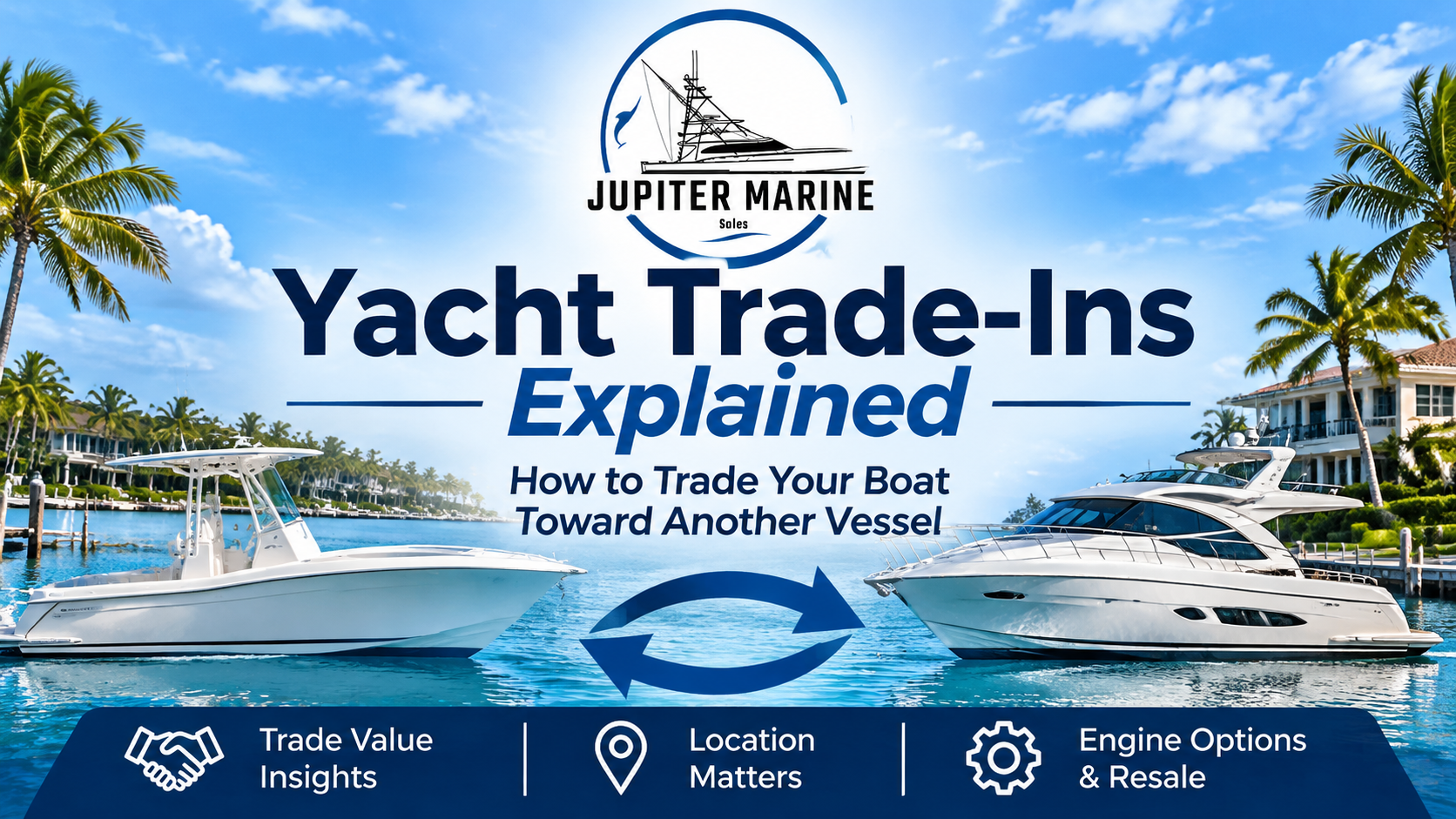
Jupiter Marine Sales explains how boat trade-in values depend on vessel type, engine configuration, location, and resale demand
Jupiter Marine Sales | The Complete Guide to Buying and Selling Boats Through a Yacht Broker — Article #17
By Darren Diaz, Founder of Jupiter Marine Sales
Buying a new boat or yacht is exciting, but for many boat owners, one major question comes up before they can move forward:
What should I do with the boat I already own?
If you're considering upgrading to a larger yacht, downsizing to something easier to manage, or simply changing the type of boating you enjoy, trading your existing vessel toward another boat may seem like the easiest solution.
But unlike trading in a car at a dealership, boat and yacht trade-ins can be significantly more complicated.
Not every yacht broker accepts trades, not every seller is willing to consider another vessel as part of a transaction, and the value of a trade-in may be considerably different from what the boat could sell for on the open market.
At Jupiter Marine Sales, we help buyers and sellers evaluate their options, understand current market conditions, and structure transactions that make financial and practical sense.
In our brokerage experience, trade-in allowances commonly range from approximately 55% to 65% of a boat's realistic retail market value. However, that figure is only a starting point. The type of vessel, engine configuration, geographic location, and ease of resale can dramatically influence what someone is willing to offer.
In this guide, we'll explain how yacht trade-ins work, how trade values are determined, why location and engine packages matter, and what boat owners should understand before offering their vessel toward another purchase.
A boat trade-in occurs when an owner offers their existing vessel as part of the consideration toward purchasing another boat or yacht.
Instead of selling the current vessel independently and using the proceeds toward the next purchase, the buyer attempts to incorporate the existing boat directly into the transaction.
For example:
A buyer owns a 2018 center console with an estimated retail market value of $150,000.
They find a larger boat listed for $350,000.
Rather than selling their center console first, they offer it as a trade toward the larger vessel.
If both parties agree on a trade allowance of $90,000, representing 60% of its estimated retail value, the buyer would be responsible for the remaining $260,000, plus any applicable taxes, closing costs, financing expenses, and other transaction-related charges.
The critical distinction is that a trade-in allowance is not the same as a boat's retail market value.
Understanding that difference is essential before entering negotiations.
There are several ways a boat trade can be structured.
The appropriate arrangement depends on the vessels involved, the parties' financial positions, the seller's willingness to accept a trade, and whether a dealer or broker is involved.
A direct trade occurs when two owners agree to exchange vessels, sometimes with additional money paid by one party.
For example:
If the owners agree on the values of both boats, they may negotiate an exchange with a cash difference.
Although this sounds straightforward, several important issues must be addressed.
Both vessels need to be evaluated for condition, ownership, outstanding liens, documentation, and market value.
The parties also need to determine how surveys, mechanical inspections, sea trials, taxes, and closing costs will be handled.
A direct trade is essentially two vessel transactions happening together, and each side should receive appropriate contractual protection.
For additional information about ownership verification and vessel transfers, see our guide to boat documentation and lien handling.
Some boat dealers accept trade-ins when selling inventory they own.
In this situation, the dealer evaluates the customer's existing vessel and offers a trade allowance toward the purchase.
The dealer may then resell the traded vessel through its own inventory or wholesale channels.
This can be convenient for the buyer because it may eliminate the need to sell their existing boat independently.
However, dealers must account for potential repairs, reconditioning, storage, insurance, carrying costs, and resale risk.
For that reason, dealer trade allowances are frequently lower than expected retail selling prices.
Convenience has value, but it often comes at a cost.
In some cases, an individual selling a boat or yacht may consider accepting another vessel as part of the purchase price.
This is especially possible when the seller is interested in downsizing or changing boating styles.
For example, someone selling a 50-foot yacht may be interested in accepting a smaller center console as partial consideration.
However, most private sellers are primarily looking to convert their boat into cash.
Accepting another vessel introduces additional ownership responsibilities, maintenance expenses, and resale uncertainty.
Consequently, trade offers involving privately owned vessels are generally evaluated on a case-by-case basis.
Although technically not a trade-in, selling your existing boat first is often the most straightforward financial approach.
The owner lists their current vessel for sale, completes the transaction, and uses the net proceeds toward their next purchase.
This strategy offers several advantages:
At Jupiter Marine Sales, we frequently help owners evaluate whether selling first or pursuing a trade is the better strategy.
The right decision depends on timing, market demand, financial flexibility, and the type of boat involved.
One of the most common misunderstandings in boat trading involves the difference between asking price, market value, and trade value.
These numbers are not interchangeable.
The retail asking price is the amount a seller advertises their boat for.
However, an asking price does not establish what the vessel will ultimately sell for.
Some boats are priced competitively, while others remain on the market because the owner's expectations exceed current buyer demand.
Fair market value generally reflects the price a vessel could reasonably achieve in a normal transaction between informed, willing buyers and sellers.
Market value is influenced by:
A knowledgeable yacht broker can help evaluate comparable listings and available sales information to develop a realistic pricing strategy.
Trade-in value generally reflects the amount another party is willing to allow for a vessel while assuming the responsibility and risk of owning or reselling it.
At Jupiter Marine Sales, our experience has shown that many boat trade-in allowances fall between approximately 55% and 65% of realistic retail market value.
This is not a fixed industry formula. Some vessels may command stronger allowances, while others may receive significantly lower offers or be declined entirely.
The receiving party must consider:
A boat's trade value is influenced just as much by how easily it can be resold as by what it may be worth on the retail market.
One of the most overlooked factors in boat trading is the geographic market where the vessel will ultimately be resold.
A boat that is highly desirable in one part of the country may be considerably less attractive in another.
Consider a 28-foot express cruiser powered by twin inboard/outboard (I/O) sterndrives.
In South Florida, where saltwater boating, offshore fishing, and outboard-powered vessels are extremely popular, that particular boat may have relatively limited demand.
A dealer or buyer accepting it as a trade may anticipate:
As a result, the trade allowance may be substantially lower than the owner expects.
Now consider that exact same boat in a freshwater market such as Lake of the Ozarks, Missouri.
In that region, sterndrive-powered recreational boats and express cruisers have an established customer base.
The same vessel may be more appealing to local buyers and easier for a dealer to resell.
The boat hasn't changed. The market has.
This is why a vessel's geographic location and engine configuration can have a major impact on its trade-in value.
A boat that receives a weak trade offer in South Florida could potentially receive a more favorable offer in a region where its design and propulsion package are better suited to local boating preferences.
Of course, transporting the vessel to another market introduces additional costs that must be considered.
Engine configuration is one of the most important factors influencing trade value.
Two otherwise similar boats may have dramatically different resale demand depending on how they are powered.
In many South Florida boating segments, outboard-powered boats are particularly desirable.
Buyers often appreciate:
Because of this demand, certain outboard-powered vessels may be easier to resell and therefore more attractive as trades.
Sterndrive-powered boats can be excellent performers and remain popular in many recreational boating markets.
However, in South Florida, particularly in the saltwater market, older I/O-powered boats may face a smaller buyer pool.
Potential buyers may be concerned about:
This doesn't mean sterndrive boats are inherently bad investments or unsuitable for saltwater use.
It means their popularity and resale value can vary considerably by region.
Diesel-powered sportfishing boats, motor yachts, and express cruisers represent another market entirely.
Trade values depend heavily on engine brand, maintenance history, operating hours, service accessibility, and buyer demand for that specific model.
A desirable diesel sportfish with strong maintenance records may have excellent resale appeal.
An older yacht with difficult-to-service engines or substantial deferred maintenance may present significantly greater resale risk.
When evaluating a trade, the question isn't simply:
"What engines does this boat have?"
The more important question is:
"How desirable is this engine package to the buyers most likely to purchase this boat in the market where it will be resold?"
That distinction can significantly influence the trade allowance.
A vessel may have an estimated retail value of $200,000, but that doesn't necessarily mean a dealer or another seller wants to own it.
Trade value depends heavily on the likelihood of converting that vessel back into cash.
Consider two boats with similar retail values.
Boat A:
Boat B:
Even if both vessels have an estimated retail market value of $150,000, their trade allowances may be very different.
A receiving party may be willing to offer a stronger allowance for Boat A because it expects a faster, more predictable resale.
Boat B may receive a substantially lower offer because of the uncertainty, expenses, and time involved in finding the right buyer.
At Jupiter Marine Sales, we emphasize that a boat's trade-in value is determined by more than its advertised value or comparable sales.
The type of boat, engine package, geographic market, and ease of resale can be equally important.
Not every boat or yacht owner wants to accept another vessel.
In fact, many sellers specifically request cash offers without trades.
There are several reasons.
Some sellers are retiring from boating, relocating, or eliminating the expenses associated with vessel ownership.
Accepting another boat would defeat their primary objective.
Even a well-maintained boat requires ongoing attention.
A seller may not want to assume responsibility for another vessel's engines, systems, insurance, dockage, and maintenance.
A seller may be unfamiliar with the proposed trade vessel or uncertain about its resale demand.
A highly specialized boat, unusual configuration, or older vessel with limited buyer interest can be difficult to resell.
Some sellers are already purchasing another boat, paying off financing, or using the proceeds for other purposes.
A trade may not provide the liquidity they need.
A trade offer only works when it benefits both parties.
Yes, it may be possible to trade a financed boat, but the outstanding loan must be properly addressed.
Before completing the transaction, the parties need to determine:
For example:
Suppose a boat receives a trade allowance of $150,000, but the owner still owes $90,000.
The owner's net equity would be approximately $60,000 before any additional transaction costs.
That $60,000 could potentially be applied toward the next vessel, depending on the structure of the transaction.
However, if the outstanding loan exceeds the agreed trade value, the owner has negative equity.
That shortfall must be addressed through additional funds or another arrangement acceptable to the parties and any lender involved.
Never assume that transferring possession of a boat automatically eliminates the owner's financing obligation.
Proper lien satisfaction and documentation are essential.
For a detailed explanation of loan payoffs, ownership verification, and USCG requirements, read our article: Documentation and Lien Handling: How Yacht Brokers Help Sellers Navigate Vessel Titles, Payoffs, and USCG Requirements.
Absolutely.
A trade-in should not be treated differently from another used-boat purchase simply because the parties are exchanging vessels.
In many cases, both vessels should undergo appropriate inspections.
Depending on the boat, these may include:
A vessel that appears cosmetically attractive may still have expensive mechanical or structural issues.
For example, a trade boat with an advertised market value of $150,000 could require substantial repairs discovered during survey.
Those findings may materially affect the agreed trade allowance.
Both parties should understand how inspection findings will be addressed before proceeding.
An experienced yacht broker can help coordinate a potential trade, but the broker's role depends on the circumstances.
At Jupiter Marine Sales, our approach is to evaluate the proposed transaction and determine whether a trade arrangement is practical for the parties involved.
We begin by reviewing relevant information about the proposed trade, including:
This helps establish whether the proposed trade deserves further consideration.
If a buyer wants to offer another vessel as part of the purchase price, the seller must first be willing to consider that arrangement.
A yacht broker can present the proposal and explain its potential advantages and disadvantages.
However, the seller ultimately decides whether accepting a trade makes sense.
A trade transaction involves two separate valuations.
The parties must agree on the value of the vessel being purchased and the allowance for the vessel being traded.
The difference between those values determines the cash component of the transaction.
The transaction should clearly address:
The appropriate agreements and closing procedures should be selected based on the transaction structure, with qualified legal or title professionals involved when necessary.
If both parties move forward, the transaction requires coordinated inspections, ownership verification, and closing procedures.
The goal is to ensure that neither party transfers ownership or possession without receiving the agreed consideration and appropriate documentation.
For more information about the process, read Closing Coordination: How Yacht Brokers Manage the Boat Closing Process.
This is one of the most important questions buyers should ask before assuming that a trade-in will save them money.
Florida may allow a trade-in credit when calculating sales tax on certain qualifying vessel transactions. However, not every boat-for-boat exchange qualifies.
Tax treatment can depend on several factors, including:
Florida also generally limits the state sales tax imposed on the sale or use of a boat to $18,000, subject to applicable rules.
A private trade between individuals should not automatically be treated the same as a dealer-accepted trade.
Important: Before structuring a yacht purchase around an anticipated tax benefit, consult a qualified Florida marine title professional, tax adviser, or the Florida Department of Revenue.
For current tax guidance, visit the Florida Department of Revenue.
There is no universal answer.
The best approach depends on the owner's priorities.
Convenience: A trade may eliminate the need to market and sell the existing vessel independently.
Potentially Faster Transition: If the transaction can be structured successfully, an owner may move directly from one boat into another.
Reduced Selling Effort: The owner may avoid separate showings, negotiations, and marketing activities.
Coordinated Closing: Both vessel transfers may be arranged as part of one overall transaction.
Lower Trade Allowance: In our experience, many trades fall around 55%–65% of realistic retail value, although individual offers vary.
Limited Buyer Interest: Many yacht sellers are unwilling to accept trades.
More Complicated Negotiations: Two vessels must be valued instead of one.
Additional Due Diligence: Both boats may require surveys, inspections, and documentation review.
Potential Financing Challenges: Lenders may impose requirements that make trade transactions more difficult.
For owners focused on maximizing their net proceeds, selling the existing vessel first may be the stronger financial choice.
For owners prioritizing convenience and a faster transition, a trade may be worth exploring.
Yes, provided the seller or dealer is willing to accept the trade.
This is a common question from boaters looking to move from a smaller center console into a larger express cruiser, sportfish, or motor yacht.
For example, a buyer might own a 32-foot center console and want to purchase a 45-foot express yacht.
The buyer could propose using the center console as partial consideration.
However, the seller of the larger yacht must be comfortable accepting the smaller vessel, and both parties must agree on its value.
In some cases, the better strategy is to list the center console for sale while simultaneously searching for the replacement yacht.
This allows the owner to explore opportunities without depending entirely on finding a seller who will accept a trade.
This is why surveys and mechanical inspections are important.
If problems are discovered during the due-diligence period, the parties may need to renegotiate the trade allowance, request repairs, or terminate the arrangement if permitted under the agreement.
For example, suppose a trade vessel is initially valued at $125,000.
During inspection, a surveyor identifies significant mechanical issues.
The receiving party may no longer be willing to accept the original trade allowance.
Possible outcomes include:
The parties should avoid relying on verbal understandings.
All material changes should be documented in writing.
Interstate boat trades are possible, but they introduce additional logistical and administrative considerations.
These may include:
For example, a buyer in Florida may offer a vessel located in North Carolina toward a yacht listed in South Florida.
The parties would need to determine where inspections occur, who pays transportation expenses, and how possession and ownership transfers are coordinated.
An experienced yacht brokerage can help organize these moving parts.
If the transaction involves a vessel registered outside the United States, additional customs and ownership requirements may apply. Learn more in our guide to buying or selling a foreign-flagged yacht in Florida.
Owners often base their expectations on advertised asking prices rather than realistic selling prices.
A boat listed online for $175,000 does not necessarily have a trade value of $175,000.
A boat that is desirable in one market may be difficult to sell in another.
Engine configuration, boating conditions, and local preferences all influence resale demand.
Many private sellers simply want cash.
Before spending time preparing a complicated proposal, determine whether the seller is open to discussing a trade.
A boat's trade allowance is not the same as the owner's available equity.
Outstanding financing must be considered.
A trade transaction does not eliminate the risk of hidden defects.
Both vessels should receive appropriate due diligence.
A generous trade allowance can be offset by an inflated price on the replacement vessel.
The most important number is the total financial outcome of the transaction.
Evaluate the agreed purchase price, trade value, cash difference, financing, taxes, and closing expenses together.
Yes. A boat may be offered as partial consideration toward another vessel if the seller or dealer agrees to accept it.
Some yacht brokers can help facilitate trade arrangements, but a broker does not necessarily purchase or accept the trade personally. The structure depends on the brokerage, seller, and transaction.
Generally, no.
At Jupiter Marine Sales, our experience indicates that many trade-in allowances fall between approximately 55% and 65% of a vessel's realistic retail market value.
However, this percentage can vary considerably depending on the type of boat, engine configuration, geographic location, condition, and resale demand.
For example, a sterndrive-powered express cruiser may have relatively low trade-in appeal in South Florida, where outboard-powered vessels are particularly popular.
That same boat may be considerably more desirable in a freshwater market such as Lake of the Ozarks, Missouri, where sterndrive-powered recreational boats have an established customer base.
The boat hasn't changed, but the potential resale market has.
Ultimately, trade-in value depends as much on how easily the receiving party can resell the vessel as it does on its estimated retail market value.
Potentially, yes. The outstanding loan must be addressed, and the lender's lien must be properly satisfied or otherwise handled through an approved arrangement.
Independent surveys and mechanical inspections are strongly recommended for both used vessels involved in a trade.
Yes, if the seller accepts the smaller vessel and the parties agree on the financial terms.
Certain qualifying transactions may be eligible for a trade-in credit, but eligibility depends on the specific transaction and applicable Florida tax rules. Consult a qualified marine title or tax professional.
Selling first may maximize proceeds and simplify the next purchase. Trading may offer convenience and potentially shorten the transition, but it can involve a lower allowance and more complicated negotiations.
At Jupiter Marine Sales, we understand that purchasing another boat often involves more than simply finding the right vessel.
For many buyers, the real challenge is deciding what to do with the boat they already own.
Should you sell it first?
Should you offer it as a trade?
Is the proposed trade allowance reasonable?
Will the seller even consider another vessel?
What happens if the trade boat has an outstanding loan?
And perhaps most importantly:
Is your current boat the type of vessel that another party can realistically and profitably resell in their market?
These are important questions that deserve thoughtful answers before committing to a transaction.
Our team works with buyers and sellers throughout Florida and beyond, helping evaluate vessel values, present purchase offers, coordinate due diligence, and navigate the complexities of boat and yacht transactions.
While not every trade proposal will make sense, understanding your options can help you make a better financial decision.
Sometimes the best trade is a direct exchange. Sometimes the better strategy is selling your current boat first.
The key is knowing the difference.
Whether you're upgrading from a center console to a larger yacht, downsizing from a motor yacht, or considering a completely different boating lifestyle, Jupiter Marine Sales can help you evaluate your options.
Contact our experienced brokerage team to discuss your current vessel, your next purchase, and the most practical path forward.
Jupiter Marine Sales
Website: www.JupiterMarineSales.com
Email: Darren@JupiterMarineSales.com
Phone: (954) 673-7702
Experience. Integrity. Results.
Previous Article — #16: Buying or Selling a Foreign-Flagged Yacht in Florida: Documentation, Customs, Taxes & Closing Requirements
Current Article — #17: Yacht Trade-Ins Explained: How to Trade Your Boat Toward Another Vessel
Explore more educational articles from Jupiter Marine Sales.
Florida is one of the world's most active yacht markets, attracting buyers and sellers from the United States, the Bahamas, Caribbean, Europe, Central America, and beyond.
Walk through a major marina in Fort Lauderdale, Miami, Palm Beach, or Jupiter, and you'll likely see yachts reg
Professional Boat-Selling Strategy — Article 15
Previous Article: Documentation and Lien Handl

By Darren Diaz, Founder of Jupiter Marine Sales
Selling a boat involves more than finding a buyer, negotiating an acceptable price, completing the survey, and collecting the purchase funds.<
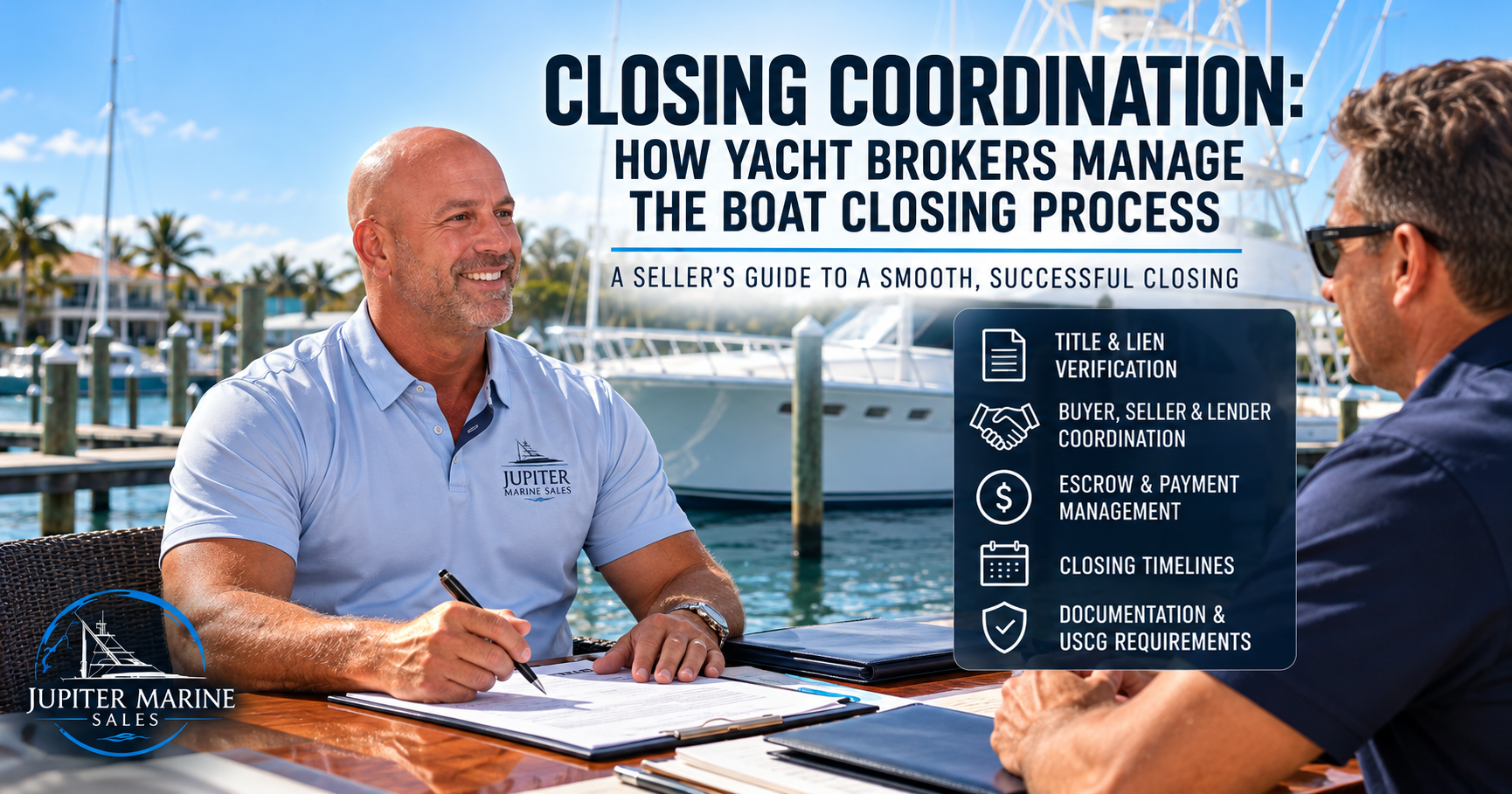
Jupiter Marine Sales | Professional Boat Selling Strategy — Article #13
A successful sea trial and survey are major milestones in selling a boat, but they do not mean the transaction is complete. Between a buyer's final acceptance and the actual closing, several importa